Results by title
405 books match the query 'Natural history' and 39 start with a
A Concise Natural History of East and West Florida
Bernard Romans, edited and with an introduction by Kathryn E. Holland Braund
University of Alabama Press, 2013
Braund presents the only annotated edition of Bernard Romans's rare and valuable 18th-century account of his observations in the southeastern United States.
Bernard Romans's A Concise Natural History of East and West Florida, William Bartram's Travels, and James Adair's History of the American Indian are the three most significant accounts of the southeastern United States published during the late 18th century. This new edition of Romans's Concise Natural History, edited by historian Kathryn Braund, provides the first fully annotated edition of this early and rare description of both the European settled areas and the adjoining Indian lands in what are now the states of Florida, Georgia, Alabama, Mississippi, and Louisiana.
Romans's purpose in producing his Concise Natural History was twofold: to aid navigators and shippers by detailing the sailing passages of the region and to promote trade and settlement in the region. To those ends, he provided detailed scientific observations on the natural history of the area, a summary of the region's political history, and an assessment of the potential for economic growth in the Floridas based on the area's natural resources.
A trained surveyor and cartographer and a self-taught naturalist, Romans supplied detailed descriptions of the region's topography and environment, including information about the climate and weather patterns, plants, animals, and diseases. He provided information about the state of scientific inquiry in the South and touched on many of the most important intellectual arguments of the day, such as the origin of the races, the practice of slavery, and the benefits and drawbacks of monopoly on trade.
In addition, Concise Natural History can be placed firmly in the genre of colonial promotional literature. Romans's book was an enthusiastic guide aimed at those seeking to establish modest holdings in the region:
"What a field is open here! . . . No country ever had such inexhaustible resources; no empire had ever half so many advantages combining in its behalf!" Romans explained how settlers should travel to the area, what they would need in terms of provisions and tools, and what it would cost to have their land surveyed. In addition to providing an abundance of practical advice, Romans also offered information about the history of earlier settlements, including the earliest and most complete account of New Smyrna near St. Augustine.
Romans also presented unique information about the various Indian tribes he encountered. In fact, historians agree that among the most useful portions of the book are Romans's descriptions of the largest Indian tribes in the 18th-century Southeast: the Creeks, Choctaws, and Chickasaws. Romans's account of the diet of the Creeks and Choctaws is one of the most complete available. And his description of the location of Choctaw village sites is one of the best sources for this information.
A Garden Of Bristlecones
Tales Of Change In The Great BasinMichael P. Cohen
University of Nevada Press, 1998
An engaging, well-illustrated natural and cultural history of the oldest living organism—the bristlecone pine. Since Edmund Schulman discovered in 1958 that individual bristlecones live nearly 5,000 years, the trees have been investigated primarily for the elaborate record their rings contain. The trees have been "read' closely, with major consequences for natural and human history. Historians have read local and global environmental change. Archaeologists have rewritten the history of civilization. Writers have transformed them into figures pertinent to the human dilemmas of time and eternity. A Garden of Bristlecones investigates professional and popular conceptions as a set of narratives drawn from the outside and inside of the trees. It reveals the premises of the investigators, the nature of their inquiry, and the extent of their knowledge, while also revealing the Great Basin bristlecone itself. Illustrations by Valerie Cohen.
A Green River Reader
Alan Blackstock
University of Utah Press, 2005
"There is something ominous about a swift river, and something thrilling about a river of any kind."—from Beyond the Hundredth Meridian by Wallace Stegner
Beginning above Flaming Gorge Dam in southwestern Wyoming, the Green River traverses the complete variety of terrain on the Colorado Plateau before joining the Colorado River above Cataract Canyon in southeastern Utah. Like its more famous cousin, the Colorado, the Green has captivated, capsized, and cajoled all types of characters with challenges and beauty to match its geologic variety.
In A Green River Reader editor Alan Blackstock brings this mysterious, magnificent, thrilling river to the reader with an interpretive guide that will inform both river novices and river veterans. Assembled here is every significant written testament to this "awesome ditch," from Domínguez-Escalante to Kit Carson and John C. Frémont; to contemporary American naturalists and writers including Wallace Stegner, Bernard DeVoto, David Brower, Ann Zwinger, Ellen Melloy, and Edward Abbey. Those with a story to tell—those who trapped the Green’s beavers, endured its wild rapids, were humbled by its imposing canyon walls, fought for its beautiful landscapes, or whose "pulse was hurried" by the "lofty chasms, walled in by precipices of red rock"—are collected here.
If you’re headed down the Green, make sure that your dry bag or ammo can has room for just one more thing, your copy of A Green River Reader.
A Guide to the Carnivores of Central America
Natural History, Ecology, and ConservationBy Carlos L. de la Rosa and Claudia C. Nocke
University of Texas Press, 2000
Carnivores such as pumas, jaguars, and ocelots have roamed the neotropical forests of Central America for millennia. Enshrined in the myths of the ancient Maya, they still inspire awe in the region's current inhabitants, as well as in the ecotourists and researchers who come to experience Central America's diverse and increasingly endangered natural environment.
This book is one of the first field guides dedicated to the carnivores of Central America. It describes the four indigenous families—wild cats, raccoons and their relatives, skunks and their relatives, and wild canids—and their individual species that live in the region. The authors introduce each species by recounting a first-person encounter with it, followed by concise explanations of its taxonomy, scientific name, English and Spanish common names, habitat, natural history, and conservation status. Range maps show the animal's past and current distribution, while Claudia Nocke's black-and-white drawings portray it visually.
The concluding chapter looks to the carnivores' future, including threats posed by habitat destruction and other human activities, and describes some current conservation programs. Designed for citizens of and visitors to Central America, as well as specialists, this book offers an excellent introduction to a group of fascinating, threatened, and still imperfectly understood animals.
A Hunger for High Country
One Woman’s Journey to the Wild in Yellowstone CountrySusan Marsh
Oregon State University Press, 2014
A Journal of Travels into the Arkansas Territory During the Year 1819
Thomas Nuttall
University of Arkansas Press, 1999
This is the famous naturalist Thomas Nuttall's only surviving complete journal of his American scientific explorations. Covering his travels in Arkansas and what is now Oklahoma, it is pivotal to an understanding of the Old Southwest in the early nineteenth century, when the United States was taking inventory of its acquisitions from the Louisiana Purchase.
The account follows Nuttall's route from Philadelphia to Pittsburg, down the Ohio River to its mouth, then down the Mississippi River to the Arkansas Post, and up the Arkansas River with a side trip to the Red River. It is filled with valuable details on the plants, animals, and geology of the region, as well as penetrating observations of the resident native tribes, the military establishment at Fort Smith, the arrival of the first governor of Arkansas Territory, and the beginnings of white settlement.
Originally published in 1980 by the University of Oklahoma Press, this fine edited version of Nuttall's work boasts a valuable introduction, notes, maps, and bibliography by Savoie Lottinville. The editor provided common names for those given in scientific classification and substituted modern genus and species names for the ones used originally by Nuttall. The resulting journal is a delight to read for anyone—historian, researcher, visitor, resident, or enthusiast.
A Moving Meditation
Life on a Cape Cod Kettle PondStephen G. Waller
University of Massachusetts Press, 2023
Cape Cod is known for its beaches, throngs of summer visitors, and the activities that accompany seaside living, but it is also home to many kettle ponds, which offer a more tranquil setting. Formed from glaciers breaking apart and so named due to a rounded shape that appears like a kettle, these waterways are home to a diverse array of wildlife, while remaining peaceful and even a bit hidden.
Big enough for a canoeist to feel solitude and serenity, small enough to not appear on large-scale maps, Centerville’s Long Pond (one of seven on the Cape that share this name), consists of fifty-one acres of crystal clear waters, fresh air, and the fish, turtles, waterfowl, ospreys, and otters that call this special place home. In A Moving Meditation, Stephen G. Waller offers an intimate look at the pond’s intriguing natural and human history; its abundant animal life, across the seasons; and the encroaching effects of climate change.
A Natural History of Belize
Inside the Maya ForestBy Samuel Bridgewater
University of Texas Press, 2012
Belize's Chiquibul Forest is one of the largest remaining expanses of tropical moist forest in Central America. It forms part of what is popularly known as the Maya Forest. Battered by hurricanes over millions of years, occupied by the Maya for thousands of years, and logged for hundreds of years, this ecosystem has demonstrated its remarkable ecological resilience through its continued existence into the twenty-first century. Despite its history of disturbance, or maybe in part because of it, the Maya Forest is ranked as an important regional biodiversity hot spot and provides some of the last regional habitats for endangered species such as the jaguar, the scarlet macaw, Baird's tapir, and Morelet's crocodile.
A Natural History of Belize presents for the first time a detailed portrait of the habitats, biodiversity, and ecology of the Maya Forest, and Belize more broadly, in a format accessible to a popular audience. It is based in part on the research findings of scientists studying at Las Cuevas Research Station in the Chiquibul Forest. The book is unique in demystifying many of the big scientific debates related to rainforests. These include "Why are tropical forests so diverse?"; "How do flora and fauna evolve?"; and "How do species interact?" By focusing on the ecotourism paradise of Belize, this book illustrates how science has solved some of the riddles that once perplexed the likes of Charles Darwin, and also shows how it can assist us in managing our planet and forest resources wisely in the future.
A Natural History of Negation
Laurence R. Horn
CSLI, 1989
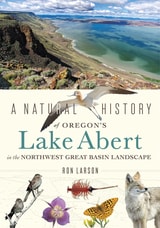
A Natural History of Oregon's Lake Abert in the Northwest Great Basin Landscape
Ron Larson
University of Nevada Press, 2023
A beautifully detailed exploration of flora and fauna.
Author Ron Larson offers a natural history of a Great Basin landscape that focuses on the northern region including Lake Abert and Abert Rim, and the adjacent area in southcentral Oregon. Although the jewel of this landscape is a lake, the real story is the many plants and animals—from the very primitive, reddish, bacteria-like archaea that thrive only in its high-salinity waters to the Golden Eagles and ravens that soar above the desert. The untold species in and around the lake are part of an ecosystem shaped by ageless processes from massive lava flows, repeated drought, and blinding snowstorms. It is an environment rich with biotic and physical interconnections going back millions of years.
The Great Basin, and in particular the Lake Abert region, is special and needs our attention to ensure it remains that way. We must recognize the importance of water for Great Basin ecosystems and the need to manage it better, and we must acknowledge how rich the Great Basin is in natural history. Salt lakes, wherever they occur, are valuable and provide critically important habitat for migratory water birds, which are unfortunately under threat from upstream water diversions and climate change. Larson’s book will help people understand that the Great Basin is unique and that wise stewardship is necessary to keep it unspoiled. The book is an essential reference source, drawing together a wide range of materials that will appeal to general readers and researchers alike.

A Natural History of Peace
Thomas A. Gregor
Vanderbilt University Press, 1996
We know a great deal about aggression, conflict, and war, but relatively little about peace, partially because it has been such a scarce phenomenon throughout history and in our own times. Peace is more than the absence of war. Peace requires special relationships, structures, and attitudes to promote and protect it.
A Natural History of Peace provides the first broadly interdisciplinary examination of peace as viewed from the perspectives of social anthropology, primatology, archaeology, psychology, political science, and economics. Among other notable features, this volume offers:
- a major theory concerning the evolution of peace and violence through human history;
- an in-depth comparative study of peaceful cultures with the goal of discovering what it is that makes them peaceful;
- one of the earliest reports of a new theory of the organization and collapse of ancient Maya civilization;
- a comparative examination of peace from the perspective of change, including the transition of one of the world's most violent societies to a relatively
- peaceful culture, and the decision-making process of terrorists who abandon violence;
- and a theory of political change that sees the conclusion of wars as uniquely creative periods in the evolution of peace among modern nations.
A Natural History of Time
Pascal Richet
University of Chicago Press, 2007
The quest to pinpoint the age of the Earth is nearly as old as humanity itself. For most of history, people trusted mythology or religion to provide the answer, even though nature abounds with clues to the past of the Earth and the stars. In A Natural History of Time, geophysicist Pascal Richet tells the fascinating story of how scientists and philosophers examined those clues and from them built a chronological scale that has made it possible to reconstruct the history of nature itself.
Richet begins his story with mythological traditions, which were heavily influenced by the seasons and almost uniformly viewed time cyclically. The linear history promulgated by Judaism, with its story of creation, was an exception, and it was that tradition that drove early Christian attempts to date the Earth. For instance, in 169 CE, the bishop of Antioch, for instance declared that the world had been in existence for “5,698 years and the odd months and days.”
Until the mid-eighteenth century, such natural timescales derived from biblical chronologies prevailed, but, Richet demonstrates, with the Scientific Revolution geological and astronomical evidence for much longer timescales began to accumulate. Fossils and the developing science of geology provided compelling evidence for periods of millions and millions of years—a scale that even scientists had difficulty grasping. By the end of the twentieth century, new tools such as radiometric dating had demonstrated that the solar system is four and a half billion years old, and the universe itself about twice that, though controversial questions remain.
The quest for time is a story of ingenuity and determination, and like a geologist, Pascal Richet carefully peels back the strata of that history, giving us a chance to marvel at each layer and truly appreciate how far our knowledge—and our planet—have come.
A Natural History of the Central Appalachians
Steven L. Stephenson
West Virginia University Press, 2013
A Natural History of the Chicago Region
Joel Greenberg
University of Chicago Press, 2002
A Natural History of the Intermountain West
Its Ecological and Evolutionary StoryGwendolyn L Waring
University of Utah Press, 2010
A Natural History of the Intermountain West was written to inform people about the wild world around us, with the idea that we all crave a connection to the natural world to ground us and give us a sense of place. It is also a book about change. While species are described throughout the chapters, the text is focused more on the profound processes that have shaped western ecosystems, based on a belief that understanding those processes is more meaningful than a list of names. The ways and the rapidity with which enormous ecosystems replace one another and sometimes even return as climates change are a magnificent testament to the tenacity of life.
The first book of its kind for this region, A Natural History of the Intermountain West takes a fresh look at the natural history of the southern Rockies and the Intermountain Region based on cutting-edge research, interviews with numerous scientists, and the author’s personal experience. Drawing together many disparate fields, the book integrates the evolution of western ecosystems with the geological and climatic history of the region. It is a passionate, humanistic, and scientific treatment of this area’s ecosystems, how they function, and how they came to be through time; it is a wonderful guide for the general public and scientists alike.
A Natural History of the Mojave Desert
Lawrence R. Walker and Frederick H. Landau
University of Arizona Press, 2018
A Natural History of the Mojave Desert explores how a combination of complex geology, varied geography, and changing climate has given rise to intriguing flora and fauna—including almost 3,000 plant species and about 380 terrestrial vertebrate animal species. Of these, one quarter of the plants and one sixth of the animals are endemic.
The authors, who, combined, have spent more than six decades living in and observing the Mojave Desert, offer a scientifically insightful and personally observed understanding of the desert. They invite readers to understand how the Mojave Desert looks, sounds, feels, tastes, and smells. They prompt us to understand how humans have lived in this desert where scant vegetation and water have challenged humans, past and present.
A Natural History of the Mojave Desert provides a lively and informed guide to understanding how life has adapted to the hidden riverbeds, huge salt flats, tiny wetlands, and windswept hills that characterize this iconic desert.
A Natural History of the New World
The Ecology and Evolution of Plants in the AmericasAlan Graham
University of Chicago Press, 2010
The paleoecological history of the Americas is as complex as the region is broad: stretching from the Arctic Circle to Tierra del Fuego, the New World features some of the most extraordinary vegetation on the planet. But until now it has lacked a complete natural history. Alan Graham remedies that with A Natural History of the New World. With plants as his scientific muse, Graham traces the evolution of ecosystems, beginning in the Late Cretaceous period (about 100 million years ago) and ending in the present, charting their responses to changes in geology and climate.
By highlighting plant communities’ roles in the environmental history of the Americas, Graham offers an overdue balance to natural histories that focus exclusively on animals. Plants are important in evolution’s splendid drama. Not only are they conspicuous and conveniently stationary components of the Earth’s ecosystems, but their extensive fossil record allows for a thorough reconstruction of the planet’s paleoenvironments. What’s more, plants provide oxygen, function as food and fuel, and provide habitat and shelter; in short, theirs is a history that can speak to many other areas of evolution.
A Natural History of the New World is an ambitious and unprecedented synthesis written by one of the world’s leading scholars of botany and geology.

A Natural State
Essays on TexasBy Stephen Harrigan
University of Texas Press, 1994
In this remarkable collection of essays, Stephen Harrigan explores, with an unfailing depth of feeling, the human longing to feel at home in the world of nature. In vivid and convincing prose, he evokes the landscape of his home territory, Texas, and his own reactions, sometimes droll, sometimes haunted, to the extraordinary power of place that Texas projects.
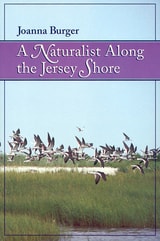
A Naturalist Along the Jersey Shore
Burger, Joanna
Rutgers University Press, 1996
Come for a journey along the Jersey shore with naturalist and ecologist Joanna Burger! In these deeply felt, closely observed personal essays, Burger invokes the intertwined lives of naturalist and wild creatures at the ever-changing edge of ocean and land. Discover with her the delicate mating dances of fiddler crabs, the dangers to piping plovers, the swarming of fish communities into the bays and estuaries, the trilling notes of Fowler's toads, and the subtle green-grays of salt marshes.
Joanna Burger knows the shore through all its seasons--the first moment of spring when the herring gulls arrive on ice-gouged salt marshes, the end of spring when the great flocks of shorebirds come to feed on horseshoe crab eggs at Cape May, the summer when the peregrine hunts its prey, the fall when the migrations of hawks and monarch butterflies attract watchers from around the world, and the depths of winter when a lone snowy owl sweeps across snow-covered dunes and frozen bay.
This is a book that anyone who loves the Jersey shore will cherish! And because so many of these wonderful creatures live all along the Atlantic coast, it will be of equal interest to beach-lovers, naturalists, bird-watchers, fishermen, and coastal and marine scientists from North Carolina to Maine.

A Naturalist amid Tropical Splendor
Alexander F. Skutch
University of Iowa Press, 1987
In this reflective account of life in the tropics, Alexander Skutch offers readers both his observations and his interpretations of what he has experienced. In the many chapters about birds and their behavior, he describes a dove that defends its nest with rare courage, castlebuilders who create elaborate nests of interlaced twigs, oropendolas that cluster long woven pouches in high treetops, and an exceptionally graceful hummingbird who fails to pay for its nectar by pollinating the flowers that yield it. Skutch also describes curious plants and their flowers, including a birthwort that holds its pollinating flies captive and fern fronds that twine high up trunks in the rain forest.
With penetrating clarity, Skutch considers the significance of all this restless activity: he examines the origins of beauty and our ability to appreciate it, the foundations of tropical splendor, the factors that help us feel close to nature or alienated from it, and the possibility of consciousness and emotion in animals. He also addresses the quandary of the biologist contemplating painful experiments on animals rather than learning by direct observation, and he asserts that our capacity to care for the world around us is the truest criterion of our evolutionary advancement.
Skutch brings a thoughtful, unequaled voice to the description of the world he has grown to know and understand, a world considered forbidding by most northerners and still largely unexplored.
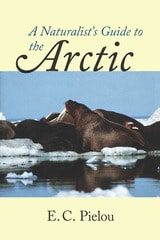
A Naturalist's Guide to the Arctic
E. C. Pielou
University of Chicago Press, 1994
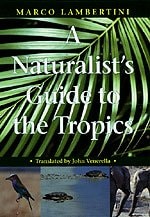
A Naturalist's Guide to the Tropics
Marco Lambertini
University of Chicago Press, 2000
Whether you're a first-time visitor or a veteran of many trips, this convenient guidebook can help you plan your vacation and serve as a knowledgeable companion to answer the many questions that may arise during the course of your journey. Why are tropical birds and fishes so colorful? What is an atoll, and how do they form? Why are tropical soils red and sterile, while rainforests are lush and green? Why does Madagascar have lemurs but not monkeys? Special features of the book include chapters on the conservation status of the Tropics and how to prepare with "caution without obsession" for tropical dangers such as infectious diseases and charging rhinoceroses.
The first comprehensive introduction to the natural history of the Tropics worldwide, A Naturalist's Guide to the Tropics has been completely revised and updated by the author and the translator to reflect the most current information available.
* first field guide in English to cover all the world's tropics, not just specific regions or countries
* more than 350 illustrations, many in color
* sturdy flexibound cover and compact size ideal for travelers
* boxes in text define scientific terms or explore side topics in more detail, such as "What Is Biodiversity?" and "Why Is Tropical Fauna So Colorful?"
* discusses tropical dangers and precautions to cope with them, such as vaccinations to obtain and foods to avoid
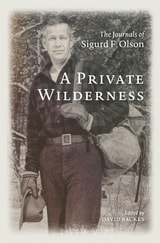
A Private Wilderness
The Journals of Sigurd F. OlsonSigurd F. Olson
University of Minnesota Press, 2024
The personal diaries of one of America’s best-loved naturalists, revealing his difficult and inspiring path to finding his voice and becoming a writer
Few writers are as renowned for their eloquence about the natural world, its power and fragility, as Sigurd F. Olson (1899–1982). Before he could give expression to The Singing Wilderness, however, he had to find his own voice. It is this struggle, the painstaking and often simply painful process of becoming the writer and conservationist now familiar to us, that Olson documented in the journal entries gathered here.
Written mostly during the years from 1930 to 1941, Olson’s journals describe the dreams and frustrations of an aspiring writer honing his skills, pursuing recognition, and facing doubt while following the academic career that allowed him to live and work even as it consumed so much of his time. But even as he speaks with immediacy and intensity about the conditions of his apprenticeship, Olson can be seen developing the singular way of observing and depicting the natural world that would bring him fame—and also, more significantly, alert others to the urgent need to understand and protect that world. Author of Olson’s definitive biography, editor David Backes brings a deep knowledge of the writer to these journals, providing critical context, commentary, and insights along the way.
When Olson wrote, in the spring of 1941, “What I am afraid of now is that the world will blow up just as I am getting it organized to suit me,” he could hardly have known how right he would prove to be. It is propitious that at our present moment, when the world seems once more balanced on the precipice, we have the words of Sigurd F. Olson to remind us of what matters—and of the hard work and the wonder that such a reckoning requires.
A Reed Shaken with the Wind
A Human and Natural History of the Bear River MarshAndrew H. Hedges
University of Utah Press, 2025
A Reed Shaken with the Wind tells the story of the Bear River Marsh, freshwater and sheltered grasslands on the northeast end of the Great Salt Lake with a complex past. Despite being one of Utah’s most renowned hunting and birdwatching locations, the marsh today holds only a shadow of its former ecological vitality.
Tracing the marsh from its creation during the last ice age to its current status as an imperiled national wildlife refuge, Andrew Hedges draws on geology, ecology, archaeology, wildlife biology, and water resource management to explore the natural and human forces that shaped the marsh and contributed to its decline. Covering Indigenous relationships with land, market economies’ impacts, and the intersection of ecology, science, and politics in establishing the Bear River Migratory Bird Refuge, this volume deepens discussions of humanity’s place in the environment and efforts to restore balance with our planet.
A Rough Sort of Beauty
Reflections on the Natural Heritage of ArkansasDana Steward
University of Arkansas Press, 2002
A Short History of Lake Tahoe
Michael J. Makley
University of Nevada Press, 2011
Lake Tahoe is one of the scenic wonders of the American West, a sapphire jewel that attracts millions of visitors each year. But the lake drew Native Americans to its summer shores for millennia, as well as more recent fortune hunters, scientists, and others.
A Short History of Lake Tahoe recounts the long, fascinating history of Lake Tahoe. Author Michael J. Makley examines the geology and natural history of the lake and introduces the people who shaped its history, including the Washoe Indians and such colorful characters as Mark Twain and legendary teamster Hank Monk, and later figures like entertainer Frank Sinatra and Olympic skier Julia Mancuso. He also covers the development of the lake's surrounding valley, including the impacts of mining, logging, and tourism, and the economic, political, and social controversies regarding the use and misuse of the lake's resources.
Generously illustrated with historic photographs, this book is an engaging introduction to one of the most magnificent sites in the world. It also illuminates the challenges of protecting natural beauty and a fragile environment while preserving public access and a viable economy in the surrounding communities.
A Year of Iowa Nature
Discovering Where We LiveCarl Kurtz
University of Iowa Press, 2014
Concentrating on Iowa’s tallgrass prairie, Kurtz also points his viewfinder toward the great variety of natural habitats in the eastern United States. Arranged chronologically throughout the year, the fifty-five color photos and their accompanying narratives rotate through the seasons like a nature film. The winter months showcase a frost-covered white-tailed deer, cedar waxwings feeding on winter apples, a muskrat on the surface of an icy pond, and dune-like snowdrifts. Kurtz’s palette warms up in springtime with stunning photos of Virginia bluebells, fox cubs, juvenile chipmunks, and ruddy ducks. Summer brings a host of butterflies, frogs, and goldfinches as well as blooming prairie plants. The colors become more subdued in fall with the change in light, revealing the rich hues of Indian grass and big bluestem and the subtle plumage of migrating warblers.
Just as Kurtz’s Practical Guide to Prairie Reconstruction offers an indispensable manual for individuals and land managers working to create a diverse prairie community, so does A Year of Iowa Nature point the way toward a sincere, month-by-month appreciation of the natural world around us.
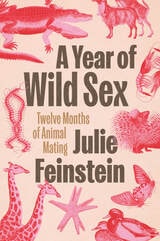
A Year of Wild Sex
Twelve Months of Animal MatingJulie Feinstein
University of Chicago Press, 2026
An eye-opening, unexpected year of animals' most intimate encounters.
It was a chance meeting with mating silverfish behind her bathroom cabinet that made biologist Julie Feinstein more curious about, well, the birds and the bees. How do other animals have sex? How do turtles do it? Or starfish without obvious sex organs? What about dangerous animals, like alligators? Or those historically associated with sex, like an oyster or a stork? What if all the animals that we see in zoos, TV ads, and children’s books, she wondered, had sex lives as seemingly strange as those of silverfish?
Feinstein’s humorous, accessible, and deeply researched text answers these and other questions on nature’s most surprising sexual behaviors, including firefly suitors bearing nutritious “nuptial gifts” and post-copulatory slug penis amputations. She raises an eyebrow at all the mammals—from goats to giraffes—that incorporate urine into courtship. She explains the complex interactions of amorous cockroaches and their equally complex genitalia. She laments that dyeing poison dart frog tadpoles sometimes commit cannibalism for a better shot at growing up and then, eventually, coupling up. In this little black book of animal sex, Feinstein guides readers through the year, drawing connections that illuminate the associations between animals’ mating behaviors and our monthly calendars. She details some animals’ peak bursts of activity, such as Atlantic white shrimp spawning in July, porcupines breeding in October, and bald eagles, decorators extraordinaires, working on their nests in December. Scorpions enter whimsically under the astrological sign of Scorpio in November, and when a holiday nears, she explains the mating nitty-gritty of species with deep cultural connections to a specific day, like New Year storks, Thanksgiving turkeys, or Christmas reindeer. Presenting a pair of animals for each month, Feinstein offers an entertaining and illuminating Noah’s ark and a year of wacky, unbelievable, truly wild sex.
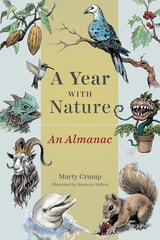
A Year with Nature
An AlmanacMarty Crump
University of Chicago Press, 2018
With Crump, we mark the publication of classics like Carson’s Silent Spring and White’s Charlotte’s Web, and even the musical premiere of Tchaikovsky’s Swan Lake. We note the discovery of the structure of DNA and the mountain gorilla, the rise of citizen science projects, and the work of people who’ve shaped how we view and protect nature—from Aristotle to E. O. Wilson. Some days feature US celebrations, like National Poinsettia Day and National Cat Day; others highlight country-specific celebrations, like Australia’s Wombat Day and Thailand’s Monkey Buffet Festival, during which thousands of macaques feast on an ornately arranged spread of fruits and vegetables. Crump also highlights celebrations that span borders, from World Wildlife Conservation Day to International Mountain Day and global festivities for snakes, sea turtles, and chocolate. Interweaving fascinating facts on everything from jellyfish bodies to monthly birth flowers with folkloric entries featuring the Loch Ness Monster, unicorns, and ancient Greek, Roman, and Egyptian mythology, the almanac is as exhaustive as it is enchanting.
A Year with Nature celebrates the wonder and beauty of our natural world as we have expressed it in visual arts, music, literature, science, natural history, and everyday experience. But more than this, the almanac’s vignettes encourage us to contemplate how we can help ensure that future generations will be able to enjoy the landscapes and rich biodiversity we so deeply cherish.

Across the Great Border Fault
The Naturalist Myth in AmericaDann, Kevin
Rutgers University Press, 2000
In recent years scholars have begun to question the cultural values underlying our view of Nature. Kevin Dann contributes to this debate by juxtaposing two radically different “Arcadian” experiments founded by Manhattanites seeking cultural renewal through contact with the natural world.
Dann focuses first on initiatives carried out by the American Museum of Natural History and the Eugenics Record Office from 1910 to 1940 within Harriman State Park in the Ramapo Mountains. He argues that these diverse expressions of the early “back-to-nature” movement are united by their biological materialism, or “Naturalism,” which became integral to the popular culture of educated metropolitan Americans in the early twentieth century.
He then compares this activity to the contemporary efforts at nearby Threefold Farm, where anthroposophists--followers of Rudolf Steiner's“spiritual science”--developed a program of natural scientific research and education that directly opposed Darwinian explanations of natural history, social Darwinian views of human society, and reductionist scientific methods. By challenging scientific “fact” with spiritual scientific descriptions of supersensible phenomena, the Threefold Farm initiative offered Americans a new gospel of nature.
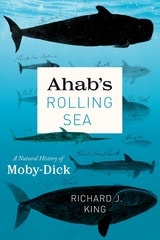
Ahab's Rolling Sea
A Natural History of "Moby-Dick"Richard J. King
University of Chicago Press, 2019
A revelation for Moby-Dick devotees and neophytes alike, Ahab’s Rolling Sea is a chronological journey through the natural history of Melville’s novel. From white whales to whale intelligence, giant squids, barnacles, albatross, and sharks, Richard J. King examines what Melville knew from his own experiences and the sources available to a reader in the mid-1800s, exploring how and why Melville might have twisted what was known to serve his fiction. King then climbs to the crow’s nest, setting Melville in the context of the American perception of the ocean in 1851—at the very start of the Industrial Revolution and just before the publication of On the Origin of Species. King compares Ahab’s and Ishmael’s worldviews to how we see the ocean today: an expanse still immortal and sublime, but also in crisis. And although the concept of stewardship of the sea would have been entirely foreign, if not absurd, to Melville, King argues that Melville’s narrator Ishmael reveals his own tendencies toward what we would now call environmentalism.
Featuring a coffer of illustrations and an array of interviews with contemporary scientists, fishers, and whale watch operators, Ahab’s Rolling Sea offers new insight not only into a cherished masterwork and its author but also into our evolving relationship with the briny deep—from whale hunters to climate refugees.

Amythia
Crisis in the Natural History of Western CultureLoyal D. Rue
University of Alabama Press, 1989
Amythia results when cosmology and morality are not effectively integrated by a root metaphor, and the only possibility for the future is to transpose the old Christian God as Person to a root metaphor that is even older in origin, the concept of the Covenant tradition inherited from Israel but now understood in a nonsupernaturalist manner.
Rue asserts that amythia is a critical condition within the natural history of Western culture. The argument of the book begins with a theoretical perspective on the place of human culture within the scope of natural history and proceeds to establish the conceptual foundations for a natural history of culture.
Following an overview of the natural history of Western culture to expose the origins and depth of the contemporary intellectual and moral crisis, Rue moves on to specify and justify the limits of distinctiveness and plausibility appropriate for the task of transposing Covenant tradition. Finally, an appeal is made to the mythmakers of contemporary culture to take up the challenge of amythia.
An Agenda for Antiquity
Henry Fairfield Osborn and Vertebrate Paleontology at the American Museum of Natural History, 1890-1935Ronald Rainger
University of Alabama Press, 1991
With a main focus on Henry Fairfield Osborn (1857-1935), a prominent scientist and administrator who dominated vertebrate paleontology in that era and played a pivotal role in creating a leading institution and a manor program of research in that field.
Born into a wealthy New York family, Osborn was in a unique position to follow vigorously his scientific interests in vertebrate paleontology and further worldwide science education through use of the considerable social, political, and financial resources at his command. Yet he was able to guide the development of the American Museum of Natural History’s program in vertebrate paleontology in such a manner as to avoid conflict with the values and beliefs associated with the interests of the upper-class elite who supported the program.
His ties to a wide network of influential figures, including the trustees of the American Museum, provided him with the political and financial resources necessary to build a major program in vertebrate paleontology. An ambitious and energetic man, Osborn took advantage of those opportunities to promote his field of study and to establish himself as a leading administrator at the American Museum, Colombia University, and the New York Zoological Society.
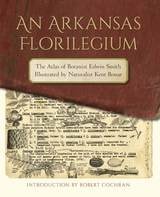
An Arkansas Florilegium
The Atlas of Botanist Edwin Smith Illustrated by Naturalist Kent BonarEdwin Smith
University of Arkansas Press, 2017
Thirty-five years later, with Smith retired and Bonar long gone from the park service but still drawing, Bonar’s weathered and battered copy of the atlas was seized by a diverse cadre of amateur admirers motivated by fears of its damage or loss. Their fears were certainly justified; after all, the pages were now jammed to the margins with some 3,500 drawings, and the volume had already survived one accidental dunking in an Ozark stream.
An Arkansas Florilegium brings Smith’s and Bonar’s knowledge and lifelong diligence to the world in this unique mix of art, science, and Arkansas saga.
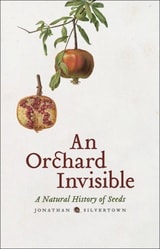
An Orchard Invisible
A Natural History of SeedsJonathan Silvertown
University of Chicago Press, 2009
The story of seeds, in a nutshell, is a tale of evolution. From the tiny sesame that we sprinkle on our bagels to the forty-five-pound double coconut borne by the coco de mer tree, seeds are a perpetual reminder of the complexity and diversity of life on earth. With An Orchard Invisible, Jonathan Silvertown presents the oft-ignored seed with the natural history it deserves, one nearly as varied and surprising as the earth’s flora itself.
Beginning with the evolution of the first seed plant from fernlike ancestors more than 360 million years ago, Silvertown carries his tale through epochs and around the globe. In a clear and engaging style, he delves into the science of seeds: How and why do some lie dormant for years on end? How did seeds evolve? The wide variety of uses that humans have developed for seeds of all sorts also receives a fascinating look, studded with examples, including foods, oils, perfumes, and pharmaceuticals. An able guide with an eye for the unusual, Silvertown is happy to take readers on unexpected—but always interesting—tangents, from Lyme disease to human color vision to the Salem witch trials. But he never lets us forget that the driving force behind the story of seeds—its theme, even—is evolution, with its irrepressible habit of stumbling upon new solutions to the challenges of life.
"I have great faith in a seed," Thoreau wrote. "Convince me that you have a seed there, and I am prepared to expect wonders." Written with a scientist’s knowledge and a gardener’s delight, An Orchard Invisible offers those wonders in a package that will be irresistible to science buffs and green thumbs alike.
Ancient Piñon-Juniper Woodlands
A Natural History of Mesa Verde CountryLisa M. Floyd
University Press of Colorado, 2003
Impressively broad in scope, Floyd's volume thoroughly explores Mesa Verde Country's important and historic ecosystem. Covering such diverse topics as geologic evolution, natural history, human history, bats, and fungi, to name but a few, this volume will appeal to scientists, resource managers, conservationists, and the lay reader with an interest in this most western of ecosystems. Technical Editors: David D. Hanna, William H. Romme and Marilyn Colyer
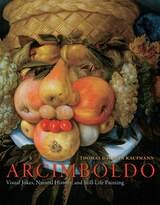
Arcimboldo
Visual Jokes, Natural History, and Still-Life PaintingThomas DaCosta Kaufmann
University of Chicago Press, 2010
In Giuseppe Arcimboldo’s most famous paintings, grapes, fish, and even the beaks of birds form human hair. A pear stands in for a man’s chin. Citrus fruits sprout from a tree trunk that doubles as a neck. All sorts of natural phenomena come together on canvas and panel to assemble the strange heads and faces that constitute one of Renaissance art’s most striking oeuvres. The first major study in a generation of the artist behind these remarkable paintings, Arcimboldo tells the singular story of their creation.
Drawing on his thirty-five-year engagement with the artist, Thomas DaCosta Kaufmann begins with an overview of Arcimboldo’s life and work, exploring the artist’s early years in sixteenth-century Lombardy, his grounding in Leonardesque traditions, and his tenure as a Habsburg court portraitist in Vienna and Prague. Arcimboldo then trains its focus on the celebrated composite heads, approaching them as visual jokes with serious underpinnings—images that poetically display pictorial wit while conveying an allegorical message. In addition to probing the humanistic, literary, and philosophical dimensions of these pieces, Kaufmann explains that they embody their creator’s continuous engagement with nature painting and natural history. He reveals, in fact, that Arcimboldo painted many more nature studies than scholars have realized—a finding that significantly deepens current interpretations of the composite heads.
Demonstrating the previously overlooked importance of these works to natural history and still-life painting, Arcimboldo finally restores the artist’s fantastic visual jokes to their rightful place in the history of both science and art.
At the Glacier’s Edge
A Natural History of Long Island from the Narrows to Montauk PointBetsy McCully
Rutgers University Press, 2024
Combining science writing, environmental history, and first-hand accounts from a longtime resident, At the Glacier’s Edge offers a unique narrative natural history of Long Island. Betsy McCully tells the story of how the island was formed at the end of the last ice age, how its habitats evolved, and how humans in the last few hundred years have radically altered and degraded its landscape. Yet as she personally recounts the habitat losses and species declines she has witnessed over the past few decades, she describes the vital efforts that environmental activists are making to restore and reclaim this land—from replanting salt marshes, to preserving remaining grasslands and forests, to cleaning up the waters. At the Glacier’s Edge provides an in-depth look at the flora, fauna and geology that make Long Island so special.

Atlas of Oregon Wildlife, 2nd Ed
Distribution, Habitat, and Natural HistoryBlair Csuti
Oregon State University Press, 2001