Results by title
4 books match the query 'Nelson, Edward'
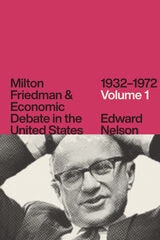
Milton Friedman and Economic Debate in the United States, 1932–1972, Volume 1
Edward Nelson
University of Chicago Press, 2020
This two-volume account provides a foundational introduction to Friedman’s role in several major economic debates that took place in the United States between 1932 and 1972. The first volume, which takes the story through 1960, covers the period in which Friedman began and developed his research on monetary policy. It traces Friedman’s thinking from his professional beginnings in the 1930s as a combative young microeconomist, to his wartime years on the staff of the US Treasury, and his emergence in the postwar period as a leading proponent of monetary policy. The second volume covers the years between 1960 and 1972— years that saw the publication of Friedman and Anna Schwartz’s Monetary History of the United States. The book also covers Friedman’s involvement in a number of debates in the 1960s and 1970s, on topics such as unemployment, inflation, consumer protection, and the environment.
As a fellow monetary economist, Nelson writes from a unique vantage point, drawing on both his own expertise in monetary analysis and his deep familiarity with Friedman’s writings. Using extensive documentation, the book weaves together Friedman’s research contributions and his engagement in public debate, providing an unparalleled analysis of Friedman’s views on the economic developments of his day.
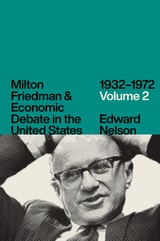
Milton Friedman and Economic Debate in the United States, 1932–1972, Volume 2
Edward Nelson
University of Chicago Press, 2020
This two-volume account provides a foundational introduction to Friedman’s role in several major economic debates that took place in the United States between 1932 and 1972. The first volume, which takes the story through 1960, covers the period in which Friedman began and developed his research on monetary policy. It traces Friedman’s thinking from his professional beginnings in the 1930s as a combative young microeconomist, to his wartime years on the staff of the US Treasury, and his emergence in the postwar period as a leading proponent of monetary policy. The second volume covers the years between 1960 and 1972— years that saw the publication of Friedman and Anna Schwartz’s Monetary History of the United States. The book also covers Friedman’s involvement in a number of debates in the 1960s and 1970s, on topics such as unemployment, inflation, consumer protection, and the environment.
As a fellow monetary economist, Nelson writes from a unique vantage point, drawing on both his own expertise in monetary analysis and his deep familiarity with Friedman’s writings. Using extensive documentation, the book weaves together Friedman’s research contributions and his engagement in public debate, providing an unparalleled analysis of Friedman’s views on the economic developments of his day.

Milton Friedman and Economic Debate in the United States, 1973–1976, Vol. 3
Edward Nelson
University of Chicago Press, 2027
The third installment in the definitive account of the famed economist's role in economic debate—and his lasting influence on economic policy.
Milton Friedman is widely recognized as one of the most significant contributors to economics in the modern age. Yet no previous study has distilled Friedman’s vast body of writings into an authoritative account of his research, his policy views, and his interventions in public debate. Through his sweeping series on the most influential economist of the second half of the twentieth century, Edward Nelson closes this gap: Milton Friedman and EconomicDebate in the United States is the defining narrative on the famed public intellectual—the first to grapple comprehensively with Friedman’s research output, economic framework, and legacy.
Volume 3 chronicles Friedman’s activities from 1973 to 1976, encompassing his final years at the University of Chicago and a period that saw his further ascension in national prominence. In the mid-1970s, economic news dominated American political discourse as the nation endured double-digit inflation and recession. It was during this time that Friedman’s views became a center of economic debate in both the research world and public debate, while his explanation for “stagflation” formed part of the critique of stabilization policy that would lead to his 1976 Nobel Prize. Nelson details the controversies that Friedman faced in the media—including his contrarian stances on inflation’s cure, the economic implications of oil price shocks, and the social responsibility of business—and how Friedman concluded that the world needed a “new Adam Smith” to press the case for free markets. Drawing upon a large body of documentary sources, interviews with dozens of the people closest to Friedman, and his own expertise in Friedman’s research area of monetary analysis, Nelson provides the definitive account of the formative (and uneven) events in Friedman’s foray into life as a public intellectual and how his research permanently shifted economic thinking.
Milton Friedman and Economic Debate in the United States, 1977–1979, Vol. 4
Edward Nelson
University of Chicago Press, 0
The fourth installment of the sweeping account of the most influential economist in modern times, focusing on his crossover into the public sphere.
Milton Friedman is widely recognized as one of the most significant contributors to economics in the modern age. Yet no previous study has distilled Friedman’s vast body of writings into an authoritative account of his research, his policy views, and his interventions in public debate. Through his sweeping series on the most influential economist of the second half of the twentieth century, Edward Nelson closes this gap: Milton Friedman and EconomicDebate in the United States is the defining narrative on the famed public intellectual—the first to grapple comprehensively with Friedman’s research output, economic framework, and legacy.
Volume 4 of Nelson’s intellectual and policy biography offers an exacting portrait of Friedman’s career following his departure from the University of Chicago. Spanning 1977 to 1979, Nelson’s narrative details Friedman’s move to California and his greater immersion in public policy, including his project with Rose Friedman and television professionals to create a TV series giving his viewpoint. Nelson details the successes and failures of Friedman’s years of extraordinary influence, including:
- His warnings about US inflation returning to double digits in 1979;
- The changes in professional thinking in the US economics profession and policymaking toward acceptance of Friedman's view that inflation is a monetary phenomenon;
- The rise of Paul Volcker to head of the Federal Reserve and his integration of monetarist ideas into US monetary policy;
- Friedman's proposal to phase in a zero-tariff arrangement in the United States;
- His role in the tax revolt of the 1970s—including his break with the emerging supply-side economics movement on the effects of tax cuts;
- The second oil-price shock and Friedman's critique of the Carter Administration's energy policy;
- The resilience after 1976 of Ronald Reagan's presidential ambitions and Friedman's 1979 endorsement of Reagan for president in the 1980 election.
Drawing upon a large body of documentary sources, interviews with dozens of the people closest to Friedman, and his own expertise in Friedman’s research area of monetary analysis, Nelson offers the definitive account of what proved to be pivotal years for Friedman and the field of economics.