Results by title
9 books match the query 'New Economy'
A Working Nation
Workers, Work, and Government in the New EconomyDavid T. Ellwood
Russell Sage Foundation, 2000
Down and Out in the New Economy
How People Find (or Don’t Find) Work TodayIlana Gershon
University of Chicago Press, 2017
Finding a job used to be simple. Now . . . well, it’s complicated. In today’s economy, you can’t just be an employee looking to get hired—you have to market yourself as a business, one that can help another business achieve its goals.
That’s a radical transformation in how we think about work and employment, says Ilana Gershon. And with Down and Out in the New Economy, she digs deep into that change and what it means, not just for job seekers, but for businesses and our very culture. In telling this story, Gershon covers all parts of the employment spectrum: she interviews hiring managers about how they assess candidates; attends personal branding seminars; talks with managers at companies around the United States to suss out regional differences—like how Silicon Valley firms look askance at the lengthier employment tenures of applicants from the Midwest. And she finds that not everything has changed: though the technological trappings may be glitzier, in a lot of cases, who you know remains more important than what you know.
Rich in the voices of people deeply involved with all parts of the employment process, Down and Out in the New Economy offers a snapshot of the quest for work today—and a pointed analysis of its larger meaning.
Frontiers of Capital
Ethnographic Reflections on the New EconomyMelissa S. Fisher and Greg Downey, eds.
Duke University Press, 2006
Some contributors highlight how expedited flows of information allow business professionals to develop new knowledge practices. They analyze dynamics ranging from the decision-making processes of the Federal Reserve Board to the legal maneuvering necessary to buttress a nascent Japanese market in over-the-counter derivatives. Others focus on the social consequences of globalization and new modes of communication, evaluating the introduction of new information technologies into African communities and the collaborative practices of open-source computer programmers. Together the essays suggest that social relations, rather than becoming less relevant in the high-tech age, have become more important than ever. This finding dovetails with the thinking of many corporations, which increasingly employ anthropologists to study and explain the “local” cultural practices of their own workers and consumers. Frontiers of Capital signals the wide-ranging role of anthropology in explaining the social and cultural contours of the New Economy.
Contributors. Jean Comaroff, John L. Comaroff, Greg Downey, Melissa S. Fisher, Douglas R. Holmes, George E. Marcus, Siobhán O’Mahony, Aihwa Ong, Annelise Riles, Saskia Sassen, Paul A. Silverstein, AbdouMaliq Simone, Neil Smith, Caitlin Zaloom
Labor in the New Economy
Edited by Katharine G. Abraham, James R. Spletzer, and Michael Harper
University of Chicago Press, 2010
As the structure of the economy has changed over the past few decades, researchers and policy makers have been increasingly concerned with how these changes affect workers. In this book, leading economists examine a variety of important trends in the new economy, including inequality of earnings and other forms of compensation, job security, employer reliance on temporary and contract workers, hours of work, and workplace safety and health.
In order to better understand these vital issues, scholars must be able to accurately measure labor market activity. Thus, Labor in the New Economy also addresses a host of measurement issues: from the treatment of outliers, imputation methods, and weighting in the context of specific surveys to evaluating the strengths and weaknesses of data from different sources. At a time when employment is a central concern for individuals, businesses, and the government, this volume provides important insight into the recent past and will be a useful tool for researchers in the future.
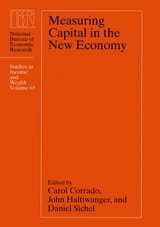
Measuring Capital in the New Economy
Edited by Carol Corrado, John Haltiwanger, and Daniel Sichel
University of Chicago Press, 2005
In Measuring Capital in the New Economy, Carol Corrado, John Haltiwanger, Daniel Sichel, and a host of distinguished collaborators offer new approaches for measuring capital in an economy that is increasingly dominated by high-technology capital and intangible assets. As the contributors show, high-tech capital and intangible assets affect the economy in ways that are notoriously difficult to appraise. In this detailed and thorough analysis of the problem and its solutions, the contributors study the nature of these relationships and provide guidance as to what factors should be included in calculations of different types of capital for economists, policymakers, and the financial and accounting communities alike.
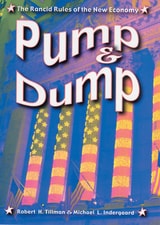
Pump and Dump
The Rancid Rules of the New EconomyTillman, Robert H
Rutgers University Press, 2005
In Pump and Dump: The Rancid Rules of the New Economy,Robert H. Tillman and Michael L. Indergaard argue that these scandals are symptoms of a corporate governance problem that began in the 1990s as New Economy pundits claimed that advances in technology and forms of business organization were changing the rules. A decade later, it looked more like a case of no rules. Endless revelations of fraud in the wake of corporate bankruptcies left ordinary investors bewildered and employees out of work with little or nothing.
Tillman and Indergaard observe that victims were taken in by organized behavior that calls to mind “pump and dump” schemes where shadowy swindlers push penny stocks. Yet, in the 1990s it was high-profile firms and high-status accomplices (financial analysts, bankers, and accountants) who used powerful institutional levers to pump the value of stock—duping investors while insiders sold their holdings for fantastic profits before the crash.
The authors explain how it was that so much of corporate America came to resemble a two-bit securities scam by focusing on the rules that mattered in three critical industries—energy trading, telecommunications, and dot-coms. Free-market hype and policies at the national level set the tone. While Wall Street wrapped itself in star-spangled packaging and celebrated its purported “democratization,” in the real halls of democracy congressional allies of business gutted protections for ordinary investors. In the regulatory vacuum that resulted, business professionals who were supposed to watch corporations instead promoted New Economy doctrines and worked with executives to tout their firms as New Economy contenders. Ringleaders in the inner circles that committed fraud made their own rules, which they enforced through a mix of bribery and bullying.
At a time when there is growing debate about proposals to privatize programs like Social Security and to promote an “ownership society,” Pump and Dump offers a path-breaking analysis of America’s most urgent economic problem: a system that relies on self-regulation and the rancid politics that continue to support the short-term interests of financial elites over the long-term interests of most Americans.
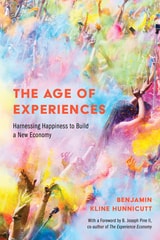
The Age of Experiences
Harnessing Happiness to Build a New EconomyBenjamin Kline Hunnicutt
Temple University Press, 2020
In The Age of Experiences, Benjamin Kline Hunnicutt examines how the advance of happiness science is impacting the economy, making possible new experience-products that really make people happy and help forward-looking businesses expand and develop new technologies. In today’s marketplace there is less interest in goods and services and more interest in buying and selling personal improvements and experiences. Hunnicutt traces how this historical shift in consumption to the “softer” technologies of happiness represents not only a change in the modern understanding of progress, but also a practical, economic transformation, profoundly shaping our work and the ordering of our life goals.
Based on incisive historical research, Hunnicutt demonstrates that we have begun to turn from material wealth to focus on the enrichment of our personal and social lives. The Age of Experiences shows how industry, technology, and the general public are just beginning to realize the potential of the new economy. Exploring the broader implications of this historical shift, Hunnicutt concludes that the new demand for experiences will result in the reduction of work time, the growth of jobs, and the regeneration of virtue—altogether an increasingly healthy public life.
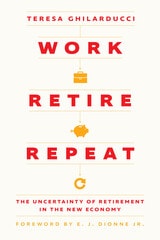
Work, Retire, Repeat
The Uncertainty of Retirement in the New EconomyTeresa Ghilarducci
University of Chicago Press, 2024
A damning portrait of the dire realities of retirement in the United States—and how we can fix it.
While the French went on strike in 2023 to protest the increase in the national retirement age, workers in the United States have all but given up on the notion of dignified retirement for all. Instead, Americans—whose elders face the highest risk of poverty compared to workers in peer nations—are fed feel-good stories about Walmart clerks who can finally retire because a customer raised the necessary funds through a GoFundMe campaign.
Many argue that the solution to the financial straits of American retirement is simple: people need to just work longer. Yet this call to work longer is misleading in a multitude of ways, including its endangering of the health of workers and its discrimination against people who work in lower-wage occupations. In Work, Retire, Repeat, Teresa Ghilarducci tells the stories of elders locked into jobs—not because they love to work but because they must.
But this doesn’t need to be the reality. Work, Retire, Repeat shows how relatively low-cost changes to how we finance and manage retirement will allow people to truly choose how they spend their golden years.
Work, Retire, Repeat
The Uncertainty of Retirement in the New EconomyTeresa Ghilarducci
University of Chicago Press, 2024
A damning portrait of the dire realities of retirement in the United States—and how we can fix it.
While the French went on strike in 2023 to protest the increase in the national retirement age, workers in the United States have all but given up on the notion of dignified retirement for all. Instead, Americans—whose elders face the highest risk of poverty compared to workers in peer nations—are fed feel-good stories about Walmart clerks who can finally retire because a customer raised the necessary funds through a GoFundMe campaign.
Many argue that the solution to the financial straits of American retirement is simple: people need to just work longer. Yet this call to work longer is misleading in a multitude of ways, including its endangering of the health of workers and its discrimination against people who work in lower-wage occupations. In Work, Retire, Repeat, Teresa Ghilarducci tells the stories of elders locked into jobs—not because they love to work but because they must.
But this doesn’t need to be the reality. Work, Retire, Repeat shows how relatively low-cost changes to how we finance and manage retirement will allow people to truly choose how they spend their golden years.