Results by title
22 books match the query 'Nin, Anaïs'

A Spy in the House of Love
Anaïs Nin
Ohio University Press, 2014
Although Anaïs Nin found in her diaries a profound mode of self-creation and confession, she could not reveal this intimate record of her experiences during her lifetime. Instead, she turned to literary fiction, transforming her private writings into artfully crafted novels that explore female desire, identity, and emotional complexity.
A Spy in the House of Love is a classic of psychological and women’s fiction, centered on Sabina, a woman torn between her longing for artistic freedom, romantic adventure, and sensual fulfillment, and the social expectations that constrain her. Moving through a bohemian, Parisian-inspired world, Sabina navigates multiple relationships in her search for passion, meaning, and self-understanding.
Written at a time when Nin’s own life was shaped by conflicting loyalties and intense relationships, the novel offers a deeply introspective exploration of love, infidelity, erotic longing, and self-discovery. As Sabina confronts her inner divisions, she asks a timeless question: can one indulge the fantasies and restless pursuit of desire without facing profound emotional consequences?
A landmark of modernist literature and feminist writing, A Spy in the House of Love remains a powerful, evocative portrait of a woman’s inner life—ideal for readers of classic literary fiction, experimental narrative, and character-driven novels about relationships and desire.

Children of the Albatross
Anaïs Nin
Ohio University Press, 1959
Children of the Albatross is divided into two sections: “The Sealed Room” focuses on the dancer Djuna and a set of characters, chiefly male, who surround her; “The Café” brings together a cast of characters already familiar to Nin’s readers, but it is their meeting place that is the focal point of the story.
As always, in Children of the Albatross, Nin’s writing is inseparable from her life. From Djuna’s story, told in “The Sealed Room” through hints and allusions, hazy in their details and chronology, the most important event to emerge is her father’s desertion (like Nin’s) when she was sixteen. By rejecting realistic writing for the experience and intuitions she drew from her diary, Nin was able to forge a novelistic style emphasizing free association, spontaneity, and improvisation, a technique that finds its parallel in the jazz music performed at the café where Nin’s characters meet.
Children of the Albatross
Anaïs Nin
Ohio University Press, 2023
The second novel in Anaïs Nin’s Cities of the Interior series, Children of the Albatross is divided into two sections: “The Sealed Room” focuses on the dancer Djuna and a set of characters, chiefly male, who surround her; “The Café” brings together a cast of characters already familiar to Nin’s readers, but it is their meeting place that is the focal point of the story.
As always, in Children of the Albatross, Nin’s writing is inseparable from her life. From Djuna’s story, told in “The Sealed Room” through hints and allusions, hazy in their details and chronology, the most important event to emerge is her father’s desertion (as Nin’s father did) when she was sixteen. By rejecting realistic writing for the experience and intuitions she drew from her diary, Nin was able to forge a novelistic style emphasizing free association, spontaneity, and improvisation, a technique that finds its parallel in the jazz music performed at the café where Nin’s characters meet.
Cities of the Interior
Anaïs Nin
Ohio University Press, 1996
Ladders to Fire, Children of the Albatross, The Four-Chambered Heart, A Spy in the House of Love, Seduction of the Minotaur. Haunting and hypnotic, these five novels by Anaïs Nin began in 1946 to appear in quiet succession. Though published separately over the next fifteen years, the five were conceived as a continuous experience—a continuous novel like Proust’s, real and flowing as a river.
The full impact of Anaïs Nin’s genius is only to be found through reading the novels in context and in succession. They form a rich, luminous tapestry whose overall theme Nin has called “woman at war with herself.” Characters, symbols appear and reappear: now one, now another unfolding, gradually revealing, changing, struggling, growing, and Nin had forged an evocative language all her own for the telling.
“The diary taught me that there were no neat ends to novels, no neat denouement, no neat synthesis,” she explains. “So I began an endless novel, a novel in which the climaxes consisted of discoveries in awareness, each step in awareness becoming a stage in the growth like the layers in trees.”
Cities of the Interior fulfills a long–time desire on the part of readers, publisher, and Anaïs Nin herself to reunite the five novels in a single volume.
Collages
Anaïs Nin
Ohio University Press, 1964
“Collages began with an image which had haunted me. A friend, Renate, had told me about her trip to Vienna where she was born, and of her childhood relationships to statues. She told me stories of her childhood, her relationship to her father, her first love.
I begin the novel with:
Vienna was the city of statues. They were as numerous as the people who walked the streets. They stood on the top of the highest towers, law down on stone tombs, sat on horseback, kneeled, prayed, fought animals and wars, danced, drank wine and read books made of stone. They adorned cornices like the figureheads of old ships. They stood in the heart of fountains glistening with water as if they had just been born. They sat under the trees in the parks summer and winter. Some wore costumes of other periods, and some no clothes at all. Men, women, children, kings, dwarfs, gargoyles, unicorns, lions, clowns, heroes, wise men, prophets, angels, saints, and soldiers preserved for Vienna a vision of eternity.
As a child Renate could see them from her bedroom window. At night, when the white muslin curtains fluttered out like ballooning wedding dresses, she heard them whispering like figures which had been petrified by a spell during the day and came alive only at night. Their silence by day taught her to read their frozen lips as one reads the messages of deaf mutes. On rainy days their granite eye sockets shed tears mixed with soot.
Renate would never allow anyone to tell her the history of the statues, or to identify them. This would have situated them in the past. She was convinced that people did not die, they became statues. They were people under a spell and if she were watchful enough they would tell her who they were and how they lived now.
If I had been asked then what was going to follow the description of the statues, I could not have answered. I was fascinated by the image of these many statues and of the child Renate inventing stories about them and dialoguing with them. It may have been that this image expressed the feeling I often had that people appear to us as a one-dimensional statue until we go deeper into their life story. People are like mute statues under a spell of appearance, and static, until we let them whisper their secrets. And this only happens at night. That is, when we are able to dream, imagine, and explore the unconscious. We see the external self. Because Collages took its images from painting and sculpture, I liked the idea that sculpture and painting could become animated, speaking, confessing, and then in daylight returning to their previous forms as statues or paintings. They spoke only to the artist. To me it meant dramatizing our relation to art, one feeding the other, the interrelation between human beings and the artist’s conception of them. In daylight (consciousness) we catch them all only in one attitude, one form. At night, we discover their lives.”
—Anaïs Nin, “The Novel of the Future,” (Athens: Ohio University Press, 1986), 128
Collages
Anaïs Nin
Ohio University Press, 2019
D. H. Lawrence
An Unprofessional StudyAnaïs Nin
Ohio University Press, 1964
In 1932, two years after D. H. Lawrence’s death, a young woman wrote a book about him and presented it to a Paris publisher. She recorded the event in her diary: “It will not be published and out by tomorrow, which is what a writer would like when the book is hot out of the oven, when it is alive within oneself. He gave it to his assistant to revise.” The woman was Anaïs Nin.
Nin examined Lawrence’s poetry, novels, essays, and travel writing. She analyzed and explained the more important philosophical concepts contained in his writings, particularly the themes of love, death, and religion, as well as his attention to primitivism and to women. But what Anaïs Nin brought to the explication of Lawrence’s writing was an understanding of the fusion of imaginative, intuitive, and intellectual elements from which he drew his characters, themes, imagery and symbolism.
House Of Incest
Anaïs Nin
Ohio University Press, 1958
With an introduction by Allison Pease, this new edition of House of Incest is a lyrical journey into the subconscious mind of one of the most celebrated feminist writers of the twentieth-century.
Originally published in 1936, House of Incest is Anaïs Nin’s first work of fiction. Based on Nin’s dreams, the novel is a surrealistic look within the narrator’s subconscious as she attempts to distance herself from a series of all-consuming and often taboo desires she cannot bear to let go. The incest Nin depicts is a metaphor—a selfish love wherein a woman can appreciate only qualities in a lover that are similar to her own. Through a descriptive exploration of romances and attractions between women, between a sister and her beloved brother, and with a Christ-like man, Nin’s narrator discovers what she thinks is truth: that a woman’s most perfect love is of herself. At first, this self-love seems ideal because it is attainable without fear and risk of heartbreak. But in time, the narrator’s chosen isolation and self-possessed anguish give way to a visceral nightmare from which she is unable to wake.
House of Incest
Anaïs Nin
Ohio University Press, 1958
With an introduction by Allison Pease, this new edition of House of Incest is a lyrical journey into the subconscious mind of one of the most celebrated feminist writers of the twentieth-century.
Originally published in 1936, House of Incest is Anaïs Nin’s first work of fiction. Based on Nin’s dreams, the novel is a surrealistic look within the narrator’s subconscious as she attempts to distance herself from a series of all-consuming and often taboo desires she cannot bear to let go. The incest Nin depicts is a metaphor—a selfish love wherein a woman can appreciate only qualities in a lover that are similar to her own. Through a descriptive exploration of romances and attractions between women, between a sister and her beloved brother, and with a Christ-like man, Nin’s narrator discovers what she thinks is truth: that a woman’s most perfect love is of herself. At first, this self-love seems ideal because it is attainable without fear and risk of heartbreak. But in time, the narrator’s chosen isolation and self-possessed anguish give way to a visceral nightmare from which she is unable to wake.
Ladders To Fire
New Expanded EditionAnaïs Nin
Ohio University Press, 1959
After struggling with her own press and printing her own works, Anaïs Nin succeeded in getting Ladders to Fire accepted and published in 1946. This recognition marked a milestone in her life and career. Admitted into the fellowship of American novelists, she maintained the individuality of her literary style. She resisted realistic writing and drew on the experience and intuitions of her diary to forge a novelistic style emphasizing free association, the language of emotion, spontaneity, and improvisation.
Ladders to Fire is the first volume of Nin’s celebrated series of novels called Cities of the Interior
For Anaïs Nin, her writing and her life were not separable, they were both part of the same experience. She claimed that “is it the fiction writer who edited the diary.”
Anaïs Nin continues to find an audience, whether for her fiction, her diaries, or her own life story, which has enjoyed the attention of biographers and filmmakers. This 1995 reissue of Ladders to Fire has a new cover and foreword.

Ladders to Fire
Anaïs Nin
Ohio University Press, 2014
Anaïs Nin’s Ladders to Fire interweaves the stories of several women, each emotionally inhibited in her own way: through self-doubt, fear, guilt, moral drift, and distrust. The novel follows their inner struggles to overcome these barriers to happiness and wholeness. The author’s own experiences, as recorded in her famous diaries, supplied the raw material for her fiction. It was her intuitive, experimental, and always original style that transformed one into the other. Nin herself memorably claimed that “it was the fiction writer who edited the diary.”
Ladders to Fire is the first book of Nin’s continuous novel, Cities of the Interior, which also includes Children of the Albatross,The Four-Chambered Heart,A Spy in the House of Love, and Seduction of the Minotaur. These loosely interlinked stories develop the characters and themes established in the first volume, leading slowly toward a resolution of inner turmoil and conflict.
This Swallow Press reissue of Ladders to Fire includes a new introduction by Nin scholar Benjamin Franklin V, as well as Gunther Stuhlmann’s classic foreword to the 1995 edition.

Mirages
The Unexpurgated Diary of Anaïs Nin, 1939–1947Anaïs Nin
Ohio University Press, 2013
Mirages collects, for the first time, the story that was cut from all of Nin’s other published diaries, particularly volumes 3 and 4 of The Diary of Anaïs Nin, which cover the same time period. It is the long-awaited successor to the previous unexpurgated diaries Henry and June, Incest, Fire, and Nearer the Moon. Mirages answers the questions Nin readers have been asking for decades: What led to the demise of Nin’s love affair with Henry Miller? Just how troubled was her marriage to Hugh Guiler? What is the story behind Nin’s “children,” the effeminate young men she seemed to collect at will? Mirages is a deeply personal story of heartbreak, despair, desperation, carnage, and deep mourning, but it is also one of courage, persistence, evolution, and redemption that reaches beyond the personal to the universal.
Reunited
The Correspondence of Anaïs and Joaquín Nin, 1933–1940Anaïs Nin
Ohio University Press, 2020
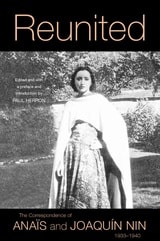
The incestuous affair between the writer Anaïs Nin and her father, the pianist-composer Joaquín Nin, is well documented in the volume of her unexpurgated diary published under the title Incest. What has been missing from that account is Joaquín’s point of view. Reunited: The Correspondence of Anaïs and Joaquín Nin, 1933–1940 presents more than one hundred intimate communications between these two artistic geniuses, revealing not only the dynamics of their complex relationship but also why Anaïs spent her life in a never-ending battle to feel loved, appreciated, and understood.
Reunited collects the correspondence between Anaïs and Joaquín just before, during, and after the affair, which commenced in 1933, twenty years after he had abandoned his ten-year-old daughter and the rest of his family. These letters were long believed to have been destroyed and lost to history. In 2006, however, a folder containing Joaquín’s original letters to his daughter was discovered in Anaïs’s Los Angeles home, along with a second folder of her letters to him. Together, these letters tell the story of an absent father’s attempt to reconnect with his adult daughter and how that rapprochement quickly turned into an illicit sexual relationship.
Seduction of the Minotaur
Anaïs Nin
Ohio University Press, 2014
Seduction of the Minotaur is the fifth and final volume of Anaïs Nin’s continuous novel known as Cities of the Interior. First published by Swallow Press in 1961, the story follows the travels of the protagonist Lillian through the tropics to a Mexican city loosely based on Acapulco, which Nin herself visited in 1947 and described in the fifth volume of her Diary. As Lillian seeks the warmth and sensuality of this lush and intriguing city, she travels inward as well, learning that to free herself she must free the “monster” that has been confined in a labyrinth of her subconscious.
This new Swallow Press edition includes an introduction by Anita Jarczok, author of Inventing Anaïs Nin: Celebrity Authorship and the Creation of an Icon.
Swallow Press publishes all five volumes that make up Cities of the Interior: Ladders to Fire, Children of the Albatross, The Four-Chambered Heart, A Spy in the House of Love, and Seduction of the Minotaur.
The Four-Chambered Heart
Anaïs Nin
Ohio University Press, 2023
The Four-Chambered Heart, Anaïs Nin’s 1950 novel, recounts the real-life affair she conducted with café guitarist Gonzalo Moré in 1936. Nin and Moré rented a house-boat on the Seine, and under the pervading influence of the boat’s watchman and Moré’s wife Helba, developed a relationship. Moré; named the boat Nanankepichu, meaning "not really a home."
In the novel, which Nin drew from her experiences on the boat, the characters' sources are clear. Djuna is an embodiment of Nin herself. A young dancer in search of fulfillment, she encapsulates all that the author was striving for at that time. The character of Djuna features in other novels, perhaps weaving a directly autobiographical thread into Nin’s fiction. The gypsy musician, Rango, is therefore Moré, and his invalid wife is Zora. The old watchman is present as a force that, along with Zora, works against the lovers in their quest for happiness.
Nin’s main concern throughout the novel is the "exterior," and how it affects the "interior." Water is a cleverly used theme. “I have no great fear of depths,” says Djuna, “and a great fear of shallow living.” Rango and Djuna’s relationship is, in effect, their effort to remain afloat. Often, Nin employs a stream of consciousness, especially in her flowing analyses of love, life and music, which continues the water image.
Anaïs Nin’s writing is typically exquisite in its detail and texture. She describes Paris: its "black lacquered cobblestones" and "silver filigree trees." The "humid scarfs of fog" on the river, and "the sharp incense of roasted chestnuts" reveal their source through their reality: Nin’s personal experience.
The Four-Chambered Heart
V3 in Nin's Continuous NovelAnaïs Nin
Ohio University Press, 1959
In the novel, which Nin drew from her experiences on the boat, the characters are clearly based. Djuna is an embodiment of Nin herself. A young dancer in search of fulfillment, she encapsulates all that the author was striving for at that time. The character of Djuna features in other novels, perhaps weaving a directly autobiographical thread into Nin’s fiction. The gypsy musician, Rango, is therefore Moré, and his invalid wife is Zora. The old watchman is present as a force which, along with Zora, works against the lovers in their quest for happiness.
Nin’s main concern is the "outside," and how it affects the "interior." Water is a cleverly used theme. “I have no great fear of depths,” says Djuna, “and a great fear of shallow living.” Rango and Djuna’s relationship is, in effect, their effort to remain afloat. Often, Nin employs a stream of consciousness, especially in her flowing analyses of love, life and music, which continues the water image.
Anaïs Nin’s writing is typically exquisite in its detail and texture. She describes Paris: its "black lacquered cobblestones" and "silver filigree trees." The "humid scarfs of fog" on the river, and "the sharp incense of roasted chestnuts" reveal their source through their reality: Nin’s personal experience.
The Novel of the Future
Anaïs Nin
Ohio University Press, 2014
In The Novel of the Future, Anaïs Nin explores the act of creation—in film, art, and dance as well as literature—to chart a new direction for the young artist struggling against what she perceived as the sterility, formlessness, and spiritual bankruptcy afflicting much of mid-twentieth-century fiction. Nin offers, instead, an argument for and synthesis of the poetic novel and discusses her own efforts in this genre as well as its influence on the development of such writers as D. H. Lawrence, Henry Miller, Lawrence Durrell, Marguerite Young, and Djuna Barnes. In chapters devoted to the pursuit of the hidden self, the genesis of fiction, and the relationship between the diary and fiction, she addresses the materials, techniques, and nourishment of the arts, and the functions of art itself.
Originally published in 1968, The Novel of the Future remains a classic among both creative writers and literary scholars. This new Swallow Press edition includes an introduction by Nin biographer Deirdre Bair.

Trapeze
The Unexpurgated Diary of Anaïs Nin, 1947–1955Anaïs Nin
Ohio University Press, 2017
Anaïs Nin made her reputation through publication of her edited diaries and the carefully constructed persona they presented. It was not until decades later, when the diaries were published in their unexpurgated form, that the world began to learn the full details of Nin’s fascinating life and the emotional and literary high-wire acts she committed both in documenting it and in defying the mores of 1950s America. Trapeze begins where the previous volume, Mirages, left off: when Nin met Rupert Pole, the young man who became not only her lover but later her husband in a bigamous marriage.
It marks the start of what Nin came to call her “trapeze life,” swinging between her longtime husband, Hugh Guiler, in New York and her lover, Pole, in California, a perilous lifestyle she continued until her death in 1977. Today what Nin did seems impossible, and what she sought perhaps was impossible: to find harmony and completeness within a split existence. It is a story of daring and genius, love and pain, largely unknown until now.

Under a Glass Bell
Anaïs Nin
Ohio University Press, 2013
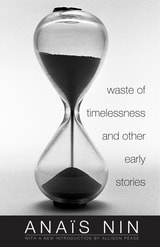
Waste of Timelessness and Other Early Stories
Anaïs Nin
Ohio University Press, 2017
Written when Anaïs Nin was in her twenties and living in France, the stories collected in Waste of Timelessness contain many elements familiar to those who know her later work as well as revelatory, early clues to themes developed in those more mature stories and novels. Seeded with details remembered from childhood and from life in Paris, the wistful tales portray artists, writers, strangers who meet in the night, and above all, women and their desires.
These experimental and deeply introspective missives lay out a central theme of Nin’s writing: the contrast between the public and private self. The stories are taut with unrealized sexual tension and articulate the ways that language and art can shape reality. Nin’s deft humor, ironic wit, and ecstatic prose display not only superb craftsmanship but also the author’s own constant balancing act between feeling and rationality, vulnerability and strength. Perhaps more than any other writer of the twentieth century, she mastered that act and wrote about it on her own terms, defying the literary and social norms of the time.

Waste of Timelessness and Other Early Stories
And Other Early StoriesAnaïs Nin
Ohio University Press, 1993
These stories precede all of Nin’s published work to date. In them are many sources of the more mature work that collectors and growing writers can appreciate.
Written when Anaïs Nin was in her twenties and living in Louveciennes, France, these stories contain many elements that will delight her readers: details remembered from childhood, of life in Paris, the cafés, theatres; characters including dancers, artists, writers, women who devote themselves to their work and visions as well as romance, strangers met in the night; themes such as the scruples of lovers, the search for brilliant, imaginative living; the writer’s experimentation with exotic words like “sybaritic” and “violaceous”. In the craft of these stories readers are treated to a deft sense of humor, ironic wit, much conversation as well as ecstatic prose, and surprise endings. Throughout all, the Nin personality shines, a wonderful mixture of feeling and rationality, of vulnerability and strength.
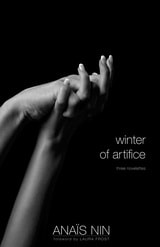
Winter of Artifice
Three NovelettesAnaïs Nin
Ohio University Press, 2016
Swallow Press first published Winter of Artifice in 1945, following two vastly different versions from other presses. The book opens with a film star, Stella, studying her own, but alien, image on the screen. It ends in the Manhattan office of a psychoanalyst—the Voice—who, as he counsels patients suffering from the maladies of modern life, reveals himself as equally susceptible to them. The middle, title story explores one of Nin’s most controversial themes, that of a woman’s sexual relationship with her father. Elliptical, fragmented prose; unconventional structure; surrealistic psychic landscapes—Nin forged these elements into a style that engaged with the artistic concerns of her time but still registers as strikingly contemporary.
This reissue, accompanied by a new introduction by Laura Frost and the original engravings by Nin’s husband Ian Hugo, presents an important opportunity to consider anew the work of an author who laid the groundwork for later writers. Swallow Press’s Winter of Artifice represents a literary artist coming into her own, with the formal experimentation, thematic daring, and psychological intrigue that became her hallmarks.