Results by title

7 books match the query 'Nineteen sixty-eight, A.D'
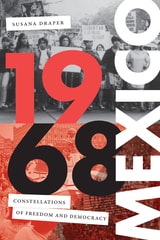
cover of 1968 Mexico: Constellations of Freedom and Democracy

1968 Mexico

Constellations of Freedom and Democracy

Susana Draper

Duke University Press, 2018
Recognizing the fiftieth anniversary of the protests, strikes, and violent struggles that formed the political and cultural backdrop of 1968 across Europe, the United States, and Latin America, Susana Draper offers a nuanced perspective of the 1968 movement in Mexico. She challenges the dominant cultural narrative of the movement that has emphasized the importance of the October 2nd Tlatelolco Massacre and the responses of male student leaders. From marginal cinema collectives to women’s cooperative experiments, Draper reveals new archives of revolutionary participation that provide insight into how 1968 and its many afterlives are understood in Mexico and beyond. By giving voice to Mexican Marxist philosophers, political prisoners, and women who participated in the movement, Draper counters the canonical memorialization of 1968 by illustrating how many diverse voices inspired alternative forms of political participation. Given the current rise of social movements around the globe, in 1968 Mexico Draper provides a new framework to understand the events of 1968 in order to rethink the everyday existential, political, and philosophical problems of the present.
[more]
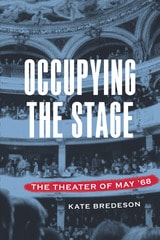
cover of Occupying the Stage: The Theater of May '68

Occupying the Stage

The Theater of May '68

Kate Bredeson

Northwestern University Press, 2018

Occupying the Stage: the Theater of May '68 tells the story of student and worker uprisings in France through the lens of theater history, and the story of French theater through the lens of May '68. Based on detailed archival research and original translations, close readings of plays and historical documents, and a rigorous assessment of avant-garde theater history and theory, Occupying the Stage proposes that the French theater of 1959–71 forms a standalone paradigm called "The Theater of May '68." 

The book shows how French theater artists during this period used a strategy of occupation-occupying buildings, streets, language, words, traditions, and artistic processes-as their central tactic of protest and transformation. It further proposes that the Theater of May '68 has left imprints on contemporary artists and activists, and that this theater offers a scaffolding on which to build a meaningful analysis of contemporary protest and performance in France, North America, and beyond.

At the book's heart is an inquiry into how artists of the period used theater as a way to engage in political work and, concurrently, questioned and overhauled traditional theater practices so their art would better reflect the way they wanted the world to be. Occupying the Stage embraces the utopic vision of May '68 while probing the period's many contradictions. It thus affirms the vital role theater can play in the ongoing work of social change.
 
[more]
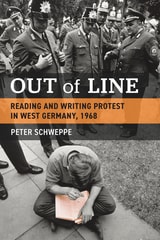
cover of Out of Line: Reading and Writing Protest in West Germany, 1968

Out of Line

Reading and Writing Protest in West Germany, 1968

Peter Schweppe

University of Michigan Press, 2026

By analyzing how protest fused the politics of reading and writing in 1968 West Germany, author Peter Schweppe uncovers the vibrant history of an alternative literary form during a watershed moment of social upheaval. Out of Line interlinks the politics of reading and writing with the verve of Global Sixties’ protest, where fringe books, underground newspapers, incendiary flyers, and furtive graffiti galvanized readers and writers alike. The phrase “out of line” scrutinizes the emerging performative relationship between visual and textual media in the late 1960s as it metamorphosed modes of West German literary production, channeled the agenda of the protest movement, and, in doing so, shaped new kinds of textual meaning. Through its engagement with theories of materiality and “things,” Out of Line interrogates the dynamic ways that protest readers and writers pushed and broke conventional boundaries. Schweppe’s exploration of form discloses how reading and writing out of line implicates a textual and material history of protest and the lessons it offers protest histories to come.
[more]
cover of Promises of 1968: Crisis, Illusion and Utopia

Promises of 1968

Crisis, Illusion and Utopia

Vladimir Tismaneanu

Central European University Press, 2011
This book is a state of the art reassessment of the significance and consequences of the events associated with the year 1968 in Europe and in North America. Since 1998, there hasn't been any collective, comparative and interdisciplinary effort to discuss 1968 in the light of both contemporary headways of scholarship and new evidence on this historical period. A significant departure from earlier approaches lies in the fact that the manuscript is constructed in unitary fashion, as it goes beyond the East–West divide, trying to identify the common features of the sixties. The latter are analyzed as simultaneously global and local developments. The main problems addressed by the contributors of this volume are: the sixties as a generational clash; the redefinition of the political as a consequence of the ideological challenges posed to the status-quo by the sixty-eighters; the role of Utopia and the de-radicalization of intellectuals; the challenges to imperialism (Soviet/American); the cultural revolution of the sixties; the crisis of 'really existing socialism' and the failure of "socialism with a human face"; the gradual departure from the Yalta-system; the development of a culture of human rights and the project of a global civil society; the situation of 1968 within the general evolution of European history (esp. the relationship of 1968 with 1989). In contrast to existing books, it provides a fundamental and unique synthesis of approaches on 1968: first, it contains critical (vs. nostalgic) re-evaluations of the events from the part of significant sixty-eighters; second, it includes historical analyses based on new archival research; third, it gathers important theoretical re-assessments of the intellectual history of the 1968; and fourth, it bridges 1968 with its aftermath and its pre-history, thus avoiding an over-contextualization of the topics in question.
[more]
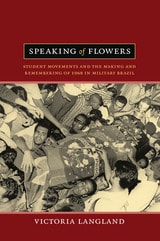
cover of Speaking of Flowers: Student Movements and the Making and Remembering of 1968 in Military Brazil

Speaking of Flowers

Student Movements and the Making and Remembering of 1968 in Military Brazil

Victoria Langland

Duke University Press, 2013

Speaking of Flowers is an innovative study of student activism during Brazil's military dictatorship (1964–85) and an examination of the very notion of student activism, which changed dramatically in response to the student protests of 1968. Looking into what made students engage in national political affairs as students, rather than through other means, Victoria Langland traces a gradual, uneven shift in how they constructed, defended, and redefined their right to political participation, from emphasizing class, race, and gender privileges to organizing around other institutional and symbolic forms of political authority.

Embodying Cold War political and gendered tensions, Brazil's increasingly violent military government mounted fierce challenges to student political activity just as students were beginning to see themselves as representing an otherwise demobilized civil society. By challenging the students' political legitimacy at a pivotal moment, the dictatorship helped to ignite the student protests that exploded in 1968. In her attentive exploration of the years after 1968, Langland analyzes what the demonstrations of that year meant to later generations of Brazilian students, revealing how student activists mobilized collective memories in their subsequent political struggles.
[more]
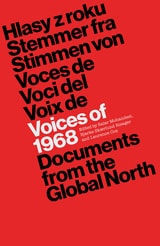
cover of Voices of 1968: Documents from the Global North

Voices of 1968

Documents from the Global North

Edited by Laurence Cox, Salar Mohandesi and Bjarke Skaerlund Risager

Pluto Press, 2018

The year 1968 marked one of the great upheavals of twentieth-century politics and culture. Across the world, people rebelled against postwar conformity and patriarchy, against the authoritarian university and factory work, and against the Cold War and state power. The legacy of 1968 endures in many of today’s social movements and struggles, and yet it is often misunderstood, the realities of the time turned to caricature.

Voices of 1968 is a vivid collection of key texts from the movements and uprisings of “the long 1968.” Emphasizing the transnational linkages between these struggles, the primary documents of this collection delve into events that took place as far afield as Italy, France, West Germany, the United States, Mexico, Canada, Britain, Northern Ireland, Denmark, Czechoslavakia, Yugoslavia, and Japan. This wealth of material is supported by framing essays helping readers to find their way around the era’s revolutionary ideas and to understand their legacy in politics, culture, and society today. Featuring many texts that have never been seen in English before, this remarkable collection is published to coincide with the fiftieth anniversary of the events of 1968.
 
[more]
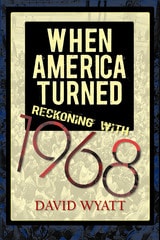
cover of When America Turned: Reckoning with 1968

When America Turned

Reckoning with 1968

David Wyatt

University of Massachusetts Press, 2013

Much has been written about the seismic shifts in American culture and politics during the 1960s. Yet for all the analysis of that turbulent era, its legacy remains unclear. In this elegantly written book, David Wyatt offers a fresh perspective on the decade by focusing on the pivotal year of 1968. He takes as his point of departure the testimony delivered by returning veteran John Kerry before the Senate Armed Services Committee in 1971, as he imagined a time in the future when the word "Vietnam" would mean "the place where America finally turned." But turning from what, to what—and for better or for worse?

Wyatt explores these questions as he retraces the decisive moments of 1968—the Tet Offensive, the McCarthy campaign, the assassinations of Martin Luther King Jr. and Robert Kennedy, the student revolt at Columbia, the "police riot" at the Democratic Convention in Chicago, Lyndon Johnson's capitulation, and Richard Nixon's ascendency to power. Seeking to recover the emotions surrounding these events as well as analyze their significance, Wyatt draws on the insights of what Michael Herr has called "straight" and "secret" histories. The first category consists of work by professional historians, traditional journalists, public figures, and political operatives, while the second includes the writings of novelists, poets, New Journalists, and memoirists.

The aim of this parallel approach is to uncover two kinds of truth: a "scholarly truth" grounded in the documented past and an "imaginative truth" that occupies the more ambiguous realm of meaning. Only by reckoning with both, Wyatt believes, can Americans come to understand the true legacy of the 1960s.
[more]