Results by title
10 books match the query 'Nineteenth - Century United States'
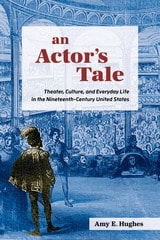
An Actor's Tale
Theater, Culture, and Everyday Life in the Nineteenth-Century United StatesAmy Hughes
University of Michigan Press, 2025
Ultimately, Hughes reveals how this actor’s tale illuminates the widespread tendency to ignore, deny, and forgive White male mediocrity in US culture, and how a deeper understanding of people like Watkins can transform our understanding of the past—and our understanding of ourselves.
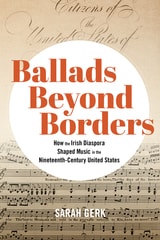
Ballads Beyond Borders
How the Irish Diaspora Shaped Music in the Nineteenth-Century United StatesSarah Gerk
University of Illinois Press, 2026
Gerk opens by considering the popularity of Thomas Moore’s iconic collection Irish Melodies in relation to the history of British colonization shared by the US and Ireland, arguing that these songs modeled what the music of an Anglo-Celtic republic could sound like. She considers blackface minstrelsy’s complicated relationship with both Irish-American performers and theatrical stereotypes of Irish people, and positions Irish-American performers and audiences as a primary driving force in new musical styles in 1840s sheet music, in which minstrelsy’s resemblances to Anglo-Celtic traditional music disappeared. She examines the legacy of the Great Famine in music of the US Civil War, considering how that music’s role in emotional life offers robust source material for understanding famine memory. She explores the increasingly elaborate sketches in the 1870s and 1880s of the variety duo Harrigan and Hart, highlighting ways in which violent conflict between the Black community and the Irish lies at the very heart of the Mulligan entertainments. Finally, she contextualizes the work of Irish-American tenor Chauncey Olcott, showing how a number of confluent trends—the growing wealth and social status of Irish-American middle classes, the Gaelic revival, new immigration patterns, and the consolidation of the US’s sheet music industry—allowed Olcott to perform an elevated version of Irish-American musical culture, influenced by superficial elements of Italian operatic music.
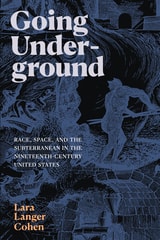
Going Underground
Race, Space, and the Subterranean in the Nineteenth-Century United StatesLara Langer Cohen
Duke University Press, 2023

How the Earth Feels
Geological Fantasy in the Nineteenth-Century United StatesDana Luciano
Duke University Press, 2024
Law and the Conditions of Freedom in the Nineteenth-Century United States
James Willard Hurst
University of Wisconsin Press, 1964
In these essays J. Willard Hurst shows the correlation between the conception of individual freedom and the application of law in the nineteenth-century United States—how individuals sought to use law to increase both their personal freedom and their opportunities for personal growth. These essays in jurisprudence and legal history are also a contribution to the study of social and intellectual history in the United States, to political science, and to economics as it concerns the role of public policy in our economy. The nonlawyer will find in them demonstration of how "technicalities" express deep issues of social values.

Law and the Conditions of Freedom in the Nineteenth-Century United States
J. Willard Hurst
University of Wisconsin Press, 1956
In these essays J. Willard Hurst shows the correlation between the conception of individual freedom and the application of law in the nineteenth-century United States—how individuals sought to use law to increase both their personal freedom and their opportunities for personal growth. These essays in jurisprudence and legal history are also a contribution to the study of social and intellectual history in the United States, to political science, and to economics as it concerns the role of public policy in our economy. The nonlawyer will find in them demonstration of how "technicalities" express deep issues of social values.
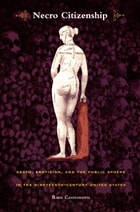
Necro Citizenship
Death, Eroticism, and the Public Sphere in the Nineteenth-Century United StatesRuss Castronovo
Duke University Press, 2001
Moving from medical engravings, séances, and clairvoyant communication to Supreme Court decisions, popular literature, and physiological tracts, Necro Citizenship explores how rituals of inclusion and belonging have generated alienation and dispossession. Castronovo contends that citizenship does violence to bodies, especially those of blacks, women, and workers. “Necro ideology,” he argues, supplied citizens with the means to think about slavery, economic powerlessness, or social injustice as eternal questions, beyond the scope of politics or critique. By obsessing on sleepwalkers, drowned women, and other corpses, necro ideology fostered a collective demand for an abstract even antidemocratic sense of freedom. Examining issues involving the occult, white sexuality, ghosts, and suicide in conjunction with readings of Harriet Jacobs, Ralph Waldo Emerson, Frederick Douglass, Nathaniel Hawthorne, and Frances Harper, Necro Citizenship successfully demonstrates why Patrick Henry's “give me liberty or give me death” has resonated so strongly in the American imagination.
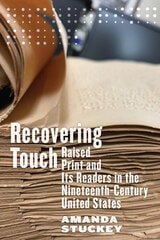
Recovering Touch
Raised Print and Its Readers in the Nineteenth-Century United StatesAmanda Stuckey
University of Massachusetts Press, 2027
Constructing a disability history of reading through the embossed books that shaped and constrained it
When the Maryland Institution for the Instruction of the Blind opened in 1853, its charter defined blindness as the inability to read ink. Embedded in that same document was a small rectangle of embossed roman letters—a “specimen of printing” that encapsulated decades of experimentation and a central contradiction: that a form of print designed to liberate visually impaired readers also asked them to read like sighted ones.
In Recovering Touch, Amanda Stuckey traces raised print developments from the first embossed book in the United States—the Gospel of St. Mark, embossed in 1833—through the late nineteenth-century War of the Dots, the contested debates among educators and administrators over which type system visually impaired readers should use. Focusing predominantly on raised roman letter systems, Stuckey brings visually impaired readers into nineteenth-century histories of reading, connecting individual acts of touch-based reading to broader histories of disability, schooling, and print culture. Embossed books promised to open the world of the printed word to readers marginalized from inked text. Yet educators often deployed these materials as tools to assimilate visually impaired students into the reading, learning, and labor standards of the sighted world.
Recovering Touch constructs a disability history of reading that centers the material conditions of touch-based reading: the paper that had to be felt rather than seen, the types that dulled over time, and the readers who adapted, repurposed, and at times defied the assimilationist expectations built into the books beneath their fingertips.
Revivalism and Cultural Change
Christianity, Nation Building, and the Market in the Nineteenth-Century United StatesGeorge M. Thomas
University of Chicago Press, 1989
"Subtle and complex. . . . Fascinating."—Randolph Roth, Pennsylvania History
"[Revivalism and Cultural Change] should be read with interest by those interested in religious movements as well as the connections among religion, economics, and politics."—Charles L. Harper, Contemporary Sociology
"Readers old and new stand to gain much from Thomas's sophisticated study of the macrosociology of religion in the United States during the nineteenth century. . . . He has given the sociology of religion its best quantitative study of revivalism since the close of the 1970s."—Journal for the Scientific Study of Religion
The Lyceum and Public Culture in the Nineteenth-Century United States
Angela G. Ray
Michigan State University Press, 2005
Angela Ray provides a refreshing new look at the lyceum lecture system as it developed in the United States from the 1820s to the 1880s. She argues that the lyceum contributed to the creation of an American "public" at a time when the country experienced a rapid change in land area, increasing immigration, and a revolution in transportation, communication technology, and social roles.
The history of the lyceum in the nineteenth century illustrates a process of expansion, diffusion, and eventual commercialization. In the late 1820s, a politically and economically dominant culture—the white Protestant northeastern middle class—institutionalized the practice of public debating and public lecturing for education and moral uplift. In the 1820s and 1830s, the lyceum was characterized by organized groups in cities and towns, particularly in the Northeast and the Old Northwest (now the Midwest). These groups were established to promote debate, to create a setting for study, and to provide a forum for members’ lecturing. By the 1840s and 1850s, however, most lyceums concentrated on the sponsorship of public lectures, presented for institutional profit as well as public instruction and entertainment. Eventually, lyceum lectures became a commercial enterprise and desirable platform for celebrities who wished to expand their incomes from lecturing.