Results by title
4 books match the query 'Nineties'

In the Nineties
John Stokes
University of Chicago Press, 1990
John Stokes's lively study is an exercise in interdisciplinary criticism inspired by the decade it observes, the decade of Wilde, Shaw, Beardsley, and Sickert. No longer dismissed as merely transitional between the Victorian and the Modern, the 1890s have now come to be recognized as unique—a period of dramatic engagement between high culture and popular forms, one medium and another, art and life.
Spurning fixed boundaries, Stokes relates the controversial topics of the day—the status of the "New Journalism," the "degenerative" influence of Impressionist painting, the dubious morality of the music hall, the urgent need for prison reform, and the prevalence of suicide—to primary literary texts, such as The Ballad of Reading Gaol, The Importance of Being Earnest, Jude the Obscure, and Portrait of a Lady. And in the process, he explores crucial areas of sociological and psychological interest: criminality, sexuality, madness, and "morbidity."
Each of the book's six chapters opens with a look at the correspondence columns of daily newspapers and goes on, with a keen eye for the hidden link, to pursue a particular theme. Locations shift from Leicester Square and the Thames embankment to the Normandy coast and the Paris morgue and feature, along with famous names, a lesser known company of acrobats, convicts, aesthetes, "philistines," and mysterious suicides.
Nearly a century later, John Stokes's unrivalled knowledge of how the arts actually functioned in the nineties makes this book a major contribution to modern cultural studies.
[more]
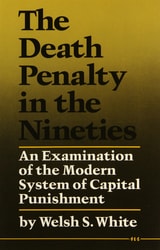
The Death Penalty in the Nineties
An Examination of the Modern System of Capital PunishmentWelsh S. White
University of Michigan Press, 1991
The Death Penalty in the Nineties: An Examination of the Modern System of Capital Punishment by Welsh S. White is a thoroughly updated and incisive assessment of America’s evolving system of capital punishment at the close of the twentieth century. Building on his acclaimed earlier work, White offers readers a clear and in-depth examination of major legal developments, Supreme Court decisions, and practical realities shaping the administration of the death penalty.Addressing dramatic changes in both the law and in patterns of execution, White explores topics such as racial discrimination, plea bargaining, the challenges of presenting mitigating evidence, prosecutorial arguments, and the controversial practice of “death-qualification” of juries. Drawing from interviews with attorneys and close analysis of real cases—such as those of Roosevelt Green and Gary Gilmore—White illuminates how the American justice system works in practice, and exposes the ongoing tensions between fairness, efficiency, public opinion, and political pressure.White’s analysis highlights not only the Supreme Court’s shifting stance—first towards expanding protections for capital defendants and then towards prioritizing expeditious executions and limiting federal review—but also the persistent issues of arbitrariness and error. He critically examines whether modern capital punishment procedures measure up to the standards of justice that a democratic society should demand.Written with clarity and balance, The Death Penalty in the Nineties is essential reading for legal scholars, practitioners, policy makers, and concerned citizens who seek to understand both the letter and the complex reality of the death penalty in the United States.
[more]
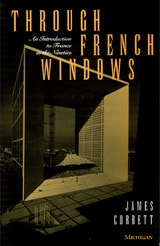
Through French Windows
An Introduction to France in the NinetiesJames Corbett
University of Michigan Press, 1994
Through French Windows is a journey into contemporary French culture and society. By describing the country's education, religion, politics, finances, technology and telecommunications, and social and ethical issues, Corbett draws a portrait of present-day France.The author provides background information necessary for understanding the changes that continue to evolve. Corbett conscientiously avoids the traditional and simplistic means of portraying France that emphasizes the cultural heritage of the country. Instead he provides an insider's view of France, separating that mythic image from the current reality. Further, he presents an accurate portrayal of the diversity of France by moving beyond the typical dichotomy between Paris and the rest of the country or the oversimplification of dividing the country into north and south.
[more]

What is to Be Done About Law and Order?
Crisis in the NinetiesJohn Lea and Jock Young
Pluto Press, 1993
The authors look at the connection between democracy and efficiency as they investigate the meaning of law and order. The authors argue that only through a democratically accountable police service can we hope to build up relationships within the inner city.
[more]