Results by title
32 books match the query 'Nonfiction (incl. Memoirs)'
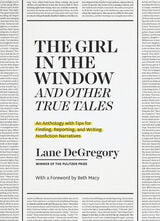
"The Girl in the Window" and Other True Tales
An Anthology with Tips for Finding, Reporting, and Writing Nonfiction NarrativesLane DeGregory
University of Chicago Press, 2023
This book—part anthology, part craft guide—provides a forensic reading of twenty-four of DeGregory’s singular stories, illustrating her tips for writers alongside pieces that put those elements under the microscope. Each of the pieces gathered here—including the Pulitzer Prize–winning title story—is accompanied by notes on how she built the story, plus tips on how nonfiction writers at all levels can do the same. Featuring a foreword by Beth Macy, author of the acclaimed Dopesick, this book is sure to delight fans of DeGregory’s writing, as well as introduce her to readers and writers who have not yet discovered her inspiring body of work.
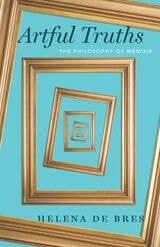
Artful Truths
The Philosophy of MemoirHelena de Bres
University of Chicago Press, 2021
Artful Truths offers a concise guide to the fundamental philosophical questions that arise when writing a literary work about your own life. Bringing a philosopher’s perspective to a general audience, Helena de Bres addresses what a memoir is, how the genre relates to fiction, memoirists’ responsibilities to their readers and subjects, and the question of why to write a memoir at all. Along the way, she delves into a wide range of philosophical issues, including the nature of the self, the limits of knowledge, the idea of truth, the obligations of friendship, the relationship between morality and art, and the question of what makes a life meaningful.
Written in a clear and conversational style, it offers a resource for those who write, teach, and study memoirs, as well as those who love to read them. With a combination of literary and philosophical knowledge, de Bres takes the many challenges directed at memoirists seriously, while ultimately standing in defense of a genre that, for all its perplexities—and maybe partly because of them—continually proves to be both beloved and valuable.
Artful Truths
The Philosophy of MemoirHelena de Bres
University of Chicago Press, 2021
Offers a philosophical perspective on the nature and value of writing a memoir.
Artful Truths offers a concise guide to the fundamental philosophical questions that arise when writing a literary work about your own life. Bringing a philosopher’s perspective to a general audience, Helena de Bres addresses what a memoir is, how the genre relates to fiction, memoirists’ responsibilities to their readers and subjects, and the question of why to write a memoir at all. Along the way, she delves into a wide range of philosophical issues, including the nature of the self, the limits of knowledge, the idea of truth, the obligations of friendship, the relationship between morality and art, and the question of what makes a life meaningful.
Written in a clear and conversational style, it offers a resource for those who write, teach, and study memoirs, as well as those who love to read them. With a combination of literary and philosophical knowledge, de Bres takes the many challenges directed at memoirists seriously, while ultimately standing in defense of a genre that, for all its perplexities—and maybe partly because of them—continually proves to be both beloved and valuable.
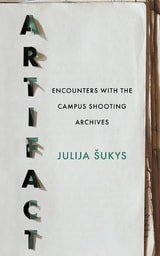
Artifact
Encounters with the Campus Shooting ArchivesJulija Šukys
West Virginia University Press, 2025
2026 IPPY Awards Bronze Medal Winner, Current Events - Social Issues/Humanitarian
2026 PROSE Award Finalist, Humanities: Literature
Artifact is about the stories we tell ourselves after mass shootings. Each college campus shooting leaves a record: archival collections, monuments to the dead, government-led inquiries, internal university investigations, and lawsuits. Artifact: Encounters with the Campus Shooting Archives seeks to understand university and college campus shootings that involve students and faculty of those institutions. The book examines the aftermaths of such attacks by moving between university archives, memorials to victims, conversations with survivors, and beyond.
Julija Šukys examines a series of five North American university and college campus shootings between 1966 and 2015: the École Polytechnique in Montreal, Concordia University in Montreal, Virginia Tech, University of Alabama–Huntsville, and Umpqua Community College in Roseburg, Oregon. These attacks involved students and faculty as both victims and perpetrators—that is, all the shooters were either faculty members or (in one case, would-be) students of the institution where the killings took place.
Šukys arrives at each site long after the killings have taken place: by now, the teddy bears, flowers, and crosses have been cleared away. Prying journalists are long gone. She sorts through myriad objects left at makeshift memorial sites. She talks for hours with a professor who survived an attack only because her colleague’s gun jammed as it was pointed at her head. She wanders and documents the reconfigured buildings made unrecognizable after the horrors that occurred within them. She reads tedious court transcripts, officious government-commissioned reports, and a troubling memoir written by a shooter’s mother and sifts through the mathematics papers that one campus shooter publishes from his prison cell.
Artifact weighs what it means to live in a place where students and their teachers are gunned down on a seemingly regular basis. It asks how we can continue to learn, teach, and live when nothing changes in response to these deaths. It attempts to speak into silence, to look at the pain of those who have come through trauma, and to meet their gazes without platitudes or triumphalism. The result is a searching book about care, memory, forgiveness, and survival.
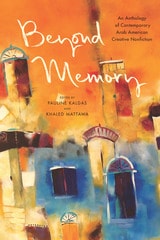
Beyond Memory
An Anthology of Contemporary Arab American Creative NonfictionPauline Kaldas
University of Arkansas Press, 2020
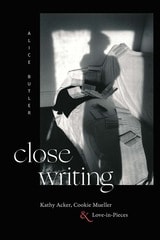
Close Writing
Kathy Acker, Cookie Mueller, and Love-in-PiecesAlice Butler
Duke University Press, 2026
Diary of a Detour
Lesley Stern
Duke University Press, 2020
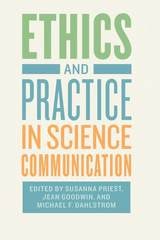
Ethics and Practice in Science Communication
Edited by Susanna Priest, Jean Goodwin, and Michael F. Dahlstrom
University of Chicago Press, 2018
In three sections—how ethics matters, professional practice, and case studies—contributors to this volume explore the many complex questions surrounding the communication of scientific results to nonscientists. Has the science been shared clearly and accurately? Have questions of risk, uncertainty, and appropriate representation been adequately addressed? And, most fundamentally, what is the purpose of communicating science to the public: Is it to inform and empower? Or to persuade—to influence behavior and policy? By inspiring scientists and science communicators alike to think more deeply about their work, this book reaffirms that the integrity of the communication of science is vital to a healthy relationship between science and society today.
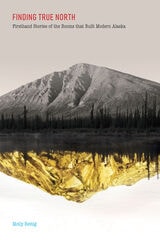
Finding True North
First-Hand Stories of the Booms that Built Modern AlaskaMolly Rettig
University of Alaska Press, 2021
Melting sea ice and rumbling volcanoes. Sled dogs racing through unnamed valleys.
These were the images that came to mind when Molly Rettig moved to Fairbanks, Alaska to work as a reporter at the local newspaper. An avid environmentalist, she couldn’t wait to explore the vast, untamed spaces that had largely been paved over on the east coast. But when her 72-year-old neighbor, Clutch, invites her on a tour of his gold mine—an 800-foot tunnel blasted into the side of his house–she begins to question many of her ideas about Alaska, and about herself.
In Finding True North, Rettig takes us on a gripping journey through Alaska's past that brings alive the state's magnificent country and its quirky, larger-than-life characters. She meets a trapper who harvests all she needs from the land, a bush pilot who taught himself how to fly, and an archaeologist who helped build an oil pipeline through pristine wilderness. While she learns how airplanes, mines, and oil fields have paved the way for newcomers like herself, she also stumbles upon a bigger question: what has this quest for Alaska’s natural resources actually cost, and how much more is at stake?
This is a book about all the ways wild places teach us about ourselves. Rettig writes both playfully and honestly about how one place can be many things to many people—and how all of it can be true.
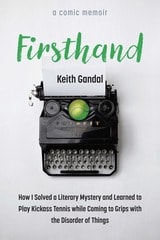
Firsthand
How I Solved a Literary Mystery and Learned to Play Kickass Tennis while Coming to Grips with the Disorder of ThingsKeith Gandal
University of Michigan Press, 2024
Keith Gandal combines this scholarly detective story with a comic personal narrative about how a midlife crisis accidentally sent him on a journey to write a research monograph that many in his profession—including at times himself—were dubious about. While researching how Hemingway, Fitzgerald, and Faulkner faced their forgotten crises of masculinity, Gandal discovers that his own crisis is instrumental to his creative process. Incorporating stories from Gandal’s comic romp through the hyper-competitive world of middle-aged men’s tennis, adopting pitbulls, and discussing Michel Foucault, Firsthand gives readers an inside look at how to acquire accurate knowledge—about the world, about history, and about oneself.
Gone Gone
Todd Meyers
Duke University Press, 2025
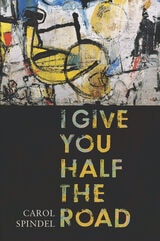
I Give You Half the Road
Carol Spindel
University of Wisconsin Press, 2021
Once considered the most stable country in West Africa, Ivory Coast was split by an armed rebellion in 2002 and endured a decade of instability and a violent conflict. Spindel provides an intimate glimpse into this turbulent period by weaving together the daily lives and paths of five neighbors. Their stories reveal Ivorians determined to reunite a divided country through reliance on mutual respect and obligation even while power-hungry politicians pursued xenophobic and anti-immigrant platforms for personal gain. Illuminating democracy as a fragile enterprise that must be continually invented and reinvented, I Give You Half the Road emphasizes the importance of connection, generosity, and forgiveness.
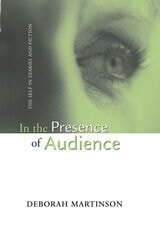
IN THE PRESENCE OF AUDIENCE
THE SELF IN DIARIES AND FICTIONDeborah Martinson
The Ohio State University Press, 2003
As a diary writer imagines shadow readers rifling diary pages, she tweaks images of the self, creating multiple readings of herself, fixed and unfixed. When the readers and potential readers are husbands and publishers, the writer maneuvers carefully in a world of men who are quick to judge and to take offense. She fills the pages with reflections, anecdotes, codes, stories, biographies, and fictions. The diary acts as a site for the writer’s tension, rebellion, and remaking of herself.
In this book Martinson examines the diaries of Virginia Woolf, Katherine Mansfield, Violet Hunt, and Doris Lessing’s fictional character Anna Wulf, and shows that these diaries (and others like them) are not entirely private writings as has been previously assumed. Rather, their authors wrote them knowing they would be read. In these four cases, the audience is the author’s male lover or husband, and Martinson reveals how knowledge of this audience affects the language and content in each diary. Ultimately, she argues, this audience enforces a certain “male censorship” which changes the shape of the revelations, the shape of the writer herself, making it impossible for the female author to be honest in writing about her true self.
Even sophisticated readers often assume that diaries are primarily private. This study interrogates the myth of authenticity and self-revelation in diaries written under the gaze of particular peekers.
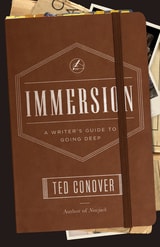
Immersion
A Writer's Guide to Going DeepTed Conover
University of Chicago Press, 2016
In immersion reporting—a literary cousin to ethnography, travel writing, and memoir—the writer fully steps into a new world or culture, participating in its trials, rites, and rituals as a member of the group. The end results of these firsthand experiences are familiar to us from bestsellers such as Nickel and Dimed and Behind the Beautiful Forevers. But in a world of wary strangers, where does one begin?
Conover distills decades of knowledge into an accessible resource aimed at writers of all levels. He covers how to “get into” a community, how to conduct oneself once inside, and how to shape and structure the stories that emerge. Conover is also forthright about the ethics and consequences of immersion reporting, preparing writers for the surprises that often surface when their piece becomes public. Throughout, Conover shares anecdotes from his own experiences as well as from other well-known writers in this genre, including Alex Kotlowitz, Anne Fadiman, and Sebastian Junger. It’s a deep-in-the-trenches book that all aspiring immersion writers should have in hand as they take that first leap into another world.
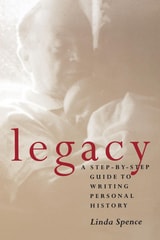
Legacy
A Step-By-Step Guide To Writing Personal HistoryLinda Spence
Ohio University Press, 1997
When Linda Spence asked her aging mother to write her life story, her mother stared at a blank sheet of paper and asked—“How? Where do I begin?” In this practical guide to capturing those memories that have been stored away, Linda Spence provides the questions that are the keys to unlocking the memories that make up a life.
Beyond the vital statistics are the personal stories that tell what it was like, what we did, and why we did it, how we feel about our choices, and what our circumstances were. Through encouraging coaching, shared memories, and open-ended questions, the process of producing a personal history becomes intriguing and engaging.
With Legacy the possibilities expand: a personal record is preserved—with its myths, traditions, joys, pains, gains, and losses; a family opens a potential dialogue that will last for generations; the writer has an opportunity for insight and resolution; the culture of a time and place is noted; the tradition of personal story is revitalized, and our present and future find nourishment and knowledge in the past.
Either as a gift that can act as a shared experience as the memories are recounted or as a personal way to take account of one’s experiences, often long since forgotten, Legacy is indeed a way to get one’s story down.
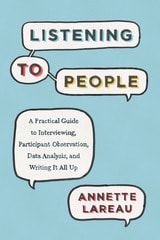
Listening to People
A Practical Guide to Interviewing, Participant Observation, Data Analysis, and Writing It All UpAnnette Lareau
University of Chicago Press, 2021
In-depth interviews and close observation are essential to the work of social scientists, but inserting one’s researcher-self into the lives of others can be daunting, especially early on. Esteemed sociologist Annette Lareau is here to help. Lareau’s clear, insightful, and personal guide is not your average methods text. It promises to reduce researcher anxiety while illuminating the best methods for first-rate research practice.
As the title of this book suggests, Lareau considers listening to be the core element of interviewing and observation. A researcher must listen to people as she collects data, listen to feedback as she describes what she is learning, listen to the findings of others as they delve into the existing literature on topics, and listen to herself in order to sift and prioritize some aspects of the study over others. By listening in these different ways, researchers will discover connections, reconsider assumptions, catch mistakes, develop and assess new ideas, weigh priorities, ponder new directions, and undertake numerous adjustments—all of which will make their contributions clearer and more valuable.
Accessibly written and full of practical, easy-to-follow guidance, this book will help both novice and experienced researchers to do their very best work. Qualitative research is an inherently uncertain project, but with Lareau’s help, you can alleviate anxiety and focus on success.
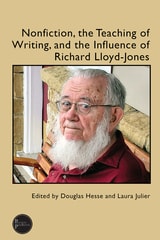
Nonfiction, the Teaching of Writing, and the Influence of Richard Lloyd-Jones
Doug Hesse
University Press of Colorado, 2023
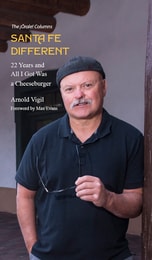
Santa Fe Different
22 Years and All I Got Was a CheeseburgerArnold Vigil
Museum of New Mexico Press, 2019
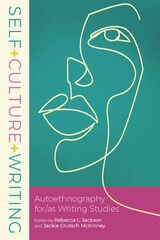
Self+Culture+Writing
Autoethnography for/as Writing StudiesRebecca Jackson
Utah State University Press, 2021
Interest in autoethnography is growing among writing studies scholars, who see clear connections to well-known disciplinary conversations about personal narrative, as well as to the narrative turn in general and social justice efforts in particular. Contributions by authors from diverse backgrounds and institutional settings are organized into three parts: a section of writing studies autoethnographies, a section on how to teach autoethnography, and a section on how ideas about autoethnography in writing studies are evolving.
Self+Culture+Writing discusses the use of autoethnography in the writing classroom as both a research method and a legitimate way of knowing, providing examples of the genre and theoretical discussions that highlight the usefulness and limitations of these methods.
Contributors: Leslie Akst, Melissa Atienza, Ross Atkinson, Alison Cardinal, Sue Doe, Will Duffy, John Gagnon, Elena Garcia, Guadalupe Garcia, Caleb Gonzalez, Lilly Halboth, Rebecca Hallman Martini, Kirsten Higgins, Shereen Inayatulla, Aliyah Jones, Autumn Laws, Soyeon Lee, Louis M. Maraj, Kira Marshall-McKelvey, Jennifer Owen, Tiffany Rainey, Marcie Sims, Amanda Sladek, Trixie Smith, Anthony Warnke
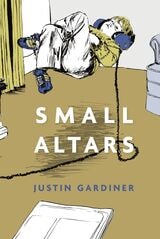
Small Altars
Justin Gardiner
Tupelo Press, 2024
In Small Altars, Justin Gardiner delves into the world of comic books and superheroes as a means for coming to terms with the many struggles of his brother’s life, as well as his untimely death, offering a lyric and honest portrayal of the tolls of mental illness, the redemptive powers of art and familial love, and the complex workings of grief.
Storycraft, Second Edition
The Complete Guide to Writing Narrative NonfictionJack Hart
University of Chicago Press, 2021
In this new edition, Hart has expanded the book’s range to delve into podcasting and has incorporated new insights from recent research into storytelling and the brain. He has also added dozens of new examples that illustrate effective narrative nonfiction.
This edition of Storycraft is also paired with Wordcraft, a new incarnation of Hart’s earlier book A Writer’s Coach, now also available from Chicago.
Storycraft
The Complete Guide to Writing Narrative NonfictionJack Hart
University of Chicago Press, 2011
From the work of the New Journalists in the 1960s, to the New Yorker essays of John McPhee, Susan Orlean, Atul Gawande, and a host of others, to blockbuster book-length narratives such as Mary Roach’s Stiff or Erik Larson’s Devil in the White City, narrative nonfiction has come into its own. Yet writers looking for guidance on reporting and writing true stories have had few places to turn for advice. Now in Storycraft, Jack Hart, a former managing editor of the Oregonian who guided several Pulitzer Prize–winning narratives to publication, delivers what will certainly become the definitive guide to the methods and mechanics of crafting narrative nonfiction.
Hart covers what writers in this genre need to know, from understanding story theory and structure, to mastering point of view and such basic elements as scene, action, and character, to drafting, revising, and editing work for publication. Revealing the stories behind the stories, Hart brings readers into the process of developing nonfiction narratives by sharing tips, anecdotes, and recommendations he forged during his decades-long career in journalism. From there, he expands the discussion to other well-known writers to show the broad range of texts, styles, genres, and media to which his advice applies. With examples that draw from magazine essays, book-length nonfiction narratives, documentaries, and radio programs, Storycraft will be an indispensable resource for years to come.
The Brazil Chronicles
Stephen G. Bloom
University of Missouri Press, 2024
As a young journalist at the Brazil Herald from 1979-81, Stephen G. Bloom spent his early professional years working in Rio’s seedy Lapa district, surrounded by fugitives, drug runners, pornographers, and stealth CIA agents. Bloom shares the wild story of this English-language newspaper in The Brazil Chronicles. The expat newspaper was a breeding ground for a different kind of storyteller — audacious risk-takers who told madcap tales of Amazon plantations, Confederate emigres, and lost Indian tribes. Several renown journalists cut their teeth at the Brazil Herald, including acclaimed New York Times correspondent Tad Szulc, Huffington Post CEO Eric Hippeau, and an untamed Gonzo reporter by the name of Hunter S. Thompson.
Drawing from extensive archival research and more than 150 interviews with his former colleagues, Bloom’s eye-opening narrative dive is both entertaining and academically rigorous. With a backdrop of coups, nonstop political instability, censorship, hyper-inflation, and weekends at sultry Ipanema Beach, The Brazil Chronicles doubles as a coming-of-age memoir, following young Bloom as he embarks on his quest to become a foreign correspondent, relocating to a foreign country to pursue under-the-radar stories and tall tales. His firsthand experience provides an insider, eye-witness account of the newspaper’s colorful history, transporting the reader to its sweltering newsroom and delving into the multifarious lives of its eclectic, trailblazing, polyglot staff.
Even as Bloom weaves between personal narrative, history, and accounts from journalism luminaries, it’s clear who the book’s main character is: the one-of-a-kind newspaper itself.
The Chicago Guide to Fact-Checking
Brooke Borel
University of Chicago Press, 2016
Corrections such as this one from the Miami Herald have become a familiar sight for readers, especially as news cycles demand faster and faster publication. While some factual errors can be humorous, they nonetheless erode the credibility of the writer and the organization. And the pressure for accuracy and accountability is increasing at the same time as in-house resources for fact-checking are dwindling. Anyone who needs or wants to learn how to verify names, numbers, quotations, and facts is largely on their own.
Enter The Chicago Guide to Fact-Checking, an accessible, one-stop guide to the why, what, and how of contemporary fact-checking. Brooke Borel, an experienced fact-checker, draws on the expertise of more than 200 writers, editors, and fellow checkers representing the New Yorker, Popular Science, This American Life, Vogue, and many other outlets. She covers best practices for fact-checking in a variety of media—from magazine articles, both print and online, to books and documentaries—and from the perspective of both in-house and freelance checkers. She also offers advice on navigating relationships with writers, editors, and sources; considers the realities of fact-checking on a budget and checking one’s own work; and reflects on the place of fact-checking in today’s media landscape.
“If journalism is a cornerstone of democracy, then fact-checking is its building inspector,” Borel writes. The Chicago Guide to Fact-Checking is the practical—and thoroughly vetted—guide that writers, editors, and publishers need to maintain their credibility and solidify their readers’ trust.
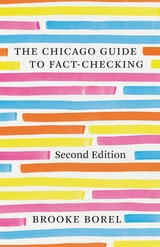
The Chicago Guide to Fact-Checking, Second Edition
Brooke Borel
University of Chicago Press, 2023
- Recognize what information to fact-check
- Identify the quality and ranking of source materials
- Learn to fact-check a variety of media types: newspaper; magazine; social media; public and commercial radio and television, books, films, etc.
- Navigate relationships with editors, writers, and producers
- Recognize plagiarism and fabrication
- Discern conflicting facts, gray areas, and litigious materials
- Learn record keeping best practices for tracking sources
- Test your own fact-checking skills
Over the past few years, fact-checking has been widely touted as a corrective to the spread of misinformation, disinformation, conspiracy theories, and propaganda through the media. “If journalism is a cornerstone of democracy,” says author Brooke Borel, “then fact-checking is its building inspector.”
In The Chicago Guide to Fact-Checking, Borel, an experienced fact-checker, draws on the expertise of more than 200 writers, editors, and fellow checkers representing the New Yorker, Popular Science, This American Life, Vogue, and many other outlets. She covers best practices for editorial fact-checking in a variety of media—from magazine and news articles, both print and online, to books and podcasts—and the perspectives of both in-house and freelance checkers.
In this second edition, Borel covers the evolving media landscape, with new guidance on checking audio and video sources, polling data, and sensitive subjects such as trauma and abuse. The sections on working with writers, editors, and producers have been expanded, and new material includes fresh exercises and advice on getting fact-checking gigs. Borel also addresses the challenges of fact-checking in a world where social media, artificial intelligence, and the metaverse may make it increasingly difficult for everyone—including fact-checkers—to identify false information. The answer, she says, is for everyone to approach information with skepticism—to learn to think like a fact-checker.
The Chicago Guide to Fact-Checking is the practical—and thoroughly vetted—guide that writers, editors, and publishers continue to consult to maintain their credibility and solidify their readers’ trust.
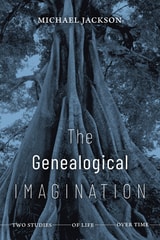
The Genealogical Imagination
Two Studies of Life over TimeMichael Jackson
Duke University Press, 2021
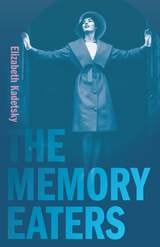
The Memory Eaters
Elizabeth Kadetsky
University of Massachusetts Press, 2020
As her mother loses her grasp on their shared history, Elizabeth Kadetsky sifts through boxes of the snapshots, newspaper clippings, pamphlets, and notebooks that remain, hoping to uncover the memories that her mother is actively losing as her dementia progresses. These remnants offer the false yet beguiling suggestion that the past is easy to reconstruct—easy to hold.
At turns lyrical, poignant, and alluring, The Memory Eaters tells the story of a family's cyclical and intergenerational incidents of trauma, secret-keeping, and forgetting in the context of 1970s and 1980s New York City. Moving from her parents' divorce to her mother's career as a Seventh Avenue fashion model and from her sister's addiction and homelessness to her own experiences with therapy for post-traumatic stress disorder, Kadetsky takes readers on a spiraling trip through memory, consciousness fractured by addiction and dementia, and a compulsion for the past salved by nostalgia.
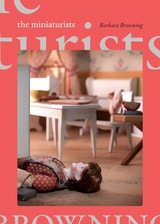
The Miniaturists
Barbara Browning
Duke University Press, 2022

Where Is the Light Coming From
Essays on Art and Regular PeopleDan Kois
Duke University Press, 2027
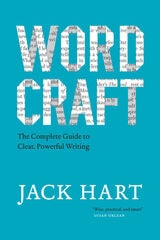
Wordcraft
The Complete Guide to Clear, Powerful WritingJack Hart
University of Chicago Press, 2021
Originally published in 2006 as A Writer’s Coach, the book has been updated to address the needs of writers well beyond print journalists. Hart breaks the writing process into a series of manageable steps, from idea to polishing. Filled with real-world examples, both good and bad, Wordcraft shows how to bring such characteristics as force, brevity, clarity, rhythm, and color to any kind of writing.
Wordcraft now functions as a set with the second edition of Hart’s book Storycraft, on the art of storytelling, also available from Chicago.
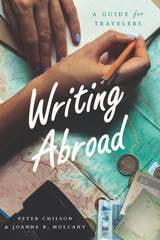
Writing Abroad
A Guide for TravelersPeter Chilson and Joanne B. Mulcahy
University of Chicago Press, 2017
Writing Abroad is meant for travelers of all backgrounds and writing levels: a student embarking on overseas study; a retiree realizing a dream of seeing China; a Peace Corps worker in Kenya. All can benefit from documenting their adventures, whether on paper or online. Through practical advice and adaptable exercises, this guide will help travelers hone their observational skills, conduct research and interviews, choose an appropriate literary form, and incorporate photos and videos into their writing.
Writing about travel is more than just safeguarding memories—it can transform experiences and tease out new realizations. With Writing Abroad, travelers will be able to deepen their understanding of other cultures and write about that new awareness in clear and vivid prose.
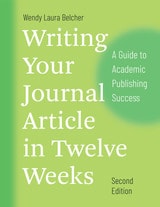
Writing Your Journal Article in Twelve Weeks, Second Edition
A Guide to Academic Publishing SuccessWendy Laura Belcher
University of Chicago Press, 2019
With this new edition, Belcher expands her advice to reach beginning scholars in even more disciplines. She builds on feedback from professors and graduate students who have successfully used the workbook to complete their articles. A new chapter addresses scholars who are writing from scratch. This edition also includes more targeted exercises and checklists, as well as the latest research on productivity and scholarly writing.
Writing Your Journal Article in Twelve Weeks is the only reference to combine expert guidance with a step-by-step workbook. Each week, readers learn a feature of strong articles and work on revising theirs accordingly. Every day is mapped out, taking the guesswork and worry out of writing. There are tasks, templates, and reminders. At the end of twelve weeks, graduate students, recent PhDs, postdoctoral fellows, adjunct instructors, junior faculty, and international faculty will feel confident they know that the rules of academic publishing and have the tools they need to succeed.