Results by title

4 books match the query 'Nontraditional Jews'
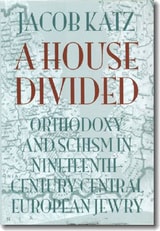
cover of A House Divided: Orthodoxy and Schism in Nineteenth-Century Central European Jewry

A House Divided

Orthodoxy and Schism in Nineteenth-Century Central European Jewry

Jacob Katz

University Press of New England, 2005
Eminent social historian Jacob Katz examines the rise and transformation of Jewish communal leadership in Central Europe. It is a story of fragmentation and polarization that sheds light on the tensions within the 19th-century Jewish community in Central Europe as it struggled to respond to the promises and perils of modernization.
[more]
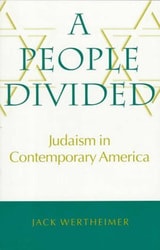
cover of A People Divided: Judaism in Contemporary America

A People Divided

Judaism in Contemporary America

Jack Wertheimer

Brandeis University Press, 1997
This brilliant analysis of American Judaism in the last half of the 20th century won the 1993-94 National Jewish Book Award for the best book on contemporary Jewry and also was named an Outstanding Book of 1993 by Choice. Jack Wertheimer examines how fundamental changes in American society have affected Jewish religious and communal life, paying special attention to contradictions and schisms that threaten the integrity of American Jewish practices and beliefs. A People Divided remains an essential primer for anyone interested in the ongoing debate about what constitutes Jewishness and who is a Jew.
[more]
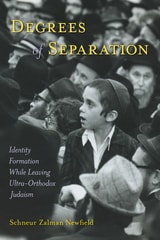
cover of Degrees of Separation: Identity Formation While Leaving Ultra-Orthodox Judaism

Degrees of Separation

Identity Formation While Leaving Ultra-Orthodox Judaism

Schneur Zalman Newfield

Temple University Press, 2020

Those who exit a religion—particularly one they were born and raised in—often find themselves at sea in their efforts to transition to life beyond their community. In Degrees of Separation, Schneur Zalman Newfield, who went through this process himself, interviews seventy-four Lubavitch and Satmar ultra-Orthodox Hasidic Jews who left their communities.He presents their motivations for leaving as well as how they make sense of their experiences and their processes of exiting, detailing their attitudes and opinions regarding their religious upbringing. Newfield also examines how these exiters forge new ways of being that their upbringing had not prepared them for, while also considering what these particular individuals lose and retain in the exit process.

Degrees of Separation presents a comprehensive portrait of the prolonged state of being “in-between” that characterizes transition out of a totalizing worldview. What Newfield discovers is that exiters experience both a sense of independence and a persistent connection; they are not completely dislocated from their roots once they “arrive” at their new destination. Moreover, Degrees of Separation shows that this process of transitioning identity has implications beyond religion.
[more]
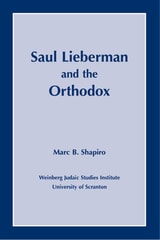
cover of Saul Lieberman and the Orthodox

Saul Lieberman and the Orthodox

Marc B. Shapiro

University of Scranton Press, 2006

One of the foremost scholars of the Talmud in the last century, Saul Lieberman (1898–1983) is also an intriguing and controversial figure. Highly influential in Orthodox society, he left Israel in 1940 to accept an appointment at the Jewish Theological Seminary, a Conservative institution. During his forty years at the Seminary, Lieberman served in the Rabbinical Assembly as one of the most important arbiters of Jewish law, though his decisions were often too progressive to be recognized by the Orthodox. Marc B. Shapiro here considers Lieberman’s experiences to examine the conflict between Jewish Orthodoxy and Conservatism in the mid-1900s. This invaluable scholarly resource also includes a Hebrew appendix and previously unpublished letters from Lieberman.
 
 
[more]