Results by title
13 books match the query 'Nonviolence'
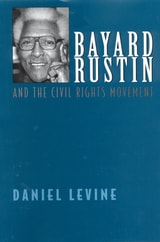
Bayard Rustin and the Civil Rights Movement
Levine, Daniel
Rutgers University Press, 1999
Rustin's long activist career began with his association with A. Phillip Randolph of the Brotherhood of Sleeping Car Porters. Then, as a member of A. J. Muste's Fellowship of Reconciliation, he participated in the "Journey of Reconciliation" (an early version of the "Freedom Rides" of 1961). He was a close associate of Martin Luther King in Montgomery and Atlanta and rose to prominence as organizer of the 1963 March on Washington. Rustin played a key role in applying nonviolent direct action to American race relations while rejecting the separatism of movements like Black Power in the 1960s, even at the risk of his being marginalized by the younger generation of civil rights activists. In his later years he tried to hold the civil rights coalition together and to fight for the economic changes he thought were necessary to decrease racism.
Daniel Levine has written the first scholarly biography that examines Rustin's public as well as private persona in light of his struggles as a gay black man and as an activist who followed his own principles and convictions. The result is a rich portrait of a complex, indomitable advocate for justice in American society.

Don't Look Away
Art, Nonviolence, and Preventive Publics in Contemporary EuropeBrianne Cohen
Duke University Press, 2023

Eyes Without Country
Searching for a Palestinian Strategy of LiberationSouad R. Dajani
Temple University Press, 1994
Since Israel's occupation of the West Bank and Gaza Strip in 1967, the quest for just and lasting peace has been a fountainhead of debate, negotiation, and violent friction. Souad Dajani traces the Palestinians' struggle and argues for a strategy of nonviolent civilian resistance based on deterrence and defense. This strategy would defeat Israel's political will to maintain their occupation and prepare Palestinians for a time beyond the interim period of self-rule agreed upon by Israel and the PLO in September 19932.
Dajani's formulation of nonviolent civilian resistance is examined against a backdrop of early developments in Mandate Palestine, the impact of Zionist ideology, and the realities of life for Palestinians under occupation. Her assessment of the role of the PLO, objectives of the Palestinian National Movement, developments since the Gulf War, and other factors crucial to an effective strategy raises critical questions surrounding the operation of nonviolent techniques for the Palestinian community, Israeli politics, and international actors, most prominently the United States.

How to Protest
Lessons on Nonviolent ActionMegan Hershey, Illustrations by Matthew Cahill
University of Wisconsin Press, 2026
Many people around the world are frustrated with their governments yet do not know what actions to take. Protest may feel out of reach, like something only seasoned activists can do. This accessible guide explores the creativity, joy, and accessibility of peaceful protest. Megan Hershey introduces readers to twenty-five specific and inspiring nonviolent protest methods through real-life examples from the past fifty years. Each chapter includes a short, vivid description of a bold nonviolent action taken by everyday people who demanded that their leaders listen to them. From patriotic choir concerts in Estonia to live painted pigs at the Ugandan parliament, these unique protest strategies will inspire those looking to effect change and offer encouragement from past successes.
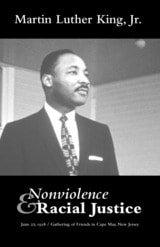
Nonviolence and Racial Justice
Martin Luther King
QuakerPress, 1958
Nonviolence
An Idea Whose Time Has ComeRamin Jahanbegloo
Haus Publishing, 2023
In this compact book, Ramin Jahanbegloo argues that the time has come for humanity to renew its political, economic, and cultural commitment to the idea of nonviolence. At the core of the work of such towering fighters against oppression as Mahatma Gandhi, Martin Luther King Jr., Nelson Mandela, the Dalai Lama, and Václav Havel, the idea of nonviolence still has much to teach us and much work to do in the ongoing fight for justice worldwide.

People Power
Unarmed Resistance and Global SolidarityHoward Clark
Pluto Press, 2009
Across the world, nonviolent movements are at the forefront of resistance against repression, imperial aggression and corporate abuse. However, it is often difficult for activists in other countries to know how best to assist such movements.
The contributors to People Power place nonviolent struggles in an international context where solidarity can play a crucial role. Yet they also warn that good intentions are not enough, solidarity has to listen to local movements.
Examining movements from Zimbabwe to Burma and Palestine, the contributors assess various forms of solidarity, arguing that a central role of solidarity is to strengthen the counter-power of those resisting domination and oppression.
Popular Resistance in Palestine
A History of Hope and EmpowermentMazin B. Qumsiyeh
Pluto Press, 2011
The book contains hundreds of stories of the heroic and highly innovative methods of resistance employed by the Palestinians over more than 100 years. The author also analyses the successes, failures, missed opportunities and challenges facing ordinary Palestinians as they struggle for freedom against incredible odds. This is the only book to critically and comparatively study the uprisings of 1920-21, 1929, 1936-9, 1970s, 1987-1991 and 2000-2006.
The compelling human stories told in this book will inspire people of all faiths and political backgrounds to chart a better and more informed direction for a future of peace with justice.
The Politics of Change in Palestine
State-Building and Non-Violent ResistanceMichael Broning
Pluto Press, 2011
This book contradicts the dominant myth that incompetent, corrupt, and uncompromising Palestinian decision-makers are responsible for the lasting stalemate in the Middle-East Peace Process. It highlights recent political developments in Palestine that fundamentally redefine important parameters of the Israeli-Palestinian conflict.
Contrary to public perception, new political trends in the Palestinian Territories bolster prospects for the realisation of Palestinian national aspirations. Michael Bröning identifies key indicators which fundamentally question dominant Israeli narratives and pose an unprecedented strategic challenge to the Israeli leadership. These include the re-invention of Hamas, the reform of the Fatah movement, Palestinian Prime Minister Salam Fayyad’s state-building efforts and the surge of non-violent resistance against Israel.
This persuasive book forces us to reconsider the perceived wisdom that the Palestinians are powerless to influence events as they struggle for peace.

Toward an Islamic Theology of Nonviolence
In Dialogue with René GirardAdnane Mokrani
Michigan State University Press, 2022
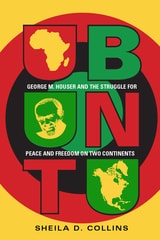
Ubuntu
George M. Houser and the Struggle for Peace and Freedom on Two ContinentsSheila D. Collins
Ohio University Press, 2020
This remarkable biography features a white American pacifist minister whose tireless work for justice and human rights helped reshape Black civil rights in the U.S. and Africa.
George M. Houser (1916–2015) was one of the most important civil rights and antiwar activists of the twentieth century. A conscientious objector during World War II, in 1942 Houser cofounded and led the Congress of Racial Equality (CORE), whose embrace of nonviolent protest strategies and tactics characterized the modern American Civil Rights Movement. Beginning in the 1950s, Houser played a critical role in pan-Africanist anticolonial movements, and his more than thirty-year dedication to the cause of human rights and self-determination helped prepare the ground for the toppling of the South African apartheid regime.
Throughout his life, Houser shunned publicity, preferring to let his actions speak his faith. Sheila Collins’s well-researched biography recounts the events that informed Houser’s life of activism—from his childhood experiences as the son of missionaries in the Philippines to his early grounding in the Social Gospel and the teachings of Mohandas Gandhi. In light of the corruption the U.S. and the world face today, Houser’s story of faith and decisive action for human rights and social justice is one for our time.

Unclenching Our Fists
Abusive Men on the Journey to NonviolenceSara Elinoff Acker
Vanderbilt University Press, 2013
Surrounding this material are chapters that provide context about the disputes among researchers about whether batterer intervention programs work (only a small number of batterers renounce their abuse) and chapters that address the reactions of partners to these stories. "When the Man You Love is Abusive" is designed to caution women not to be manipulated by accounts of change and to outline the stages men need to pass through in the long process of becoming accountable. "The Last Word: Voices of Survivors" ends the book with a focus group discussion in which former abuse victims and advocates respond candidly to the men's stories.

Voices of Dissent
An EssayRomila Thapar
Seagull Books, 2020
People have argued since time immemorial. Disagreement is a part of life, of human experience. But we now live in times when any form of protest in India is marked as anti-Indian and met with arguments that the very concept of dissent was imported into India from the West. As Romila Thapar explores in her timely historical essay, however, dissent has a long history in the subcontinent, even if its forms have evolved through the centuries.
In Voices of Dissent: An Essay, Thapar looks at the articulation of nonviolent dissent and relates it to various pivotal moments throughout India’s history. Beginning with Vedic times, she takes us from the second to the first millennium BCE, to the emergence of groups that were jointly called the Shramanas—the Jainas, Buddhists, and Ajivikas. Going forward in time, she also explores the views of the Bhakti sants and others of the fifteenth and sixteenth centuries and brings us to a major moment of dissent that helped to establish a free and democratic India: Mahatma Gandhi’s satyagraha. Then Thapar places in context the recent peaceful protests against India’s new, controversial citizenship law, maintaining that dissent in our time must be opposed to injustice and supportive of democratic rights so that society may change for the better.