Results by title
6 books match the query 'Northwest Territories'
Arctic Madness
The Anthropology of a DelusionPierre Déléage
HAU, 2020
Like the Sound of a Drum
Aboriginal Cultural Politics in Denendeh and NunavutPeter Kulchyski
University of Manitoba Press, 2005
Report of an Inquiry into an Injustice
Begade Shutagot'ine and the Sahtu TreatyPeter Kulchyski
University of Manitoba Press, 2018
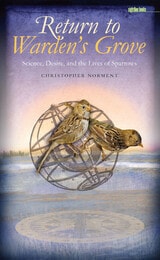
Return to Warden's Grove
Science, Desire, and the Lives of SparrowsChristopher Norment
University of Iowa Press, 2008
Based on three seasons of field research in the Canadian Arctic, Christopher Norment's exquisitely crafted meditation on science and nature, wildness and civilization, is marked by bottomless prose, reflection on timeless questions, and keen observations of the world and our place in it. In an era increasingly marked by cutting-edge research at the cellular and molecular level, what is the role for scientists of sympathetic observation? What can patient waiting tell us about ourselves and our place in the world?
His family at home in the American Midwest, Norment spends months on end living in isolation in the Northwest Territories, studying the ecology of the Harris's Sparrow. Although the fourteenth-century German mystic Meister Eckhardt wrote, "God is at home, we are in the far country," Norment argues that an intellectual, emotional, and spiritual "far country" can be found in the lives of animals and arctic wilderness. For Norment, "doing science" can lead to an enriched aesthetic and emotional connection to something beyond the self and a way to develop a sacred sense of place in a world that feels increasingly less welcoming, certain, and familiar.
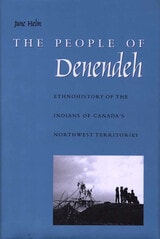
The People of Denendeh
Ethnohistory of the Indians of Canada's Northwest TerritoriesJune Helm
University of Iowa Press, 2000
Helm begins with a broad-ranging, stimulating overview of the social organization of hunter-gatherer peoples of the world, past and present, that provides a background for all she has learned about the Dene. The chapters in part 1 focus on community and daily life among the Mackenzie Dene in the middle of the twentieth century. After two historical overview chapters, Helm moves from the early years of the twentieth century to the earliest contacts between Dene and white culture, ending with a look at the momentous changes in Dene-government relations in the 1970s. Part 3 considers traditional Dene knowledge, meaning, and enjoyments, including a chapter on the Dogrib hand game. Throughout, Helm's encyclopedic knowledge combines with her personal interactions to create a collection that is unique in its breadth and intensity.
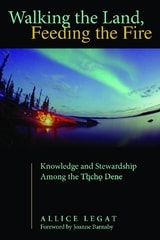
Walking the Land, Feeding the Fire
Knowledge and Stewardship Among the Tlicho DeneBy Allice Legat; Foreword by Joanne Barnaby
University of Arizona Press, 2012
In the Dene worldview, relationships form the foundation of a distinct way of knowing. For the Tlicho Dene, indigenous peoples of Canada's Northwest Territories, as stories from the past unfold as experiences in the present, so unfolds a philosophy for the future. Walking the Land, Feeding the Fire vividly shows how—through stories and relationships with all beings—Tlicho knowledge is produced and rooted in the land.
Tlicho-speaking people are part of the more widespread Athapaskan-speaking community, which spans the western sub-arctic and includes pockets in British Columbia, Alberta, California, and Arizona. Anthropologist Allice Legat undertook this work at the request of Tlicho Dene community elders, who wanted to provide younger Tlicho with narratives that originated in the past but provide a way of thinking through current critical land-use issues. Legat illustrates that, for the Tlicho Dene, being knowledgeable and being of the land are one and the same.
Walking the Land, Feeding the Fire marks the beginning of a new era of understanding, drawing both connections to and unique aspects of ways of knowing among other Dene peoples, such as the Western Apache. As Keith Basso did with his studies among the Western Apache in earlier decades, Legat sets a new standard for research by presenting Dene perceptions of the environment and the personal truths of the storytellers without forcing them into scientific or public-policy frameworks. Legat approaches her work as a community partner—providing a powerful methodology that will impact the way research is conducted for decades to come—and provides unique insights and understandings available only through traditional knowledge.