Results by title
3 books match the query 'Nothingness'
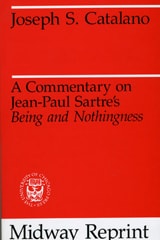
A Commentary on Jean-Paul Sartre's Being and Nothingness
Joseph S. Catalano
University of Chicago Press, 1985
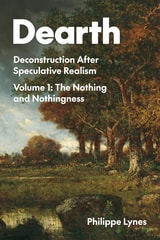
Dearth
Deconstruction After Speculative Realism. The Nothing and NothingnessPhilippe Lynes
Northwestern University Press, 2026
Proposing a radical reconceptualization of deconstruction and nothingness
The first of two volumes exploring Jacques Derrida’s prefiguration of speculative realism, The Nothing and Nothingness examines the transcendental naturalism of Ray Brassier and Iain Hamilton Grant and the speculative materialism of Quentin Meillassoux. Philippe Lynes proposes nothing less than a radical reconceptualization of deconstruction as a call to bear witness to nothingness: let the earth be the earth, let nature be nature, and leave them to their reality, secrecy, and withdrawal without us.
Dearth: Deconstruction After Speculative Realism argues that Derrida’s seminars on Martin Heidegger and Maurice Blanchot, La Chose (The Thing), anticipated many of the philosophical, literary, and aesthetic questions animating speculative realism today: an anti-anthropocentric critique of Kantian correlationism; an overcoming of the apocalyptic nihilism of extinction through a deeper, affirmative habituation to nothingness; and poignant reflections on the literary and poetic aspects of living and dying in impossible worlds. His is an anti-correlationist plea that resounds now more urgently than ever.
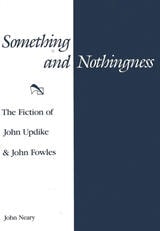
Something and Nothingness
The Fiction of John Updike and John FowlesJohn Neary
Southern Illinois University Press, 1992
John Neary shows that the theological dichotomy of via negativa (which posits the authentic experience of God as absence, darkness, silence) and via affirmativa (which emphasizes presence, images, and the sounds of the earth) is an overlooked key to examining and comparing the works of John Fowles and John Updike.
Drawing on his extensive knowledge of both Christian and secular existentialism within the modern theology of Barth and Levinas and the contemporary critical theory of Derrida and J. Hillis Miller, Neary demonstrates the ultimate affinity of these authors who at first appear such opposites. He makes clear that Fowles’s postmodernist, metafictional experiments reflect the stark existentialism of Camus and Sartre while Updike’s social realism recalls Kierkegaard’s empirical faith in a generous God within a kind of Christian deconstructionism.
Neary’s perception of uncanny similarities between the two authors—whose respective careers are marked by a series of novels that structurally and thematically parallel each other—and the authors’ shared long-term interest in existentialism and theology support both his critical comparison and his argument that neither author is "philosophically more sophisticated nor aesthetically more daring."