Results by title
7 books match the query 'Nuclear arms control'
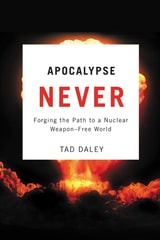
Apocalypse Never
Forging the Path to a Nuclear Weapon-Free WorldDaley, Tad
Rutgers University Press, 2012
Apocalypse Never illuminates why we must abolish nuclear weapons, how we can, and what the world will look like after we do. The twenty-first century has ushered in a world at the atomic edge. The pop culture days of Dr. Strangelove have been replaced by the all-too-real single day of 24. Tad Daley has written a book for the general reader about this most crucial of contemporary challenges.
Apocalypse Never maintains that the abolition of nuclear weapons is both essential and achievable, and reveals in fine detail what we need to do--both governments and movements--to make it a reality. Daley insists that while global climate change poses the single greatest long-term peril to the human race, the nuclear challenge in its many incarnation--nuclear terror, nuclear accident, a nuclear crisis spinning out of control--poses the single most immediate peril. Daley launches a wholesale assault on the nuclear double standard--the notion that the United States permits itself thousands of these weapons but forbids others from aspiring to even one--insisting that it is militarily unnecessary, morally indefensible, and politically unsustainable. He conclusively repudiates the most frequent objection to nuclear disarmament, "the breakout scenario"--the possibility that after abolition someone might whip back the curtain, reveal a dozen nuclear warheads, and proceed to "rule the world."
On the wings of a brand new era in American history, Apocalypse Never makes the case that a comprehensive nuclear policy agenda from President Obama, one that fully integrates nonproliferation with disarmament, can both eliminate immediate nuclear dangers and set us irreversibly on the road to abolition. In jargon-free language, Daley explores the possible verification measures, enforcement mechanisms, and governance structures of a nuclear weapon-free world. Most importantly, he decisively argues that universal nuclear disarmament is something we can transform from a utopian fantasy into a concrete political goal.
[more]
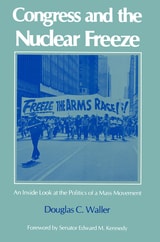
Congress and the Nuclear Freeze
An Inside Look at the Politics of a Mass MovementDouglas Waller
University of Massachusetts Press, 1987
Early in 1982 a group of lawmakers introduced into both houses of the U.S. Congress a resolution calling on the United States and the Soviet Union to negotiate a mutual and verifiable halt to the nuclear arms race. It was a bold measure and one that sparked intense debate between members of Congress and the White House over the conduct of U.S. arms control policy. This book is an inside account of that legislative battle, told by a congressional aide who was in the thick of it.
[more]
Tacit Bargaining, Arms Races, and Arms Control
George W. Downs and David M. Rocke
University of Michigan Press, 1990
When most people, including social scientists, reflect on the ways that nations resolve their differences, they tend to think in terms of polar alternatives: war versus negotiation. This perspective ignores a third path: tacit bargaining, which is applicable, as this book shows, to a wide variety of international issues and is especially germane to the problem of treaty maintenance.
[more]
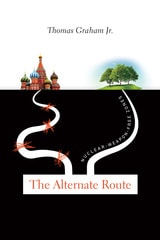
The Alternate Route
Thomas Graham
Oregon State University Press, 2017
Eventual achievement of nuclear disarmament has been an objective and a dream of the world community since the dawn of the Nuclear Age. Considerable progress has been made over the decades, but this has always required close US-Russian cooperation. At present, further progress is likely blocked by the return of Vladimir Putin to the Russian presidency and the toxic US-Russia relationship.
The classic road toward nuclear disarmament appears to be closed for the foreseeable future, but there may be another route. In the last fifty years, well-conceived regional treaties have been developed in Latin America, the South Pacific, Africa, Southeast Asia, and Central Asia. These arrangements have developed for many and varied political and security reasons, but now virtually all of the Southern Hemisphere and important parts of the Northern Hemisphere are legally nuclear-weapon-free. These regional nuclear weapon disarmament treaties are formally respected by the five states recognized under the Non-Proliferation Treaty (NPT) as nuclear weapon states: the United States, the United Kingdom, Russia, France, and China—often referred to collectively as the P-5 states.
Variations of these regional treaties might eventually be negotiated in the Middle East, Northeast Asia, and South Asia, setting aside the P-5 states until the very end of the process. With regional agreements in place around the globe, negotiation among the P-5 states would be all that stands between the world community and the banishment of nuclear weapons, verifiably and effectively worldwide. By the time this point is reached, Russia and the United States might be able to cooperate.
Essential reading for policy advisors, foreign service professionals, and scholars in political science, The Alternate Route examines the possibilities of nuclear-weapon-free zones as a pathway to worldwide nuclear disarmament.
[more]
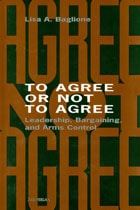
To Agree or Not to Agree
Leadership, Bargaining, and Arms ControlLisa A. Baglione
University of Michigan Press, 1999
Why were the leaders of the United States and the Soviet Union able to negotiate a series of arms control agreements despite the deep and important differences in their interests during the Cold War? Lisa A. Baglione considers a variety of explanations for the successes--and failures--of these negotiations drawn from international relations theories. Focusing on the goals and strategies of individual leaders--and their ability to make these the goals and strategies of their nation--the author develops a nuanced understanding that better explains the outcome of these negotiations. Baglione then tests her explanation in a consideration of negotiations surrounding the banning of above-ground nuclear tests, the Strategic Arms Limitation Talks of the 1970s, the negotiations for the limitation of intermediate-range nuclear forces in the 1980s, and the last negotiations between the Americans and the disintegrating Soviet Union in 1990 and 1991. How these great rivals were able to negotiate significant arms control agreements not only will shed light on international relations during an important period of history but will help us understand how such agreements might develop in the post-Cold War period, when arms proliferation has become a serious problem.
This book will appeal to scholars of international relations and arms control as well as those interested in bargaining and international negotiations and contemporary military history.
Lisa A. Baglione is Assistant Professor of Political Science, St. Joseph's University.
[more]
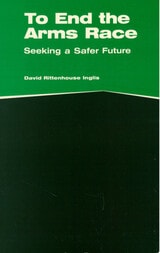
To End the Arms Race
Seeking a Safer FutureDavid Rittenhouse Inglis
University of Michigan Press, 1986
Since participating in the original development of the atomic bomb at Los Alamos over forty years ago, David Inglis has written more than sixty articles on various aspects of the subject. These articles not only provide a useful background for specific issues of the arms race, but also point out missed opportunities for making our future safer and the major obstacles in reaching any agreements in arms reduction. This book is built around selections from those articles.
[more]

West European Arms Control Policy
Robbin F. Laird, ed.
Duke University Press, 1990
European arms control policy and domestic policy processes in the four major West European countries (the United Kingdom, France, West Germany, and Italy) are assessed in this study, based on extensive interviews with governmental and opinion-making leaders in these four nations. The interview data are unique and make possible for the first time this kind of analysis of West European defense policy.
The contributors assess the impact of the INF treaty and arms control developments since the Reagan-Gorbachev meeting in Reykjavik.
The contributors assess the impact of the INF treaty and arms control developments since the Reagan-Gorbachev meeting in Reykjavik.
[more]