Results by title
10 books match the query 'Nuclear disarmament'
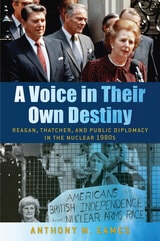
A Voice in Their Own Destiny
Reagan, Thatcher, and Public Diplomacy in the Nuclear 1980sAnthony M. Eames
University of Massachusetts Press, 2023
On June 8, 1982, Ronald Reagan delivered a historic address to the British Parliament, promising that the United States would give people around the world “a voice in their own destiny” in the struggle against Soviet totalitarianism. While British Prime Minister Margaret Thatcher celebrated Reagan’s visit and thanked him for putting “freedom on the offensive,” over 100,000 Britons marched from Hyde Park to Trafalgar Square to protest his arrival and call for nuclear disarmament. Reagan’s homecoming was equally eventful, with 1,000,000 protesters marking his return with a rally for nuclear disarmament in Central Park—the largest protest in American history up to that point.
Employing a wide range of previously unexamined primary sources, Anthony M. Eames demonstrates how the Reagan and Thatcher administrations used innovations in public diplomacy to build back support for their foreign policy agendas at a moment of widespread popular dissent. A Voice in Their Own Destiny traces how competition between the governments of Reagan and Thatcher, the Anglo-American antinuclear movement, and the Soviet peace offensive sparked a revolution in public diplomacy.
Apocalypse Never
Forging the Path to a Nuclear Weapon-Free WorldDaley, Tad
Rutgers University Press, 2012
Apocalypse Never maintains that the abolition of nuclear weapons is both essential and achievable, and reveals in fine detail what we need to do--both governments and movements--to make it a reality. Daley insists that while global climate change poses the single greatest long-term peril to the human race, the nuclear challenge in its many incarnation--nuclear terror, nuclear accident, a nuclear crisis spinning out of control--poses the single most immediate peril. Daley launches a wholesale assault on the nuclear double standard--the notion that the United States permits itself thousands of these weapons but forbids others from aspiring to even one--insisting that it is militarily unnecessary, morally indefensible, and politically unsustainable. He conclusively repudiates the most frequent objection to nuclear disarmament, "the breakout scenario"--the possibility that after abolition someone might whip back the curtain, reveal a dozen nuclear warheads, and proceed to "rule the world."
On the wings of a brand new era in American history, Apocalypse Never makes the case that a comprehensive nuclear policy agenda from President Obama, one that fully integrates nonproliferation with disarmament, can both eliminate immediate nuclear dangers and set us irreversibly on the road to abolition. In jargon-free language, Daley explores the possible verification measures, enforcement mechanisms, and governance structures of a nuclear weapon-free world. Most importantly, he decisively argues that universal nuclear disarmament is something we can transform from a utopian fantasy into a concrete political goal.
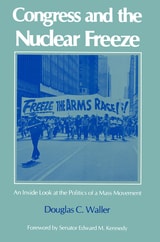
Congress and the Nuclear Freeze
An Inside Look at the Politics of a Mass MovementDouglas Waller
University of Massachusetts Press, 1987

Empire and the Bomb
How the U.S. Uses Nuclear Weapons to Dominate the WorldJoseph Gerson
Pluto Press, 2007
Gerson reveals how and why the United States made more than twenty threats of nuclear attack during the Cold War---against Russia, China, Vietnam, and the Middle East. He shows how such threats continued under Presidents Bush, Clinton, and George W. Bush.
The book concludes with an appeal for the abolition of nuclear weapons and an overview of the history of the anti-nuclear movement. Drawing from a wide range of sources, including extensive government documents, this fascinating and timely account shows how the United States has used nuclear weapons to dominate the world.
Read a review of Empire and the Bomb:
http://www.jamesclayfuller.com/2007/09/terrifying-book-but-read-it-anyway.html
Nuclear Freeze in a Cold War
The Reagan Administration, Cultural Activism, and the End of the Arms RaceWilliam M. Knoblauch
University of Massachusetts Press, 2017
Alarmed, the Reagan administration worked to co-opt the rhetoric of the nuclear freeze and contain antinuclear activism. Recently declassified White House memoranda reveal a concerted campaign to defeat activists' efforts. In this book, William M. Knoblauch examines these new sources, as well as the influence of notable personalities like Carl Sagan and popular culture such as the film The Day After, to demonstrate how cultural activism ultimately influenced the administration's shift in rhetoric and, in time, its stance on the arms race.

Open Skies
Eisenhower's Proposal of July 21, 1955By W.W. Rostow
University of Texas Press, 1982
In 1955 the United States and the Soviet Union were matching steps in a race to develop missiles tipped with thermonuclear weapons. American officials were frustrated and alarmed by their inability to learn the scale and progress of the Soviet program, which directly threatened the security of the United States, and they were convinced that serious arms control measures required reliable means for mutual inspection. The result: President Dwight D. Eisenhower's dramatic Open Skies proposal, advanced—and rejected—at the Geneva summit of 1955.
Vetoed by Nikita Khrushchev, Eisenhower's proposal to allow mutual aerial inspection between the United States and the U.S.S.R. was accepted as policy only after satellite photography became feasible. But at the time of the 1955 summit, it was a stunning, if transient, psychological and political victory for the United States and its president.
W. W. Rostow was an active participant in this important episode in American history, and his is the first authoritative account of how Eisenhower's Open Skies proposal came to be. His insider's knowledge, combined with data from hitherto unexploited documentary sources, vividly brings to life the discussions and events that preceded the president's proposal.
Rostow explores the diplomatic forces that led to Eisenhower's reluctant acceptance of a summit with the Soviets. He tracks the origins of the Open Skies concept to an obscure meeting organized at Quantico Marine Corps Base by presidential adviser Nelson Rockefeller. He describes the tensions between Rockefeller and Secretary of State John Foster Dulles that complicated Eisenhower's task in mounting the initiative for Open Skies and explains the differences between Eisenhower himself and Rockefeller over postsummit policy that provoked the latter's resignation. He examines Soviet motives and objectives at Geneva. Finally, Rostow reflects on the meaning of this fascinating episode in American history, in particular its importance to later arms control negotiations.
Redefining Science
Scientists, the National Security State, and Nuclear Weapons in Cold War AmericaPaul Rubinson
University of Massachusetts Press, 2016
The Cold War forced scientists to reconcile their values of internationalism and objectivity with the increasingly militaristic uses of scientific knowledge. For decades, antinuclear scientists pursued nuclear disarmament in a variety of ways, from grassroots activism to transnational diplomacy and government science advising. The U.S. government ultimately withstood these efforts, redefining science as a strictly technical endeavor that enhanced national security and deeming science that challenged nuclear weapons on moral grounds “emotional” and patently unscientific. In response, many activist scientists restricted themselves to purely technical arguments for arms control. When antinuclear protest erupted in the 1980s, grassroots activists had moved beyond scientific and technical arguments for disarmament. Grounding their stance in the idea that nuclear weapons were immoral, they used the “emotional” arguments that most scientists had abandoned.
Redefining Science shows that the government achieved its Cold War “consensus” only by active opposition to powerful dissenters and helps explain the current and uneasy relationship between scientists, the public, and government in debates over issues such as security, energy, and climate change.
The Alternate Route
Thomas Graham
Oregon State University Press, 2017
The classic road toward nuclear disarmament appears to be closed for the foreseeable future, but there may be another route. In the last fifty years, well-conceived regional treaties have been developed in Latin America, the South Pacific, Africa, Southeast Asia, and Central Asia. These arrangements have developed for many and varied political and security reasons, but now virtually all of the Southern Hemisphere and important parts of the Northern Hemisphere are legally nuclear-weapon-free. These regional nuclear weapon disarmament treaties are formally respected by the five states recognized under the Non-Proliferation Treaty (NPT) as nuclear weapon states: the United States, the United Kingdom, Russia, France, and China—often referred to collectively as the P-5 states.
Variations of these regional treaties might eventually be negotiated in the Middle East, Northeast Asia, and South Asia, setting aside the P-5 states until the very end of the process. With regional agreements in place around the globe, negotiation among the P-5 states would be all that stands between the world community and the banishment of nuclear weapons, verifiably and effectively worldwide. By the time this point is reached, Russia and the United States might be able to cooperate.
Essential reading for policy advisors, foreign service professionals, and scholars in political science, The Alternate Route examines the possibilities of nuclear-weapon-free zones as a pathway to worldwide nuclear disarmament.

The Dynamics of Deterrence
Frank C. Zagare
University of Chicago Press, 1987
The Dynamics of Deterrence is the first comprehensive treatment of deterrence theory since the mid-1960s. Frank C. Zagare introduces a new theoretical framework for deterrence that is rigorous, consistent, and illuminating. By placing the deterrence relationship in a "theory of moves" framework, Zagare is able to remedy the defects of other models. His approach is illustrated by and applied to a number of complex deterrence situations: the Berlin crisis of 1948, the Middle East crises of 1967 and 1973, and The Falkland/Malvinas crisis of 1980. He also examines the strategic relationship between the United States and the Soviet Union from 1945 to the present.
Zagare studies the dynamics of both mutual and unilateral deterrence games in nuclear and non-nuclear situations, and the impact of credibility, capability, and power asymmetries on deterrence stability. He shows that his theory is applicable for analyzing deterrence situations between allies as well as between hostile states. One of the additional strengths of his model, however, is its general usefulness for other levels and settings, such as deterrence games played by husband and wife, parent and child, employer and employee, and the state and its citizens. With its lucid prose and illustrative examples, The Dynamics of Deterrence will be of interest to a wide audience in international relations, peace studies, and political science.

To End the Arms Race
Seeking a Safer FutureDavid Rittenhouse Inglis
University of Michigan Press, 1986