Results by title
4 books match the query 'O'Hara, Daniel T.'
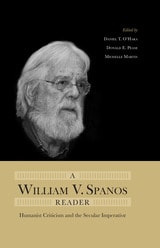
A William V. Spanos Reader
Humanist Criticism and the Secular ImperativeEdited by Daniel T. O'Hara, Donald E. Pease, Michelle Martin
Northwestern University Press, 2015
The American critic William V. Spanos, a pioneer of postmodern theory and co-founder of one of its principal organs, the journal boundary 2, is, in the words of A William V. Spanos Reader coeditor Daniel T. O’Hara, everything that current post-modern theory is accused of not being: polemical, engaged, prophetic, passionate. Informed by his experience as a prisoner of war in Dresden, Spanos saw dire con-sequences for life in modernist aesthetic experiments, and he thereafter imbued his work with a constructive aspect ever in the name of more life.
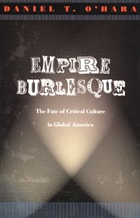
Empire Burlesque
The Fate of Critical Culture in Global AmericaDaniel T. O Hara
Duke University Press, 2003
Empire Burlesque presents several interrelated analyses through readings of a range of writers and cultural figures including Henry James, Freud, Said, De Man, Derrida, and Cordwainer Smith (an academic, spy, and classic 1950s and 1960s science fiction writer). It describes the debilitating effects of globalization on the university in general and the field of literary studies in particular, it critiques literary studies’ embrace of globalization theory in the name of a blind and vacant modernization, and it meditates on the ways critical reading and writing can facilitate an imaginative alternative to institutionalized practices of modernization. Drawing on Lacanian psychoanalytical theory, it diagnoses contemporary American Studies as typically driven by the mindless abjection and transference of professional identities.
A provocative commentary on contemporary cultural criticism, Empire Burlesque will inform debates on the American university across the humanities, particularly among those in literary criticism, cultural studies, and American studies.
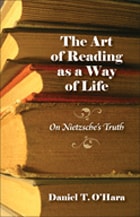
The Art of Reading as a Way of Life
On Nietzsche's TruthDaniel T. O'Hara
Northwestern University Press, 2009
The shape of this critical tracing begins, however, in the middle of his career with The Gay Science andmoves on to Thus Spoke Zarathustra, which Nietzsche believed was the central work of his life. It then revalues Ecce Homo, Nietzsche’s final autobiographical statement about his life and career, and concludes with a comparative analysis of two works from the beginning and end of that career: respectively, The Birth of Tragedy and The Anti-Christ. O’Hara’s highly original study, which uses Badiou’s theory of the truth-event as a guide, will surely provoke larger conversations across many disciplines.

Thinking through Art
Aesthetic Agency and Global Modernity, Volume 25Daniel T. O’Hara and Alan Singer, eds.
Duke University Press, 0
Included in this volume are considerations of the relation between theories of art and the avant-garde; art’s relation to cognition; the aesthetic as history; the aesthetic as a unique access to modernity; and its impact on problems of identity formation, ideology, and resistances to the institutional powers inherent in dominant social formations.
Contributors. Charles Altieri, Peter Burger, David Carroll, Anthony J. Cascardi, Howard Caygill, Allen Dunn, Eric Gans, Agnes Heller, Ronald A. T. Judy, Marie-Rose Logan, Daniel T. O’Hara, Donald E. Pease, Alan Singer