Results by title

7 books match the query 'Occupational training'
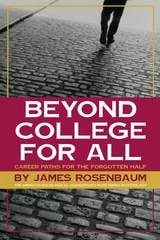
cover of Beyond College For All: Career Paths for the Forgotten Half

Beyond College For All

Career Paths for the Forgotten Half

James E. Rosenbaum

Russell Sage Foundation, 2001
In a society where everyone is supposed to go to college, the problems facing high school graduates who do not continue their education are often forgotten. Many cannot find jobs, and those who do are often stuck in low-wage, dead-end positions. Meanwhile employers complain that high school graduates lack the necessary skills for today's workplace. Beyond College for All focuses on this crisis in the American labor market. Around the world, author James E. Rosenbaum finds, employers view high school graduates as valuable workers. Why not here? Rosenbaum reports on new studies of the interaction between employers and high schools in the United States. He concludes that each fails to communicate its needs to the other, leading to a predictable array of problems for young people in the years after graduation. High schools caught up in the college-for-all myth, provide little job advice or preparation, leading students to make unrealistic plans and hampering both students who do not go to college and those who start college but do not finish. Employers say they care about academic skills, but then do not consider grades when deciding whom to hire. Faced with few incentives to achieve, many students lapse into precisely the kinds of habits employers deplore, doing as little as possible in high school and developing poor attitudes. Rosenbaum contrasts the situation in the United States with that of two other industrialized nations-Japan and Germany-which have formal systems for aiding young people who are looking for employment. Virtually all Japanese high school graduates obtain work, and in Germany, eighteen-year-olds routinely hold responsible jobs. While the American system lacks such formal linkages, Rosenbaum uncovers an encouraging hidden system that helps many high school graduates find work. He shows that some American teachers, particularly vocational teachers, create informal networks with employers to guide students into the labor market. Enterprising employers have figures out how to use these networks to meet their labor needs, while students themselves can take steps to increase their ability to land desirable jobs. Beyond College for All suggests new policies based on such practices. Rosenbaum presents a compelling case that the problems faced by American high school graduates and employers can be solved if young people, employers, and high schools build upon existing informal networks to create formal paths for students to enter the world of work. A Volume in the American Sociological Association's Rose Series in Sociology
[more]
cover of Capitol Investments: The Marketability of Political Skills

Capitol Investments

The Marketability of Political Skills

Glenn R. Parker

University of Michigan Press, 2011

What would you do if, the very day you were hired, you knew you could be unemployed in as little as two years? You'd seek opportunities in your current job to develop a portfolio of skills and contacts in order to make yourself more attractive to future employers. Representatives and senators think about their jobs in Congress in this way, according to Glenn R. Parker.

While in office, members of Congress plan not merely for the next election but for the next stage of their careers. By networking, serving on committees, and championing particular legislation, they deliberately accumulate human capital---expertise, networks, and reputation---which later will give them bargaining power in the job market. Parker's study of the postelective careers of more than 200 former members of Congress, both U.S. representatives and senators, who have left office during the last half century shows that such strategic planning generally succeeds. In most cases, the human capital these politicians amassed while in office increased their occupational mobility and earning power.

Capitol Investments offers a sophisticated yet accessible analysis of the acquisition and marketability of political skills. It suggests that an awareness of the trade in human capital shapes an officeholder's actions as much as the desire to win another election.

Glenn R. Parker is Distinguished Professor in the Department of Political Science at Purdue University.
[more]
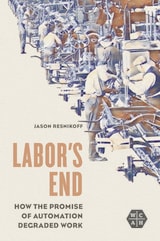
cover of Labor's End: How the Promise of Automation Degraded Work

Labor's End

How the Promise of Automation Degraded Work

Jason Resnikoff

University of Illinois Press, 2022

Labor's End traces the discourse around automation from its origins in the factory to its wide-ranging implications in political and social life. As Jason Resnikoff shows, the term automation expressed the conviction that industrial progress meant the inevitable abolition of manual labor from industry. But the real substance of the term reflected industry's desire to hide an intensification of human work--and labor's loss of power and protection--behind magnificent machinery and a starry-eyed faith in technological revolution. The rhetorical power of the automation ideology revealed and perpetuated a belief that the idea of freedom was incompatible with the activity of work. From there, political actors ruled out the workplace as a site of politics while some of labor's staunchest allies dismissed sped-up tasks, expanded workloads, and incipient deindustrialization in the name of technological progress.

A forceful intellectual history, Labor's End challenges entrenched assumptions about automation's transformation of the American workplace.
[more]
cover of Learning to Work: The Case for Reintegrating Job Training and Education

Learning to Work

The Case for Reintegrating Job Training and Education

W. Norton Grubb

Russell Sage Foundation, 1996

"Grubb's powerful vision of a workforce development system connected by vertical ladders for upward mobility adds an important new dimension to our continued efforts at system reform. The unfortunate reality is that neither our first-chance education system nor our second-chance job training system have succeeded in creating clear pathways out of poverty for many of our citizens. Grubb's message deserves a serious hearing by policy makers and practitioners alike." —Evelyn Ganzglass, National Governors' Association Over the past three decades, job training programs have proliferated in response to mounting problems of unemployment, poverty, and expanding welfare rolls. These programs and the institutions that administer them have grown to a number and complexity that make it increasingly difficult for policymakers to interpret their effectiveness. Learning to Work offers a comprehensive assessment of efforts to move individuals into the workforce, and explains why their success has been limited. Learning to Work offers a complete history of job training in the United States, beginning with the Department of Labor's manpower development programs in the1960s and detailing the expansion of services through the Comprehensive Employment and Training Act in the 1970s and the Job Training Partnership Act in the 1980s.Other programs have sprung from the welfare system or were designed to meet the needs of various state and corporate development initiatives. The result is a complex mosaic of welfare-to-work, second-chance training, and experimental programs, all with their own goals, methodology, institutional administration, and funding. Learning to Work examines the findings of the most recent and sophisticated job training evaluations and what they reveal for each type of program. Which agendas prove most effective? Do their effects last over time? How well do programs benefit various populations, from welfare recipients to youths to displaced employees in need of retraining? The results are not encouraging. Many programs increase employment and reduce welfare dependence, but by meager increments, and the results are often temporary. On average most programs boosted earnings by only $200 to $500 per year, and even these small effects tended to decay after four or five years.Overall, job training programs moved very few individuals permanently off welfare, and provided no entry into a middle-class occupation or income. Learning to Work provides possible explanations for these poor results, citing the limited scope of individual programs, their lack of linkages to other programs or job-related opportunities, the absence of academic content or solid instructional methods, and their vulnerability to local political interference. Author Norton Grubb traces the root of these problems to the inherent separation of job training programs from the more successful educational system. He proposes consolidating the two domains into a clearly defined hierarchy of programs that combine school- and work-based instruction and employ proven methods of student-centered, project-based teaching. By linking programs tailored to every level of need and replacing short-term job training with long-term education, a system could be created to enable individuals to achieve increasing levels of economic success. The problems that job training programs address are too serious too ignore. Learning to Work tells us what's wrong with job training today, and offers a practical vision for reform.
[more]
cover of Training and the Private Sector: International Comparisons

Training and the Private Sector

International Comparisons

Edited by Lisa M. Lynch

University of Chicago Press, 1994

How can today's workforce keep pace with an increasingly competitive global economy? As new technologies rapidly transform the workplace, employee requirements are changing and workers must adapt to different working conditions. This volume compares new evidence on the returns from worker training in the United States, Germany, France, Britain, Japan, Norway, and the Netherlands.

The authors focus on Germany's widespread, formal apprenticeship programs; the U.S. system of learning-by-doing; Japan's low employee turnover and extensive company training; and Britain's government-led and school-based training schemes. The evidence shows that, overall, training in the workplace is more effective than training in schools. Moreover, even when U.S. firms spend as much on training as other countries do, their employees may still be less skilled than workers in Europe or Japan.

Training and the Private Sector points to training programs in Germany, Japan, and other developed countries as models for creating a workforce in the United States that can compete more successfully in today's economy.
[more]
cover of Workforce Development Politics: Civic Capacity And Performance

Workforce Development Politics

Civic Capacity And Performance

edited by Robert P. Giloth, Published in association with the Annie E. Casey Foundation.

Temple University Press, 2004
If 88% of Americans believe that education and training resources should be available to the jobless and more than two-thirds of employers have identified workforce and skills shortages as top priorities, why aren't we, as a society, able to provide that training in such a way that it leads to long-term economic security? This book looks at the politics of local and regional workforce development: the ways politicians and others concerned with the workforce systems have helped or hindered that process. Contributors examine the current systems that are in place in these cities and the potential for systemic reform through case studies of Denver, Milwaukee, Philadelphia, St. Louis, and Seattle.Published in association with the Annie E. Casey Foundation.
[more]
cover of Workforce Intermediaries: For The 21St Century

Workforce Intermediaries

For The 21St Century

edited by Robert P. Giloth, Published in association with The American Assembly, Columbia University

Temple University Press, 2003

Confronted with businesses facing a long-term shortage of skilled workers and evaluations showing that job training for the poor over the past 25 years had produced only meager results, a number of groups throughout the country have sought to find a more effective approach. The efforts of these partnerships, which editor Robert Giloth calls "workforce intermediaries," are characterized by a focus on improving business productivity and helping low-income individuals not just find a job, but advance over time to jobs that enable them to support themselves and their families. This book takes stock of the world of workforce intermediaries: entrepreneurial partnerships that include businesses, unions, community colleges, and community organizations. Noted scholars and policy makers examine the development and effectiveness of these intermediaries, and a concluding chapter discusses where we need to go from here, if society is to provide a more coherent approach to increasing the viability and capacity of these important institutions.Published in association with The American Assembly, Columbia University.
[more]