Results by title

13 books match the query 'Office'
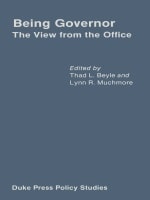
cover of Being Governor: The View from the Office

Being Governor

The View from the Office

Thad L. Beyle and Lynn Muchmore, eds.

Duke University Press, 1983

This book examines the changing role of the governor in our federal system, giving particular attention to recent developments. The expansion of gubernatorial responsibilities into managerial, executive, and intergovernmental positions has taken place at the same time that the governor's role as leader of his political party has declined. In discussing the contemporary role of governors, the editors provide a view of how the office functions on a day-to-day basis.

The editors base their data on personal experience; interviews with governors, former governors, and staff; on -site visits; and responses to a series of nineteen surveys of governors and their staff conducted between 1976 and 1981. The research was undertaken by the Center for Policy Research of the National Governors' Association.
[more]
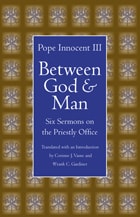
cover of Between God and Man

Between God and Man

Pope Innocent III

Catholic University of America Press, 2004
The sermons presented in this rich collection cast a clearer light on Innocent's concept of what his duties were as priest and bishop.
[more]
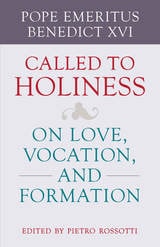
cover of Called to Holiness

Called to Holiness

Pope Emeritus Benedict XVI Pope Emeritus Benedict XVI

Catholic University of America Press, 2017
This edited collection is the first to gather in one volume the most relevant addresses, speeches, and homilies of His Holiness, Pope Emeritus Benedict XVI to seminarians and consecrated men and women into a single volume for the English-speaking world.
[more]
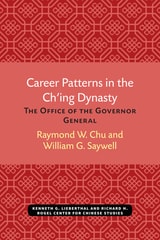
cover of Career Patterns in the Ch’ing Dynasty: The Office of the Governor General

Career Patterns in the Ch’ing Dynasty

The Office of the Governor General

Raymond W. Chu and William G. Saywell

University of Michigan Press, 1981
The office of governor general (tsung-tu) was the highest provincial post throughout the Ch’ing dynasty. As such, it was a vital link in the control of a vast empire by a very small and alien ruling elite. This is primarily a biographical and statistical analysis of the incumbents of that office. By analyzing the biographical data of those who held the position of governor-general, much may be learned about the nature of the office itself. However, the main objective of the study is to provide information on career patterns, that is, the variety of different posts held from the first official appointment to that of governor-general, of an important cross section of successful Ch’ing bureaucrats. By plotting and analyzing the different patterns their official careers took, we should be able to determine what kind of men reached the top of China’s provincial and national administration during the final centuries of China’s imperial history; the qualifications that were required; the factors which prompted rapid promotion or sudden disgrace. We should also be able to determine the extent to which these and other factors varied markedly among Manchu, Mongol, Chinese Bannerman, and Han incumbents and whether changes throughout the dynasty can be detected in policies concerning the office or in the career patterns of its personnel. If such detection is possible, this study may lend support to the view that late imperial China was not static, but a society undergoing significant changes. [xi]
[more]
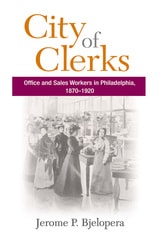
cover of City of Clerks: Office and Sales Workers in Philadelphia, 1870-1920

City of Clerks

Office and Sales Workers in Philadelphia, 1870-1920

Jerome P. Bjelopera

University of Illinois Press, 2005

Below the middle class managers and professionals yet above the skilled blue-collar workers, sales and office workers occupied an intermediate position in urban America's social structure as the nation industrialized. Jerome P. Bjelopera traces the shifting occupational structures and work choices that facilitated the emergence of a white-collar workforce. His fascinating portrait reveals the lives led by Philadelphia's male and female clerks, both inside and outside the workplace, as they formed their own clubs, affirmed their "whiteness," and challenged sexual norms. 

A vivid look at an overlooked but recognizable workforce, City of Clerks reveals how the notion of "white collar" shifted over half a century.
[more]
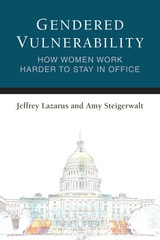
cover of Gendered Vulnerability: How Women Work Harder to Stay in Office

Gendered Vulnerability

How Women Work Harder to Stay in Office

Jeffrey Lazarus and Amy Steigerwalt

University of Michigan Press, 2018
Gendered Vulnerability examines the factors that make women politicians more electorally vulnerable than their male counterparts. These factors combine to convince women that they must work harder to win elections—a phenomenon that Jeffrey Lazarus and Amy Steigerwalt term “gendered vulnerability.” Since women feel constant pressure to make sure they can win reelection, they devote more of their time and energy to winning their constituents’ favor. Lazarus and Steigerwalt examine different facets of legislative behavior, finding that female members do a better job of representing their constituents than male members.
[more]
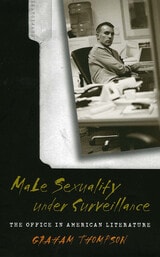
cover of Male Sexuality under Surveillance: Office In American Literature

Male Sexuality under Surveillance

Office In American Literature

Graham Thompson

University of Iowa Press, 2003
Male Sexuality under Surveillance is a lively, intelligent, and expertly argued analysis of the construction of male sexuality in the business office. Graham Thompson interweaves three main threads: a historicized cultural analysis of the development of the modern business office from its beginnings in the early nineteenth century to the present day, a Foucauldian discussion of the office as the site of various disciplinary practices, and a queer-theoretical discussion of the textualization of the gay male body as a device for producing a taxonomy of male-male relations. The combination of these themes produces a study that is fresh, insightful, and provocative.
[more]
cover of Political Parties and the Winning of Office

Political Parties and the Winning of Office

Joseph A. Schlesinger

University of Michigan Press, 1994
A theory of political parties as office-seeking organizations
[more]
cover of The Electorate, the Campaign, and the Office: A Unified Approach to Senate and House Elections

The Electorate, the Campaign, and the Office

A Unified Approach to Senate and House Elections

Paul Gronke

University of Michigan Press, 2001
Voters simultaneously choose among candidates running for different offices, with different terms, and occupying different places in the Constitutional order. Conventional wisdom holds that these overlapping institutional differences make comparative electoral research difficult, if not impossible. Paul Gronke's path-breaking study compares electoral contexts, campaigns, and voter decision-making in House and Senate elections. Gronke's book offers new insights into how differences--and similarities--across offices structure American elections.
Congressional elections research holds that Senate races are more competitive than House contests because states are more heterogeneous, or because candidates are more prominent and raise more money, or because voters have fundamentally different expectations. Because House and Senate contests are seldom compared, we have little empirical evidence to test the various hypotheses about how voters make choices for different offices. Gronke finds that the similarities between House and Senate elections are much greater than previously thought and that voters make their decisions in both races on the same bases.
Gronke first looks at differences in congressional districts and states, showing that context does not really help us understand why Senate elections feature better candidates, higher spending, and closer outcomes. Next, he turns to campaigns. Surprisingly, over a turbulent twenty-year period, House and Senate candidacies have retained the same competitive dynamics.
Gronke also considers voting behavior in House and Senate elections. Focusing on the 1988 and 1990 elections, he argues that voters do not distinguish between institutions, applying fundamentally the same decision rule, regardless of the office being contested. Gronke closes by considering the implications of his results for the way we relate settings, electoral dynamics, and institutional arrangements.
This book will appeal to those interested in Congress, political campaigning, and voting.
Paul Gronke is Associate Professor of Political Science at Reed College.
[more]
cover of The First Fifty Years: A Jubilee in Prose and Poetry Honoring Women Rabbis

The First Fifty Years

A Jubilee in Prose and Poetry Honoring Women Rabbis

Rabbi Sue Levi Elwell, Jessica Greenbaum, Rabbi Hara E. Person

Central Conference of American Rabbis, 2023

The ordination of Rabbi Sally J. Priesand in 1972 was a watershed moment in Jewish history. In The First Fifty Years, contributors from across the Jewish and gender spectrums reflect on the meaning of this moment and the ensuing decades, both personally and for the Jewish community. In short pieces of new prose, authors—many of them pioneering rabbis—share stories, insights, analysis, and celebrations of women in the rabbinate. These are intertwined with a wealth of poetry that poignantly captures the spirit of this anniversary. The volume is a deep, heartfelt tribute to women rabbis and their indelible impact on all of us.
[more]
cover of The Office and Authority of the Local Prior in the Order of Saint Augustine

The Office and Authority of the Local Prior in the Order of Saint Augustine

Robert F. Prevost

Catholic University of America Press, 2025
As a young priest, Robert Prevost was sent in 1981 to Rome to study church law at the Pontifical University of Saint Thomas (known as the Angelicum). There he earned a licentiate and composed a doctoral thesis, which made final in 1987. This is that thesis, the first book-length work composed by the man now known as Pope Leo XIV. Specifically, his study— drawing from sources in English, Italian, and Spanish and from medieval history and theology as well as canon law —focused on the role of the prior as the local superior in the Order of St. Augustine. In doing so, he describes a traditional notion of obedience in religious life -- one based on love of the truth and growth in one's inner freedom to pursue holiness. At the center of his reflection are key ideas regarding the common good of the Church; the Eucharistic liturgy at the center of the life of the community; the role of hierarchy and consultation; and mutual respect for the diverse contributions of each person. Present in this text, moreover, is a far-reaching conception of the priesthood characterized by the triple munera: the priestly work of teaching, sanctification, and governance. Central to the whole volume is an Augustinian conception of the spiritual life that focuses on the inward work of grace, the primacy of the love of God, and inward conformity to Christ. The book's preface—composed by eminent theologian and present-day rector of the Angelicum, Fr. Thomas Joseph White, OP—helps frame the work for the wider public interested in it as a privileged window into the mind and heart of Prevost as a young priest, showing how its subject matter has implications for how one thinks about the life of the Catholic Church. There are clearly in this early work central themes regarding the life of Church, the apostolic tradition, and ecclesial authority in the service of the common good, that may well indicate directions and themes in the subsequent life and teaching of the author. Canonists will be drawn to Prevost's analysis of the Constitutions of the Augustinians in light of the then-newly promulgated Code of Canon Law. Historians and theologians alike may enjoy considering parallelisms that occur between this Augustinian vision of the prior and the subsequent unfolding of an Augustinian pontificate. Hopefully the publication of this work will lead to constructive debate about and comprehension of the relation of between the two.
[more]
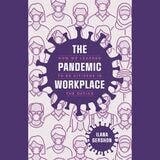
cover of The Pandemic Workplace: How We Learned to Be Citizens in the Office

The Pandemic Workplace

How We Learned to Be Citizens in the Office

Ilana Gershon

University of Chicago Press, 2024

A provocative book arguing that the workplace is where we learn to live democratically.

In The Pandemic Workplace, anthropologist Ilana Gershon turns her attention to the US workplace and how it changed—and changed us—during the pandemic. She argues that the unprecedented organizational challenges of the pandemic forced us to radically reexamine our attitudes about work and to think more deeply about how values clash in the workplace. These changes also led us as workers to engage more with the contracts that bind us as we rethought when and how we allow others to tell us what to do.

Based on over two hundred interviews, Gershon’s book reveals how negotiating these tensions during the pandemic made the workplace into a laboratory for democratic living—the key place where Americans are learning how to develop effective political strategies and think about the common good. Exploring the explicit and unspoken ways we are governed (and govern others) at work, this accessible book shows how the workplace teaches us to be democratic citizens.
[more]
cover of The Pandemic Workplace: How We Learned to Be Citizens in the Office

The Pandemic Workplace

How We Learned to Be Citizens in the Office

Ilana Gershon

University of Chicago Press, 2024

This is an auto-narrated audiobook version of this book.

A provocative book arguing that the workplace is where we learn to live democratically.


In The Pandemic Workplace, anthropologist Ilana Gershon turns her attention to the US workplace and how it changed—and changed us—during the pandemic. She argues that the unprecedented organizational challenges of the pandemic forced us to radically reexamine our attitudes about work and to think more deeply about how values clash in the workplace. These changes also led us as workers to engage more with the contracts that bind us as we rethought when and how we allow others to tell us what to do.

Based on over two hundred interviews, Gershon’s book reveals how negotiating these tensions during the pandemic made the workplace into a laboratory for democratic living—the key place where Americans are learning how to develop effective political strategies and think about the common good. Exploring the explicit and unspoken ways we are governed (and govern others) at work, this accessible book shows how the workplace teaches us to be democratic citizens.
[more]