Results by title
9 books match the query 'One Hundred Years'
Dollar, Dove, and Eagle
One Hundred Years of Palestinian Migration to HondurasNancie L. Gonzalez
University of Michigan Press, 1993

From Skisport to Skiing
One Hundred Years of an American Sport, 1840-1940E. John B. Allen
University of Massachusetts Press, 1993
The first full-length study of skiing in the United States, this book traces the history of the sport from its utilitarian origins to its advent as a purely recreational and competitive activity.
During the mid-1800s, inhabitants of frontier mining communities in the Sierra and Rocky mountains used skis for many practical reasons, including mail and supply delivery, hunting, and railroad repair. In some towns skis were so common that, according to one California newspaper, “the ladies do nearly all their shopping and visiting on them.”
But it was Norwegian immigrants in the Midwest, clinging to their homeland traditions, who first organized the skisport. Through the founding of local clubs and the National Ski Association, this ethnic group dominated American skiing until the 1930s.
At this time, a wave of German immigrants infused America with the ethos of what we today call Alpine skiing. This type of skiing became increasingly popular, especially in the East among wealthy collegians committed to the romantic pursuit of the “strenuous life.” Ski clubs proliferated in towns and on college campuses and specialized resorts cropped up from New England to California. At the same time, skiing became mechanized with tows and lifts, and the blossoming equipment and fashion industries made a business of the sport.
On the eve of World War II, as the book concludes its story, all the elements were in place for the explosion in recreational and competitive skiing that erupted after 1945.
Long Is the Way and Hard
One Hundred Years of the NAACPKevern Verney
University of Arkansas Press, 2009

One Hundred Years of Communist Experiments
Vladimir Tismaneanu
Central European University Press, 2021
Why has communism’s humanist quest for freedom and social justice without exception resulted in the reign of terror and lies? The authors of this collective volume address this urgent question covering the one hundred years since Lenin’s coup brought the first communist regime to power in St. Petersburg, Russia in November 1917. The first part of the volume is dedicated to the varieties of communist fantasies of salvation, and the remaining three consider how communist experiments over many different times and regions attempted to manage economics, politics, as well as society and culture. Although each communist project was adapted to the situation of the country where it operated, the studies in this volume find that because of its ideological nature, communism had a consistent penchant for totalitarianism in all of its manifestations.
This book is also concerned with the future. As the world witnesses a new wave of ideological authoritarianism and collectivistic projects, the authors of the nineteen essays suggest lessons from their analyses of communism’s past to help better resist totalitarian projects in the future.

One Hundred Years of Futurism
Aesthetics, Politics and PerformanceEdited by John London
Intellect Books, 2017
One Hundred Years of Futurism
Aesthetics, Politics and PerformanceEdited by John London
Intellect Books, 2017

One Hundred Years of Philosophy
Brian Shanley
Catholic University of America Press, 2019

One Hundred Years of The Souls of Black Folk
A Celebration of W. E. B. Du Bois, Volume 17Robert Gooding-Williams and Dwight A. McBride, eds.
Duke University Press, 0
This collection relies on the language of literary aesthetics to examine Du Bois’s political agenda and, conversely, on varying accounts of that political agenda to assess his aesthetic choices. It also helps us understand why Souls became a literary and political classic and has played such a decisive role in the formation of twentieth-century African American literature and political thought. The essays explore a variety of topics, including the possibility that Souls was modeled on Richard Wagner’s idea of a total artwork, Du Bois’s thinking about the political significance of homosociality, and the interplay of racialism, nationalism, and globalism in Souls.
Contributors. Anne E. Carroll, Vilashini Cooppan, Robert Gooding-Williams, Sheila Lloyd, Dwight A. McBride, Charles I. Nero, Cheryl A. Wall, Alexander G. Weheliye
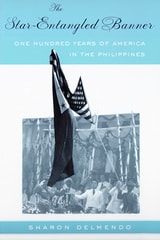
The Star-Entangled Banner
One Hundred Years of America in the PhilippinesDelmendo, Sharon
Rutgers University Press, 2004
During a ceremony held in 1996 to commemorate the fiftieth anniversary of formal Philippine independence, the U.S. flag was being lowered while the Philippine flag was being raised, and the two became entangled. In The Star-Entangled Banner, Sharon Delmendo demonstrates that this incident is indicative of the longstanding problematic relationship between the two countries. When faced with a national crisis or a compelling need to reestablish its autonomy, each nation paradoxically turns to its history with the other to define its place in the world.
Each chapter of the book deals with a separate issue in this linked history: the influence of Buffalo Bill’s show on the proto-nationalism of José Rizal, who is often described as the “First Filipino”; the portrayal of the Philippines in American children’s books; Back to Bataan, a World War II movie starring John Wayne; the post-independence fiction of F. Sionil José; and the refusal of the U..S military to return the Balangiga Bells, which were taken as war booty during the Philippine-American War. Ultimately, Delmendo demonstrates how the effects of U.S. imperialism in the Philippines continue to resonate in U.S. foreign policy in the post cold war era and the war on terrorism.