Results by title
7 books match the query 'Operations'

Changing Academic Library
Operations, Culture, EnvironmentsJohn Budd
Assoc of College & Research Libraries, 2012
[more]
Changing Academic Library
Operations, Culture, EnvironmentsJohn Budd
Assoc of College & Research Libraries, 2012
[more]
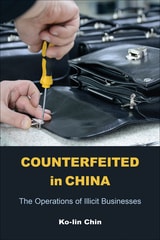
Counterfeited in China
The Operations of Illicit BusinessesKo-lin Chin
Temple University Press, 2025
Counterfeiting tops the list of organized crimes committed worldwide, raking in nearly half a trillion dollars in 2019. The impact of this illicit business is felt by consumers, brand owners, state authorities, and workers, and it impacts the economy. Moreover, its proliferation has fueled the advancement of organized crime groups.
In his illuminating study, Counterfeited in China, Ko-lin Chin investigates this lucrative industry and its emergence in China. His face-to-face interviews with counterfeiters — business owners, workers, facilitators, and key informants — in the hub of Guangzhou, China reveal how businesses that design, produce, and distribute fake and unauthorized luxury goods manage the risks inherent in their business.
Counterfeited in China examines the individual and group characteristics of counterfeiters and their relationships with organized crime; analyzes the economic aspects of counterfeiting; assesses the relationships among counterfeiting, violence, and corruption; and seeks to understand the demand for counterfeit goods. Chin also discusses the role of Chinese authorities and other parties in the war against counterfeiting.
Assessing the state of the industry and its future, Chin provides fascinating new insights into the modus operandi of counterfeiters.
[more]
The Changing Academic Library
Operations, Culture, EnvironmentsJohn Budd
Assoc of College & Research Libraries, 2018
[more]
The Politics of Operations
Excavating Contemporary CapitalismSandro Mezzadra and Brett Neilson
Duke University Press, 2019
In The Politics of Operations Sandro Mezzadra and Brett Neilson investigate how capital reshapes its relation with politics through operations that enable the extraction and exploitation of mineral resources, labor, data, and cultures. They show how capital—which they theorize as a direct political actor—operates through the logistical organization of relations between people, property, and objects as well as through the penetration of financialization into all realms of economic life. Mezzadra and Neilson present a capacious analysis of a wide range of issues, from racial capitalism, the convergence of neoliberalism and nationalism, and Marx's concept of aggregate capital to the financial crisis of 2008 and how colonialism, empire, and globalization have shaped the modern state since World War II. In so doing, they illustrate the distinctive rationality and logics of contemporary capitalism while calling for a politics based on collective institutions that exist outside the state.
[more]
The Theater of Operations
National Security Affect from the Cold War to the War on TerrorJoseph Masco
Duke University Press, 2014
How did the most powerful nation on earth come to embrace terror as the organizing principle of its security policy? In The Theater of Operations, Joseph Masco locates the origins of the present-day U.S. counterterrorism apparatus in the Cold War's "balance of terror." He shows how, after the attacks of 9/11, the U.S. global War on Terror mobilized a wide range of affective, conceptual, and institutional resources established during the Cold War to enable a new planetary theater of operations. Tracing how specific aspects of emotional management, existential danger, state secrecy, and threat awareness have evolved as core aspects of the American social contract, Masco draws on archival, media, and ethnographic resources to offer a new portrait of American national security culture. Undemocratic and unrelenting, this counterterror state prioritizes speculative practices over facts, and ignores everyday forms of violence across climate, capital, and health in an unprecedented effort to anticipate and eliminate terror threats—real, imagined, and emergent.
[more]
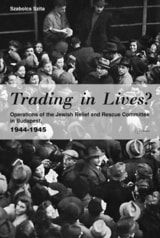
Trading in Lives?
Operations of the Jewish Relief and Rescue Committee in Budapest, 1944-1945Szabolcs Szita
Central European University Press, 2005
Set in the tumultuous moments of 1944–45 Budapest, this work discusses the operations of the Budapest Relief and Rescue Committee. Drawing out the contradictions and complexities of the mass deportations of Hungarian Jews during the final phase of World War II, Szita suggests that in the Hungarian context, a commerce in lives ensued, where prominent Zionists like Dr. Rezso Kasztner negotiated with the higher echelons of the SS, trying to garner the freedom of Hungarian Jews. Szita's portrait of the controversial Kasztner is a more sympathetic rendition of a powerful Zionist leader who was later assassinated in Israel for his dealings with Nazi leaders. Szita reveals a story of interweaving personalities and conflicts during arguably the most tragic moment in European history. The author's extensive research is a tremendous contribution to a field of study that has been much ignored by scholarship-the Hungarian holocaust and the trade in human lives.
[more]