Results by title
5 books match the query 'Opinion'
Demanding Choices
Opinion, Voting, and Direct DemocracyShaun Bowler and Todd Donovan
University of Michigan Press, 2000
Policy and Opinion in the Gulf War
John Mueller
University of Chicago Press, 1994
Mueller analyzes key issues: the actual shallowness of public support for war; the effect of public opinion on the media (rather than the other way around); the use and misuse of polls by policy makers; the American popular focus on Hussein's ouster as a central purpose of the War; and the War's short-lived impact on voting. Of particular interest is Mueller's conclusion that Bush succeeded in leading the country to war by increasingly convincing the public that it was inevitable, rather than right or wise.
Throughout, Mueller, author of War, Presidents, and Public Opinion, an analysis of public opinion during the Korean and Vietnam wars, places this analysis of the Gulf crisis in a broad political and military context, making comparisons to wars in Panama, Vietnam, Korea, and the Falklands, as well as to World War II and even the War of 1812. The book also collects nearly 300 tables charting public opinion through the Gulf crisis, making Policy and Opinion in the Gulf War an essential reference for anyone interested in recent American politics, foreign policy, public opinion, and survey research.
Political Attitudes in Venezuela
Societal Cleavages and Political OpinionBy Enrique A. Baloyra and John D. Martz
University of Texas Press, 1979
Here is a benchmark study of voter attitudes in a Latin American country. This volume is based on extensive survey research conducted during the Venezuelan elections of 1973. The methods employed by Baloyra and Martz to poll an "unpollable" society successfully challenge previously established paradigms.
The authors interviewed a representative sample of over 1,500 voters to determine relationships between class, status, community, context, religion, ideology, and partisanship on the one hand and political attitudes and preferences on the other. They found that the Venezuelan electorate is defined by a series of contradictory tendencies, and they place their conclusions in the context of contemporary political science literature regarding class and party, ideology and party, and inequality and participation.

The Pliant Public
Ideology and Public Opinion in ChinaJason Y. Wu
University of Michigan Press, 2027
The Chinese Communist Party has long depended on ideology to set the agenda, communicate its priorities, and legitimize its rule. The Pliant Public argues that for Chinese citizens, however, ideology is in short supply. Surveys show that public opinion is depolarized. Ordinary people have little sense of what ideological labels like “left” and “right” mean, and most of the people who put themselves on the right have the scale backwards. Since a depolarized public is ill-equipped to check the state, China’s leaders can make massive changes to government policy without triggering much backlash.
But depolarization does not always strengthen the state. When citizens lack clear ideological commitments, it is easier for them to set aside their differences. If China’s leaders lost their performance legitimacy, then depolarization could facilitate a broader challenge to party rule.
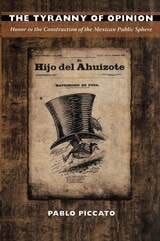
The Tyranny of Opinion
Honor in the Construction of the Mexican Public SpherePablo Piccato
Duke University Press, 2010
Tracing how notions of honor changed in nineteenth-century Mexico, Pablo Piccato examines legislation, journalism, parliamentary debates, criminal defamation cases, personal stories, urban protests, and the rise and decline of dueling in the 1890s. He highlights the centrality of notions of honor to debates over the nature of Mexican liberalism, describing how honor helped to define the boundaries between public and private life; balance competing claims of free speech, public opinion, and the protection of individual reputations; and motivate politicians, writers, and other men to enter public life. As Piccato explains, under the authoritarian rule of Porfirio Díaz, the state became more active in the protection of individual reputations. It implemented new restrictions on the press. This did not prevent people from all walks of life from defending their honor and reputations, whether in court or through violence. The Tyranny of Opinion is a major contribution to a new understanding of Mexican political history and the evolution of Mexican civil society.