Results by title
11 books match the query 'Oriental influences'
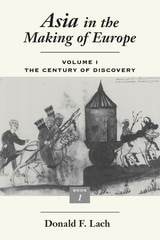
Asia in the Making of Europe, Volume I
The Century of Discovery. Book 1.Donald F. Lach
University of Chicago Press, 1994
Volume I: The Century of Discovery brings together "everything that a European could know of India, Southeast Asia, China, and Japan, from printed books, missionary reports, traders' accounts and maps" (The New York Review of Books). Volume II: A Century of Wonder examines the influence of that vast new body of information about Asia on the arts, institutions, literatures, and ideas of sixteenth-century Europe.
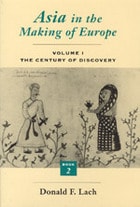
Asia in the Making of Europe, Volume I
The Century of Discovery. Book 2.Donald F. Lach
University of Chicago Press, 1994
Volume I: The Century of Discovery brings together "everything that a European could know of India, Southeast Asia, China, and Japan, from printed books, missionary reports, traders' accounts and maps" (The New York Review of Books). Volume II: A Century of Wonder examines the influence of that vast new body of information about Asia on the arts, institutions, literatures, and ideas of sixteenth-century Europe.
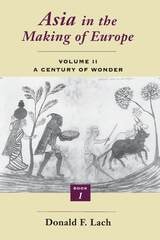
Asia in the Making of Europe, Volume II
A Century of Wonder. Book 1: The Visual ArtsDonald F. Lach
University of Chicago Press, 1970
The rise to world dominance of the Western nations in modern times and the rapid industrial growth of the West, which outpaced the East in technical and military achievements, have led to a historical eclipse of the ancient and brilliant cultures of Asia.
Historican Donald F. Lach, in his influential scholarly work, Asia in the Making of Europe, points out that an eclipse is never permanent, that this one was never total, and that there was a period in early modern times when Asia and Europe were close rivals in brilliance and mutual influence.
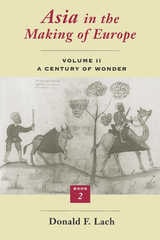
Asia in the Making of Europe, Volume II
A Century of Wonder. Book 2: The Literary ArtsDonald F. Lach
University of Chicago Press, 1994
Volume I: The Century of Discovery brings together "everything that a European could know of India, Southeast Asia, China, and Japan, from printed books, missionary reports, traders' accounts and maps" (The New York Review of Books). Volume II: A Century of Wonder examines the influence of that vast new body of information about Asia on the arts, institutions, literatures, and ideas of sixteenth-century Europe.
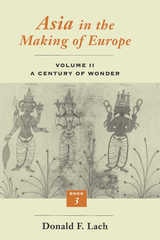
Asia in the Making of Europe, Volume II
A Century of Wonder. Book 3: The Scholarly DisciplinesDonald F. Lach
University of Chicago Press, 1994
Volume I: The Century of Discovery brings together "everything that a European could know of India, Southeast Asia, China, and Japan, from printed books, missionary reports, traders' accounts and maps" (The New York Review of Books). Volume II: A Century of Wonder examines the influence of that vast new body of information about Asia on the arts, institutions, literatures, and ideas of sixteenth-century Europe.
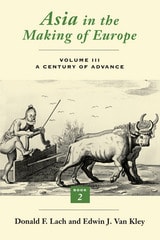
Asia in the Making of Europe, Volume III
A Century of Advance. Book 2, South AsiaDonald F. Lach and Edwin J. Van Kley
University of Chicago Press, 1993
In Volume III: A Century of Advance, the authors have researched seventeenth-century European writings on Asia in an effort to understand how contemporaries saw Asian societies and peoples.
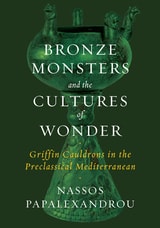
Bronze Monsters and the Cultures of Wonder
Griffin Cauldrons in the Preclassical MediterraneanNassos Papalexandrou
University of Texas Press, 2021
The eighth and seventh centuries BCE were a time of flourishing exchange between the Mediterranean and the Near East. One of the period’s key imports to the Hellenic and Italic worlds was the image of the griffin, a mythical monster that usually possesses the body of a lion and the head of an eagle. In particular, bronze cauldrons bore griffin protomes—figurative attachments showing the neck and head of the beast. Crafted in fine detail, the protomes were made to appear full of vigor, transfixing viewers.
Bronze Monsters and the Cultures of Wonder takes griffin cauldrons as case studies in the shifting material and visual universes of preclassical antiquity, arguing that they were perceived as lifelike monsters that introduced the illusion of verisimilitude to Mediterranean arts. The objects were placed in the tombs of the wealthy (Italy, Cyprus) and in sanctuaries (Greece), creating fantastical environments akin to later cabinets of curiosities. Yet griffin cauldrons were accessible only to elites, ensuring that the new experience of visuality they fostered was itself a symbol of status. Focusing on the sensory encounter of this new visuality, Nassos Papalexandrou shows how spaces made wondrous fostered novel subjectivities and social distinctions.
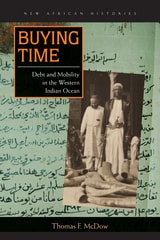
Buying Time
Debt and Mobility in the Western Indian OceanThomas F. McDow
Ohio University Press, 2018
In Buying Time, Thomas F. McDow synthesizes Indian Ocean, Middle Eastern, and East African studies as well as economic and social history to explain how, in the nineteenth century, credit, mobility, and kinship knit together a vast interconnected Indian Ocean region. That vibrant and enormously influential swath extended from the desert fringes of Arabia to Zanzibar and the Swahili coast and on to the Congo River watershed.
In the half century before European colonization, Africans and Arabs from coasts and hinterlands used newfound sources of credit to seek out opportunities, establish new outposts in distant places, and maintain families in a rapidly changing economy. They used temporizing strategies to escape drought in Oman, join ivory caravans in the African interior, and build new settlements.
The key to McDow’s analysis is a previously unstudied trove of Arabic business deeds that show complex variations on the financial transactions that underwrote the trade economy across the region. The documents list names, genealogies, statuses, and clan names of a wide variety of people—Africans, Indians, and Arabs; men and women; free and slave—who bought, sold, and mortgaged property. Through unprecedented use of these sources, McDow moves the historical analysis of the Indian Ocean beyond connected port cities to reveal the roles of previously invisible people.
Orientalism and Modernism
The Legacy of China in Pound and WilliamsZhaoming Qian
Duke University Press, 1995
Consulting rare and unpublished materials, Qian traces Pound’s and Williams’s remarkable dialogues with the great Chinese poets—Qu Yuan, Li Bo, Wang Wei, and Bo Juyi—between 1913 and 1923. His investigation reveals that these exchanges contributed more than topical and thematic ideas to the Americans’ work and suggests that their progressively modernist style is directly linked to a steadily growing contact and affinity for similar Chinese styles. He demonstrates, for example, how such influences as the ethics of pictorial representation, the style of ellipsis, allusion, and juxtaposition, and the Taoist/Zen–Buddhist notion of nonbeing/being made their way into Pound’s pre-Fenollosan Chinese adaptations, Cathay, Lustra, and the Early Cantos, as well as Williams’s Sour Grapes and Spring and All. Developing a new interpretation of important work by Pound and Williams, Orientalism and Modernism fills a significant gap in accounts of American Modernism, which can be seen here for the first time in its truly multicultural character.
The Orient of Style
Modernist Allegories of ConversionBeryl Schlossman
Duke University Press, 1991
Toward the end of Remembrance of Things Past, the narrator describes the act of creating a work of art as a conversion of sensation into a spiritual equivalent. By means of such allegories of “conversion,” Schlossman shows, the modernist artist disappeared within the work of art and left behind the trace of his sublime vocation, a vocation in which he was transformed, in Schlossman’s words, “into a kind of priest kneeling at the altar of beauty before the masked divinity of representation.”
The author shows how allegory—the representation of the symbolic as something real—was adapted by modernist writers to reflect subjectivity while masking an authorial origin. She reveals how modernist allegory arose, as Walter Benjamin suggests, at the crossroads of history, sociology, economics, urban architecture, and art—providing a kind of map of capitalism—and was produced through the eyes of a melancholic gazing at a “monument of absence.”
U.S. Orientalisms
Race, Nation, and Gender in Literature, 1790-1890Malini Johar Schueller
University of Michigan Press, 2001
This book begins with an examination of the literature of the "Barbary" Orient generated by the U.S. Algerian conflict in the late eighteenth century in the works of such writers as Royall Tyler, Susanna Rowson, and Washington Irving. It then moves on to the Near East Orientalist literature of the nineteenth century in light of Egyptology, theories of race, and the growth of missionary fervor in writers such as John DeForest, Maria Susanna Cummins, Herman Melville, Edgar Allan Poe, and Harriet Prescott Spofford. Finally, Schueller considers the Indic Orientalism of the period in the context of Indology, British colonialism, and the push for Asian trade in the United States, focusing particularly on Emerson and Whitman. U.S. Orientalisms demonstrates how these writers strove to create an Orientalism premised on the idea of civilization and empire moving West, from Asia, through Europe, and culminating in the New World.
Schueller draws on the work of Michel Foucault, Edward Said, Homi Bhabha, Rey Chow, and Judith Butler and compellingly demonstrates how a raced, compensatory "Orientalist" discourse of empire was both contested and evoked in the literary works of a wide variety of writers. The book will be of interest to readers in American history, postcolonial studies, gender studies, and literary theory.
Malini Johar Schueller is Associate Professor, Department of English, University of Florida. She is the author of The Politics of Voice: Liberalism and Social Criticism from Franklin to Kingston.