Results by title
7 books match the query 'Orpheus'
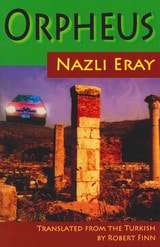
Orpheus
By Nazli Eray
University of Texas Press, 2006
Robert Finn's translation of Turkish author Nazli Eray's Orphée makes available to the English-language reader a rewriting of the myth from the perspective of Eurydice, the wife of Orpheus. Eray's surrealistic version takes place in a hot resort town in contemporary Turkey. The setting of an archaeological dig gives a connection to the past and literally to the underworld. Found in the dig is a statue of the Roman emperor Hadrian, who proceeds to offer an unusual perspective on modern life and values through mysterious letters carried by a messenger pigeon. Eray also comments on modernity, as the city of Ankara emerges as a character in the novel's fantasy. Set in junta-ruled Turkey of the 1980s, the novel takes its place as a crucial slice of Turkish literary history.
Resonating with haunting references to the film Last Tango in Paris, the novel evolves as a mystery story with a humorous bent. Thus Eray illuminates her insatiable curiosity about other cultures, particularly those of the West. Finally, the style of the translation is simple and clear, with crisp dialogue. Sibel Erol, professor of Turkish literature at New York University, has written an introduction that places this fantastic plot in a literary context, as well as in understandable terms that relate to the reality of today's Turkey.
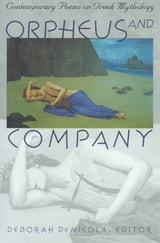
Orpheus and Company
Contemporary Poems on Greek MythologyEdited by Deborah De Nicola
Brandeis University Press, 1999
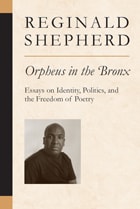
Orpheus in the Bronx
Essays on Identity, Politics, and the Freedom of PoetryReginald Shepherd
University of Michigan Press, 2010
"Orpheus in the Bronx not only extols the freedom language affords us; it embodies that freedom, enacting poetry's greatest gift---the power to recognize ourselves as something other than what we are. These bracing arguments were written by a poet who sings."
---James Longenbach
A highly acute writer, scholar, editor, and critic, Reginald Shepherd brings to his work the sensibilities of a classicist and a contemporary theorist, an inheritor of the American high modernist canon, and a poet drawing and playing on popular culture, while simultaneously venturing into formal experimentation.
In the essays collected here, Shepherd offers probing meditations unified by a "resolute defense of poetry's autonomy, and a celebration of the liberatory and utopian possibilities such autonomy offers." Among the pieces included are an eloquent autobiographical essay setting out in the frankest terms the vicissitudes of a Bronx ghetto childhood; the escape offered by books and "gifted" status preserved by maternal determination; early loss and the equivalent of exile; and the formation of the writer's vocation. With the same frankness that he brings to autobiography, Shepherd also sets out his reasons for rejecting "identity politics" in poetry as an unnecessary trammeling of literary imagination. His study of the "urban pastoral," from Baudelaire through Eliot, Crane, and Gwendolyn Brooks, to Shepherd's own work, provides a fresh view of the place of urban landscape in American poetry.
Throughout his essays---as in his poetry---Shepherd juxtaposes unabashed lyricism, historical awareness, and in-your-face contemporaneity, bristling with intelligence.

Orpheus in the Underworld
Essays on MusicTheodor W. Adorno
Seagull Books, 2024
Theodor W. Adorno is recognized as one of the twentieth century’s most prominent social theorists. Though best known for his association with the Frankfurt School of critical theory, Adorno began his career as a composer and successful music critic.
Comprehensive and illuminating, Orpheus in the Underworld centers on Adorno’s concrete and immediate engagement with musical compositions and their interpretation in the concert hall and elsewhere. Here, Adorno registers his initial encounters with the compositions of the Second Viennese School, when he had yet to integrate them into a broad aesthetics of music. Complementarily essays on Bela Bartók, Jean Sibelius, and Kurt Weill afford insight into his understanding of composers who did not fit neatly into the dialectical schema propounded in the Philosophy of New Music. Additionally, essays on recording and broadcasting show Adorno engaging with these media in a spirit that is no less productive than polemical and focused as sharply on their potentialities as on their shortcomings.
Orpheus in the Underworld offers a captivating exploration of Adorno’s musical compositions, shedding new light on his understanding of influential composers and his critical perspectives on recording and broadcasting.
Sonnets to Orpheus
Rainer Maria Rilke
University of Scranton Press, 2007
The Dismemberment of Orpheus
Toward a Postmodern LiteratureIhab Hassan
University of Wisconsin Press, 1982
In this book, the first edition of which was published in 1971 by Oxford University Press, Ihab Hassan takes Orphic dismemberment and regeneration as his metaphor for a radical crisis in art and language, culture and consciousness, which prefigures postmodern literature. The modern Orpheus, he writes, “sings on a lyre without strings.” Thus, his sensitive critique traces a hypothetical line from Sade through four modern authors—Hemingway, Kafka, Genet, and Beckett—to a literature still to come. But the line also breaks into two Interludes, one concerning ’Pataphysics, Dada, and Surrealism, and the other concerning Existentialism and Aliterature.
Combining literary history, brief biography, and critical analysis, Hassan surrounds these authors with a complement of avant-garde writers whose works also foreshadow the postmodern temper. These include Jarry, Apollinaire, Tzara, Breton, Sartre, Camus, Nathalie Sarraute, Robbe-Grillet, and in America, Cage, Salinger, Ginsberg, Barth, and Burroughs. Hassan takes account also of related contemporary developments in art, music, and philosophy, and of many works of literary theory and criticism.
For this new edition, Hassan has added a new preface and postface on the developing character of postmodernism, a concept which has gained currency since the first edition of this work, and which he himself has done much to theorize.
Under the Spell of Orpheus
The Persistence of a Myth in Twentieth-Century ArtJudith E. Bernstock. Foreword by Peter Selz
Southern Illinois University Press, 1991
This comprehensive view of the Orpheus myth in modern art focuses on an extremely rich artistic symbol and cuts through all the clichés to explore truly significant problems of meaning. The author takes a new approach to the iconography of major modern artists by incorporating psychological and literary analysis, as well as biography.
The three parts of the book explore the ways in which artists have identified with different aspects of the often paradoxical Orpheus myth. The first deals with artists such as Paul Klee, Carl Milles, and Barbara Hepworth. In the second, Max Beckmann, Oskar Kokoschka, and Isamu Noguchi are discussed. Artists examined in the final part include Pablo Picasso, Jacques Lipchitz, Ethel Schwabacher, and Cy Twombly. The author documents her argument with more than sixty illustrations.