Results by title
19 books match the query 'Orthodox Eastern Church'
A Service of Love
Paul McPartlan
Catholic University of America Press, 2013
A Service of Love
Paul McPartlan
Catholic University of America Press, 2016
Adam's Sin, Our Humanity, and Christ's Redemption in Cyril of Alexandria
An Eastern Christian Theological AnthropologyAnthony Bibawy
Catholic University of America Press, 2026
Beyond the Monastery Walls
The Ascetic Revolution in Russian Orthodox Thought, 1814–1914Patrick Lally Michelson
University of Wisconsin Press, 2017
Patrick Lally Michelson's intellectual history of asceticism in Russian Orthodox thought traces the development of these competing arguments from the early nineteenth century to the early months of World War I. He demonstrates that this discourse was an imaginative interpretation of lived Orthodoxy, primarily meant to satisfy the ideological needs of Russian thinkers and Orthodox intellectuals as they responded to the socioeconomic, political, and cultural challenges of modernity.
Christian Networks in the Ottoman Empire
A Transnational HistoryYura Konstantinova
Central European University Press, 2024
Observers and historians continue to marvel at the diversity and complexity of the Ottoman Empire. This book explores the significant and multifaceted role that Orthodox Christian networks played in the sultan’s realm from the 17th century until WWI. These multi-ethnic, multi-lingual, and multi-confessional formations contributed fundamentally to the political, economic, social, and cultural development of the Empire as well as to its gradual disintegration.
Bringing together scholars from most Balkan countries, Christian Networks in the Ottoman Empire describes the variety of Orthodox Christian networks under Ottoman rule. The examples examined include commercial relations, intellectual networks, educational systems, religious dynamics, consular activities, and revolutionary movements, and involve Muslims and Christians, Romanians and Serbs, Bulgarians and Greeks, Albanians and Turks. The contributions show that the Christian populations and their elites were an integral part of Ottoman society.
The geographical spread of the formal and informal networks enriches our understanding of the terms ‘center’ and ‘periphery.’ They were either centered within the official Ottoman borders and extended their activities to other states and empires, or vice versa, located elsewhere, but also active in the Ottoman Empire. A common feature of these formations is their constant fluctuation, which enables a dynamic understanding of Ottoman history.
Denial and Repression of Anti-Semitism
Post-Communist Rehabilitation of the Serbian Bishop Nikolaj VelimirovicJovan Byford
Central European University Press, 2008
Epiphanius of Cyprus
Imagining an Orthodox WorldYoung Richard Kim
University of Michigan Press, 2015
Icon and Devotion
Sacred Spaces in Imperial RussiaOleg Tarasov
Reaktion Books, 2002
By tracing the artistic vocabulary, techniques and working methods of icon painters, Tarasov shows how icons have been integral to the history of Russian art, influenced by folk and mainstream currents alike. As well as articulating the specifically Russian piety they invoke, he analyzes the significance of icons in the cultural life of modern Russia in the context of popular prints and poster design.
Icon of the Kingdom of God
An Orthodox EcclesiologyRadu Bordeianu
Catholic University of America Press, 2023
In Search of the Triune God
The Christian Paths of East and WestEugene Webb
University of Missouri Press, 2013
Under the broad umbrella of the Christian religion, there exists a great divide between two fundamentally different ways of thinking about key aspects of the Christian faith. Eugene Webb explores the sources of that divide, looking at how the Eastern and Western Christian worlds drifted apart due both to the different ways they interpreted their symbols and to the different roles political power played in their histories. Previous studies have focused on historical events or on the history of theological ideas. In Search of the Triune God delves deeper by exploring how the Christian East and the Christian West have conceived the relation between symbol and experience.
Webb demonstrates that whereas for Western Christianity discussion of the doctrine of the Trinity has tended toward speculation about the internal structure of the Godhead, in the Eastern tradition the symbolism of the Triune God has always been closely connected to religious experience. In their approaches to theology, Western Christianity has tended toward a speculative theology, and Eastern Christianity toward a mystical theology.
This difference of focus has led to a large range of fundamental differences in many areas not only of theology but also of religious life. Webb traces the history of the pertinent symbols (God as Father, Son of God, Spirit of God, Messiah, King, etc.) from the Hebrew Bible and New Testament through patristic thinkers and the councils that eventually defined orthodoxy. In addition, he shows how the symbols, interpreted through the different cultural lenses of the East and the West, gradually took on meanings that became the material of very different worldviews, especially as the respective histories of the Eastern and Western Christian worlds led them into different kinds of entanglement with ambition and power.
Through this incisive exploration, Webb offers a dramatic and provocative new picture of the history of Christianity.
Letters, Volume 1
John Barsanuphius and John
Catholic University of America Press, 2006
Letters, Volume 2
John Barsanuphius and John
Catholic University of America Press, 2006
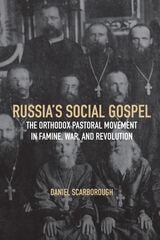
Russia's Social Gospel
The Orthodox Pastoral Movement in Famine, War, and RevolutionDaniel Scarborough
University of Wisconsin Press, 2023
This volume draws upon extensive archival research to examine the effects of the pastoral movement on Russian society and the Orthodox Church. Scarborough argues that the social work of parish clergymen shifted the focus of Orthodox practice in Russia toward cooperative social activism as a devotional activity. He furthers our understanding of Russian Orthodoxy by illuminating the difficult position of parish priests, who were charged with both spiritual and secular responsibilities but were supported by neither church nor state. His nuanced look at the pastorate shows how social and historical traumas shifted perceptions of what being religious meant, in turn affecting how the Orthodox Church organized itself, and contributed to Russia’s modernization.
Russian Religious Thought
Edited by Judith Deutsch Kornblatt and Richard F. Gustafson
University of Wisconsin Press, 1996
As Russia entered the modern age in the nineteenth century, many Russian intellectuals combined the study of European philosophy with a return to their own traditions, culminating in the novels of Tolstoy and Dostoevsky and in the religious philosophy of their younger contemporary, Vladimir Soloviev. This book explores central issues of modern Russian religious thought by focusing on the work of Soloviev and three religious philosophers who further developed his ideas in the early twentieth century: P. A. Florensky, Sergei Bulgakov, and S. L. Frank. The essays place these thinkers in the contexts of both Western philosophy and Eastern Orthodoxy, presenting a substantially new perspective on Russian religious thought.
The work of these four philosophers, this volume demonstrates, influenced virtually all aspects of twentieth-century Russian culture, and indeed, many aspects of Soviet culture as well, but also represents a rich philosophical tradition devoted to issues of divinity, community, and humanity that transcend national boundaries and historical eras.
Included in Russian Religious Thought is an introduction, brief biographical information on Soloviev, Florensky, Bulgakov, and Frank, and an Afterword by scholar James Scanlan, who elaborates on the volume’s aim to provide a thoughtful corrective, both to unexamined assumptions of past scholarship and to nationalist readings currently popular in post-Soviet Russia.
"Russian religious philosophy, banned under the Soviets, has been marginalized in the Western academy as well. This interdisciplinary volume helps explain why this body of thought has remained for so long at the center of Russian culture."—Caryl Emerson, Princeton University
The Christian Tradition
A History of the Development of Doctrine, Volume 2: The Spirit of Eastern Christendom (600-1700)Jaroslav Pelikan
University of Chicago Press, 1974
"It is a pleasure to salute this masterpiece of exposition. . . . The book flows like a great river, slipping easily past landscapes of the utmost diversity—the great Christological controversies of the seventh century, the debate on icons in the eighth and ninth, attitudes to Jews, to Muslims, to the dualistic heresies of the high Middle Ages, to the post-Reformation churches of Western Europe. . . . His book succeeds in being a study of the Eastern Christian religion as a whole."—Peter Brown and Sabine MacCormack, New York Review of Books
"The second volume of Professor Pelikan's monumental work on The Christian Tradition is the most comprehensive historical treatment of Eastern Christian thought from 600 to 1700, written in recent years. . . . Pelikan's reinterpretation is a major scholarly and ecumenical event."—John Meyendorff
"Displays the same mastery of ancient and modern theological literature, the same penetrating analytical clarity and balanced presentation of conflicting contentions, that made its predecessor such an intellectual treat."—Virgina Quarterly Review
The Correspondence of Theodoret of Cyrus
The Collectio Sirmondiana, Volume 4John F. Theodoret of Cyrus
Catholic University of America Press, 2025
The Correspondence of Theodoret of Cyrus
The Collectio Sirmondiana, Volume 5John F. Theodoret of Cyrus
Catholic University of America Press, 2025
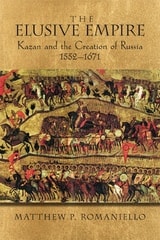
The Elusive Empire
Kazan and the Creation of Russia, 1552–1671Matthew P. Romaniello
University of Wisconsin Press, 2012
In 1552, Muscovite Russia conquered the city of Kazan on the Volga River. It was the first Orthodox Christian victory against Islam since the fall of Constantinople, a turning point that, over the next four years, would complete Moscow’s control over the river. This conquest provided a direct trade route with the Middle East and would transform Muscovy into a global power. As Matthew Romaniello shows, however, learning to manage the conquered lands and peoples would take decades.
Russia did not succeed in empire-building because of its strength, leadership, or even the weakness of its neighbors, Romaniello contends; it succeeded by managing its failures. Faced with the difficulty of assimilating culturally and religiously alien peoples across thousands of miles, the Russian state was forced to compromise in ways that, for a time, permitted local elites of diverse backgrounds to share in governance and to preserve a measure of autonomy. Conscious manipulation of political and religious language proved more vital than sheer military might. For early modern Russia, empire was still elusive—an aspiration to political, economic, and military control challenged by continuing resistance, mismanagement, and tenuous influence over vast expanses of territory.
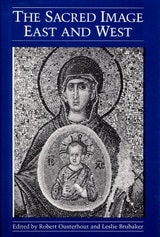
The Sacred Image East and West
Edited by Robert Ousterhout and Leslie Brubaker
University of Illinois Press, 1995