Results by title
2 books match the query 'Other Minds'
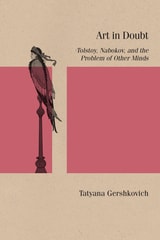
Art in Doubt
Tolstoy, Nabokov, and the Problem of Other MindsTatyana Gershkovich
Northwestern University Press, 2021
Leo Tolstoy’s and Vladimir Nabokov’s radically opposed aesthetic worldviews emanate from a shared intuition—that approaching a text skeptically is easy, but trusting it is hard
Two figures central to the Russian literary tradition—Tolstoy, the moralist, and Nabokov, the aesthete—seem to have sharply conflicting ideas about the purpose of literature. Tatyana Gershkovich undermines this familiar opposition by identifying a shared fear at the root of their seemingly antithetical aesthetics: that one’s experience of the world might be entirely one’s own, private and impossible to share through art.
Art in Doubt: Tolstoy, Nabokov, and the Problem of Other Minds reconceives the pair’s celebrated fiction and contentious theorizing as coherent, lifelong efforts to reckon with the problem of other people’s minds. Gershkovich demonstrates how the authors’ shared yearning for an impossibly intimate knowledge of others formed and deformed their fiction and brought them through parallel logic to their rival late styles: Tolstoy’s rustic simplicity and Nabokov’s baroque complexity. Unlike those authors for whom the skeptical predicament ends in absurdity or despair, Tolstoy and Nabokov both hold out hope that skepticism can be overcome, not by force of will but with the right kind of text, one designed to withstand our impulse to doubt it. Through close readings of key canonical works—Anna Karenina, The Kreutzer Sonata, Hadji Murat, The Gift, Pale Fire—this book brings the twin titans of Russian fiction to bear on contemporary debates about how we read now, and how we ought to.

Tennyson'S Characters
"Strange Faces, Other Minds"David Goslee
University of Iowa Press, 1989
Scholars since Paden have commented on the anxieties embedded in Tennyson's poetry, but this is the first study to examine them systematically. Within each poem Goslee discovers a vulnerable authorial presence threatened by some Other—a personification of divine, sexual, or natural power—which encroaches upon it from the fringes of the poem's imaginative universe. This Other is always interpreted, humanized, or conciliated by some mediating figure, yet the more effectively the mediator confronts an otherwise alien cosmos, the more alien he or she becomes to the authorial presence.
Goslee's approach toward understanding the conflict between Tennyson and the characters he creates includes elements of formalism, psychodynamics, and literary history without being narrowly confined to any one of these. His subtle, elegant reading mediates between those critics who stress authorial intention (e.g., Reed's Perception and Design) and the growing number of critics who follow E. D. H. Johnson in claiming that Tennyson wrote more subversively than he wanted to admit. This original, highly suggestive volume will be important for all Victorian scholars and literary critics.