Results by title
6 books match the query 'PHELAN, JAMES'
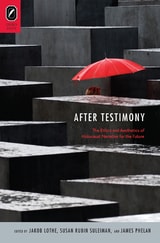
After Testimony
The Ethics and Aesthetics of Holocaust Narrative for the FutureEdited by Jakob Lothe, Susan Rubin Suleiman, and James Phelan
The Ohio State University Press, 2012
After Testimony: The Ethics and Aesthetics of Holocaust Narrative for the Future collects sixteen essays written with the awareness that we are on the verge of a historical shift in our relation to the Third Reich’s programmatic genocide. Soon there will be no living survivors of the Holocaust, and therefore people not directly connected to the event must assume the full responsibility for representing it. The contributors believe that this shift has broad consequences for narratives of the Holocaust. By virtue of being “after” the accounts of survivors, storytellers must find their own ways of coming to terms with the historical reality that those testimonies have tried to communicate. The ethical and aesthetic dimensions of these stories will be especially crucial to their effectiveness. Guided by these principles and employing the tools of contemporary narrative theory, the contributors analyze a wide range of Holocaust narratives—fictional and nonfictional, literary and filmic—for the dual purpose of offering fresh insights and identifying issues and strategies likely to be significant in the future. In addition to the editors, the contributors are Daphna Erdinast-Vulcan, Sidra DeKoven Ezrahi, Anniken Greve, Jeremy Hawthorn, Marianne Hirsch, Irene Kacandes, Phillipe Mesnard, J. Hillis Miller, Michael Rothberg, Beatrice Sandberg, Anette H. Storeide, Anne Thelle, and Janet Walker.
Debating Rhetorical Narratology
On the Synthetic, Mimetic, and Thematic Aspects of NarrativeMatthew Clark and James Phelan
The Ohio State University Press, 2020
Clark and Phelan’s deep dive into the synthetic, mimetic, and thematic leads them to explore many other aspects of narrative and narrative theory: style, audiences, the mimetic illusion, fictionality, and more. Their investigation also leads them into questions about rhetorical narratology’s relation to other projects in narrative theory, especially unnatural narratology, and, indeed, about how to assess the explanatory power of competing theories. Ultimately, their debate is compelling testimony about the power of both narrative theory and narrative itself.
Experiencing Fiction
Judgments, Progressions, and the Rhetorical Theory of NarrativeJames Phelan
The Ohio State University Press, 2007
Fictionality and Literature
Core Concepts RevisitedEdited by Lasse R. Gammelgaard, Stefan Iversen, Louise Brix Jacobsen, James Phelan, Richard Walsh, Henrik Zetterberg-Nielsen, and Simona Zetterberg-Nielsen
The Ohio State University Press, 2022
Contributors:
H. Porter Abbott, Catherine Gallagher, Lasse R. Gammelgaard, Stefan Iversen, Louise Brix Jacobsen, Rikke Andersen Kraglund, Susan S. Lanser, Jakob Lothe, Maria Ma¨kela¨, Greta Olson, Sylvie Patron, James Phelan, Richard Walsh, Wendy Veronica Xin, Henrik Zetterberg-Nielsen, Simona Zetterberg-Nielsen
Narrative Theory
Core Concepts and Critical DebatesDavid Herman, James Phelan, Peter J. Rabinowitz, Brian Richardson, and Robyn Warhol
The Ohio State University Press, 2012
Narrative Theory: Core Concepts and Critical Debates addresses two frequently asked questions about narrative studies: “what is narrative theory?” and “how do different approaches to narrative relate to each other?” In engaging with these questions, the book demonstrates the diversity and vitality of the field and promotes a broader dialogue about its assumptions, methods, and purposes.
Somebody Telling Somebody Else
A Rhetorical Poetics of NarrativeJames Phelan
The Ohio State University Press, 2017
In doing so, he offers new readings of a wide range of narratives from Jane Austen’s Pride and Prejudice to Joan Didion’s The Year of Magical Thinking, from Joseph Conrad’s Lord Jim to George V. Higgins’s The Friends of Eddie Coyle, from Franz Kafka’s “Das Urteil” to Toni Morrison’s “Recitatif,” from David Small’s Stitches to Jhumpa Lahiri’s “Third and Final Continent,” from John O’Hara’s “Appearances” to Ian McEwan’s Enduring Love. Phelan contends that the standard view of narrative as a synthesis of story and discourse is inadequate to handle the complexities of narrative communication, and he demonstrates the greater explanatory power of his rhetorical view. Furthermore, Phelan gives new prominence to the presence and activity of the “somebody else,” as he shows that an audience’s unfolding responses to a narrative often influence its very construction.