116 books match the query 'Palestine' and 5 start with a

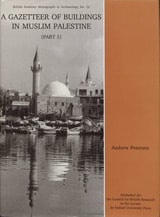
cover of A Gazetteer of Buildings in Muslim Palestine

A Gazetteer of Buildings in Muslim Palestine

Andrew Petersen

Council for British Research in the Levant, 2001

The aim of the survey on which this book is based was to make a record of all buildings constructed in Palestine during the medieval and Ottoman periods. The survey area covers the modern state of Israel excluding West Jerusalem and Ramla (which are covered in separate publications). The West Bank and Gaza will be the subject of Volume II.


Library of Congress subject headings for this publication:
Architecture, Islamic -- Palestine -- Guidebooks.
Architecture, Ottoman -- Palestine -- Guidebooks.
Architecture, Medieval -- Palestine -- Guidebooks.
Historic buildings -- Palestine -- Guidebooks.
[more]
cover of A Young Palestinian's Diary, 1941–1945: The Life of Sami 'Amr

A Young Palestinian's Diary, 1941–1945

The Life of Sami 'Amr

Translated, annotated, and with an introduction by Kimberly Katz

University of Texas Press, 2009

Writing in his late teens and early twenties, Sāmī ‘Amr gave his diary an apt subtitle: The Battle of Life, encapsulating both the political climate of Palestine in the waning years of the British Mandate as well as the contrasting joys and troubles of family life. Now translated from the Arabic, Sāmī's diary represents a rare artifact of turbulent change in the Middle East.

Written over four years, these ruminations of a young man from Hebron brim with revelations about daily life against a backdrop of tremendous transition. Describing the public and the private, the modern and the traditional, Sāmī muses on relationships, his station in life, and other universal experiences while sharing numerous details about a pivotal moment in Palestine's modern history. Making these never-before-published reflections available in translation, Kimberly Katz also provides illuminating context for Sāmī's words, laying out biographical details of Sāmī, who kept his diary private for close to sixty years. One of a limited number of Palestinian diaries available to English-language readers, the diary of Sāmī ‘Amr bridges significant chasms in our understanding of Middle Eastern, and particularly Palestinian, history.

[more]
cover of An Aesthetic Occupation: The Immediacy of Architecture and the Palestine Conflict

An Aesthetic Occupation

The Immediacy of Architecture and the Palestine Conflict

Daniel Bertrand Monk

Duke University Press, 2002


In An Aesthetic Occupation Daniel Bertrand Monk unearths the history of the unquestioned political immediacy of “sacred” architecture in the conflict between Palestinians and Israelis. Monk combines groundbreaking archival research with theoretical insights to examine in particular the Mandate era—the period in the first half of the twentieth century when Britain held sovereignty over Palestine. While examining the relation between monuments and mass violence in this context, he documents Palestinian, Zionist, and British attempts to advance competing arguments concerning architecture’s utility to politics.
Succumbing neither to the view that monuments are autonomous figures onto which political meaning has been projected, nor to the obverse claim that in Jerusalem shrines are immediate manifestations of the political, Monk traces the reciprocal history of both these positions as well as describes how opponents in the conflict debated and theorized their own participation in its self-representation. Analyzing controversies over the authenticity of holy sites, the restorations of the Dome of the Rock, and the discourse of accusation following the Buraq, or Wailing Wall, riots of 1929, Monk discloses for the first time that, as combatants looked to architecture and invoked the transparency of their own historical situation, they simultaneously advanced—and normalized—the conflict’s inability to account for itself.
This balanced and unique study will appeal to anyone interested in Israel or Zionism, the Palestinians, the Middle East conflict, Jerusalem, or its monuments. Scholars of architecture, political theory, and religion, as well as cultural and critical studies will also be informed by its arguments.
[more]
cover of An Israeli in Palestine: Resisting Dispossession, Redeeming Israel

An Israeli in Palestine

Resisting Dispossession, Redeeming Israel

Jeff Halper

Pluto Press, 2010

Israeli anthropologist and activist Jeff Halper throws a harsh light on the Israeli-Palestinian conflict from the point of view of a critical insider. While the Zionist founders of Israel created a vibrant society, culture and economy, they did so at a high price: Israel could not maintain its exclusive Jewish character without imposing on the country's Palestinian population policies of ethnic cleansing, occupation and discrimination, expressed most graphically in its ongoing demolition of thousands of Palestinian homes, both inside Israel and in the Occupied Territories.

An Israeli in Palestine records Halper's journey 'beyond the membrane' that shields his people from the harsh realities of Palestinian life to his 'discovery' that he was actually living in another country: Palestine. Without dismissing the legitimacy of his own country, he realises that Israel is defined by its oppressive relationship to the Palestinians.

This second edition is includes an epilogue gauging the chances for peace after the failed Annapolis process.

[more]
cover of Arrows in the Dark (Volumes 1 and 2): David Ben-Gurion, the Yishuv Leadership, and Rescue Attempts during the Holocaust

Arrows in the Dark (Volumes 1 and 2)

David Ben-Gurion, the Yishuv Leadership, and Rescue Attempts during the Holocaust

Tuvia Friling; Translated by Ora Cummings

University of Wisconsin Press, 2005

Arrows in the Dark recounts and analyzes the many efforts of aid and rescue made by the Jewish community of Palestine—the Yishuv—to provide assistance to European Jews facing annihilation by the Nazis. Tuvia Friling provides a detailed account of the activities carried out at the behest of David Ben-Gurion and the Yishuv leadership, from daring attempts to extract Jews from Nazi-occupied territory, to proposals for direct negotiations with the Nazis. Through its rich array of detail and primary documentation, this book shows the wide scope and complexity of Yishuv activity at this time, refuting the idea that Ben-Gurion and the Yishuv ignored the plight of European Jews during the Holocaust.
[more]