Results by title
5 books match the query 'Palm oil industry'
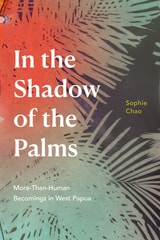
In the Shadow of the Palms
More-Than-Human Becomings in West PapuaSophie Chao
Duke University Press, 2022
With In the Shadow of the Palms, Sophie Chao examines the multispecies entanglements of oil palm plantations in West Papua, Indonesia, showing how Indigenous Marind communities understand and navigate the social, political, and environmental demands of the oil palm plant. As Chao notes, it is no secret that the palm oil sector has destructive environmental impacts: it greatly contributes to tropical deforestation and is a major driver of global warming. Situating the plant and the transformations it has brought within the context of West Papua’s volatile history of colonization, ethnic domination, and capitalist incursion, Chao traces how Marind attribute environmental destruction not just to humans, technologies, and capitalism but also to the volition and actions of the oil palm plant itself. By approaching cash crops as both drivers of destruction and subjects of human exploitation, Chao rethinks capitalist violence as a multispecies act. In the process, Chao centers how Marind fashion their own changing worlds and foreground Indigenous creativity and decolonial approaches to anthropology.
[more]
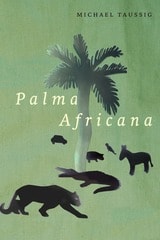
Palma Africana
Michael Taussig
University of Chicago Press, 2018
“It is the contemporary elixir from which all manner of being emerges, the metamorphic sublime, an alchemist’s dream.” So begins Palma Africana, the latest attempt by anthropologist Michael Taussig to make sense of the contemporary moment. But to what elixir does he refer?
Palm oil. Saturating everything from potato chips to nail polish, palm oil has made its way into half of the packaged goods in our supermarkets. By 2020, world production will be double what it was in 2000. In Colombia, palm oil plantations are covering over one-time cornucopias of animal, bird, and plant life. Over time, they threaten indigenous livelihoods and give rise to abusive labor conditions and major human rights violations. The list of entwined horrors—climatic, biological, social—is long. But Taussig takes no comfort in our usual labels: “habitat loss,” “human rights abuses,” “climate change.” The shock of these words has passed; nowadays it is all a blur. Hence, Taussig’s keen attention to words and writing throughout this work. He takes cues from precursors’ ruminations: Roland Barthes’s suggestion that trees form an alphabet in which the palm tree is the loveliest; William Burroughs’s retort to critics that for him words are alive like animals and don’t like to be kept in pages—cut them and the words are let free.
Steeped in a lifetime of philosophical and ethnographic exploration, Palma Africana undercuts the banality of the destruction taking place all around us and offers a penetrating vision of the global condition. Richly illustrated and written with experimental verve, this book is Taussig’s Tristes Tropiques for the twenty-first century.
[more]
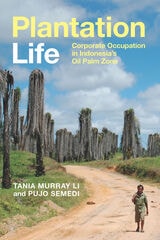
Plantation Life
Corporate Occupation in Indonesia's Oil Palm ZoneTania Murray Li and Pujo Semedi
Duke University Press, 2021
In Plantation Life Tania Murray Li and Pujo Semedi examine the structure and governance of Indonesia's contemporary oil palm plantations in Indonesia, which supply 50 percent of the world's palm oil. They attend to the exploitative nature of plantation life, wherein villagers' well-being is sacrificed in the name of economic development. While plantations are often plagued by ruined ecologies, injury among workers, and a devastating loss of livelihoods for former landholders, small-scale independent farmers produce palm oil more efficiently and with far less damage to life and land. Li and Semedi theorize “corporate occupation” to underscore how massive forms of capitalist production and control over the palm oil industry replicate colonial-style relations that undermine citizenship. In so doing, they question the assumption that corporations are necessary for rural development, contending that the dominance of plantations stems from a political system that privileges corporations.
[more]
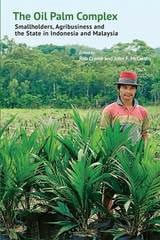
The Oil Palm Complex
Smallholders, Agribusiness and the State in Indonesia and MalaysiaEdited by Robert Cramb and John F. McCarthy
National University of Singapore Press, 2016
The oil palm industry has transformed rural livelihoods and landscapes across wide swathes of Indonesia and Malaysia, generating wealth along with economic, social, and environmental controversy. Who benefits and who loses from oil palm development? Can oil palm development provide a basis for inclusive and sustainable rural development?
Based on detailed studies of specific communities and plantations and an analysis of the regional political economy of oil palm, this book unpicks the dominant policy narratives, business strategies, models of land acquisition, and labour-processes. It presents the oil palm industry in Malaysia and Indonesia as a complex system in which land, labour and capital are closely interconnected. Understanding this complex is a prerequisite to developing better strategies to harness the oil palm boom for a more equitable and sustainable pattern of rural development.
Based on detailed studies of specific communities and plantations and an analysis of the regional political economy of oil palm, this book unpicks the dominant policy narratives, business strategies, models of land acquisition, and labour-processes. It presents the oil palm industry in Malaysia and Indonesia as a complex system in which land, labour and capital are closely interconnected. Understanding this complex is a prerequisite to developing better strategies to harness the oil palm boom for a more equitable and sustainable pattern of rural development.
[more]
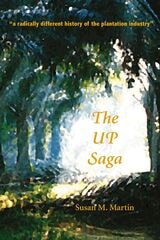
The UP Saga
Susan M. Martin
National University of Singapore Press, 2003
Histories of the plantations sector in Malaysia have largely focused on the rubber industry and on the rise and fall of big British-owned colonial enterprises. But since independence, the sector has entered a new phase of spectacular growth founded on the oil palm. This volume offers a radically different history of a firm which spans both eras. The fascinating story of United Plantations Berhad (UP) highlights a Scandinavian-founded firm that evolved along quite different lines from the normal models of British imperial business. Tracing the company’s origins before the First World War, it describes the crisis years of economic depression and Japanese occupation then on to the years of spectacular growth which has lasted since the time of the Emergency and Merdeka right up to the present day. The success of this firm - based not just on an extraordinary combination of agricultural, engineering and marketing innovation but also on the company’s engagement and commitment to its local environment - provides a glowing example of a partnership between Europeans and Asians which has benefited both sides.
[more]