Results by title
13 books match the query 'Paradise lost'

Answerable Style
Essays on Paradise LostArnold Stein
University of Minnesota Press, 1953
Answerable Style was first published in 1953. Minnesota Archive Editions uses digital technology to make long-unavailable books once again accessible, and are published unaltered from the original University of Minnesota Press editions.
By the use of both new and traditional techniques of critical analysis, Arnold Stein presents in this volume of six essays a fresh interpretation of Milton's epic.
Beginning with the assumption that style is "answerable" to idea, he has tried to trace Milton's epic vision as it is bodied forth in patterns of structure (the ideas tested in action) and patterns of expression (the ideas tested in style). Mr. Stein explains: "My approach is in part based on an attempt to accept as fact both that I am a twentieth century reader and that this is a seventeenth-century poem. Milton is, I think, illuminated by some modern critical considerations; and some of those considerations are in turn illuminated, and some are found wanting."
Fictions of God
English Renaissance Literature and the Invention of the Biblical NarratorRaphael Magarik
University of Chicago Press, 2025
We often identify secularization's characteristic literary form as the modern novel: out with divine scripture, in with human fictions. In Fictions of God, Raphael Magarik argues that this story overlooks the cultural upheavals of the Protestant Reformation. Early reformers imagined a Bible that was neither infallible nor inerrant but fictional, composed by a divine counterfactual: God crafted the text, they said, as if it had been written by the prophets. Early modern Protestants now found in their Bibles not a source of foundational truths but a model for unreliable narration, even fiction.
Fictions of God traces how this approach to literature passed from biblical commentators to poets like Abraham Cowley, John Milton, and Lucy Hutchinson amid the violent emergence of a new religious and political order—long before the eighteenth-century rise of the English novel. The result is a transformative account of the Reformation’s effect on imaginative literature and the secularization of the Bible itself.
Milton's Epic Voice
The Narrator in Paradise LostAnne Ferry
University of Chicago Press, 1983
Milton’s Moving Bodies
Marissa Greenberg and Rachel Trubowitz
Northwestern University Press, 2024
A collection of innovative examinations of embodiment in Milton’s oeuvre that challenge assumptions about disciplinary boundaries
This volume brings unprecedented focus to the forms, spaces, and implications of embodied motion in Milton’s writing and its afterlives to explore how and why he privileges the body—human and textual—as a site of dynamic movement. The contributors bring a variety of lenses to Milton’s moving bodies: political history, kinematics, mathematics, cosmology, translation, illustration, anatomies of racialized and disabled bodies, and twenty-first-century pedagogies. From these wide-ranging vantage points, they consider anew Milton’s contributions to the histories of scientific development, global exploration and imperial expansion, migration and diaspora, and translation and adaptation in England, Europe, and the Americas, from the early modern period to today. Milton’s Moving Bodies draws together established and emerging scholars, offering fresh analyses of the poet’s legacy for multiple traditions within and beyond Milton studies.
New Science, New World
Denise Albanese
Duke University Press, 1996
Albanese reads the inaugurators of the scientific revolution against the canonical authors of early modern literature, discussing Galileo’s Dialogue on the Two Chief World Systems and Bacon’s New Atlantis as well as Milton’s Paradise Lost and Shakespeare’s The Tempest. She examines how the newness or “novelty” of investigating nature is expressed through representations of the New World, including the native, the feminine, the body, and the heavens. “New” is therefore shown to be a double sign, referring both to the excitement associated with a knowledge oriented away from past practices, and to the oppression and domination typical of the colonialist enterprise. Exploring the connections between the New World and the New Science, and the simultaneously emerging patterns of thought and forms of writing characteristic of modernity, Albanese insists that science is at its inception a form of power-knowledge, and that the modern and postmodern division of “Two Cultures,” the literary and the scientific, has its antecedents in the early modern world.
New Science, New World makes an important contribution to feminist, new historicist, and cultural materialist debates about the extent to which the culture of seventeenth-century England is proto-modern. It will offer scholars and students from a wide range of fields a new critical model for historical practice.

PARADISE LOST
A HISTORY OF GAME PRESERVATION IN EAST AFRICATHOMAS P. OFCANSKY
West Virginia University Press, 2002
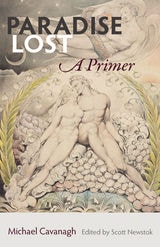
Paradise Lost
A PrimerMichael Cavanagh
Catholic University of America Press, 2020

Remembering and Repeating
On Milton's Theology and PoeticsRegina M. Schwartz
University of Chicago Press, 1993
"A brilliant study that quietly but powerfully recharacterizes many of the contexts of discussion in Milton criticism. Particularly noteworthy is Schwartz's ability to introduce advanced theoretical perspectives without ever taking the focus of attention away from the dynamics and problematics of Milton's poem."—Stanley Fish
The Epic Catalogue
List Form and Reception from Beowulf to Paradise LostEva von Contzen
The Ohio State University Press, 2026
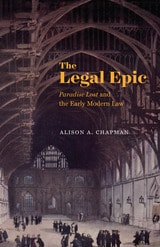
The Legal Epic
"Paradise Lost" and the Early Modern LawAlison A. Chapman
University of Chicago Press, 2017
Alison A. Chapman argues that Milton’s Paradise Lost sits at the apex of the early modern period’s long fascination with law and judicial processes. Milton’s world saw law and religion as linked disciplines and thought therefore that in different ways, both law and religion should reflect the will of God. Throughout Paradise Lost, Milton invites his readers to judge actions using not only reason and conscience but also core principles of early modern jurisprudence. Law thus informs Milton’s attempt to “justify the ways of God to men” and points readers toward the types of legal justice that should prevail on earth.
Adding to the growing interest in the cultural history of law, The Legal Epic shows that England’s preeminent epic poem is also a sustained reflection on the role law plays in human society.
The Ruins of Allegory
Paradise Lost and the Metamorphosis of Epic ConventionCatherine Gimelli Martin
Duke University Press, 1998
Martin shows how Paradise Lost, written at the threshold of the enormous imaginative shift that accompanied the Protestant, scientific, and political revolutions of the seventeenth century, conforms to a prophetic baroque model of allegory similar to that outlined by Walter Benjamin. As she demonstrates, Milton’s experimentation with baroque forms radically reformulates classical epic, medieval romance, and Spenserian allegory to allow for both a naturalistic, empirically responsible understanding of the universe and for an infinite and incomprehensible God. In this way, the resulting poetic world of Paradise Lost is like Milton’s God, an allegorical “ruin” in which the divine is preserved but at the price of a loss of certainty. Also, as Martin suggests, the poem affirmatively anticipates modernity by placing the chief hope of human progress in the fully self-authored subject.
Maintaining a dialogue with a critical tradition that extends from Johnson and Coleridge to the best contemporary Milton scholarship, Martin sets Paradise Lost in both the early modern and the postmodern worlds. Ruins of Allegory will greatly interest all Milton scholars, as well as students of literary criticism and early modern studies.
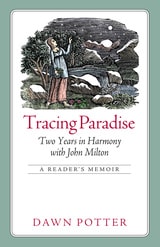
Tracing Paradise
Two Years in Harmony with John MiltonDawn Potter
University of Massachusetts Press, 2009
One winter morning, poet Dawn Potter sat down at her desk in Harmony, Maine, and began copying out the opening lines of John Milton's Paradise Lost. Her intent was to spend half an hour with a poem she had never liked, her goal to transcribe a page or two. Maybe she would begin to appreciate the poet's art, though she had no real expectations that the exercise would change her mind about the poem. Yet what began as a whim turned rapidly into an obsession, and soon Potter was immersed in a strange and unexpected project: she found herself copying out every single word of Milton's immense, convoluted epic.
Tracing Paradise: Two Years in Harmony with John Milton is her memoir of that long task. Over the course of twelve chapters, Potter explores her very personal response to Milton and Paradise Lost, tracing the surprising intersections between a seventeenth-century biblical epic and the routine joys and tragedies of domestic life in contemporary rural Maine. Curious, opinionated, and eager, she engages with the canon on mutable, individual terms. Though she writes perceptively about the details and techniques of Milton's art, always her reactions are linked to her present-tense experiences as a poet, small-time farmer, family member, and citizen of a poor and beleaguered north-country town.
A skilled and entertaining writer, Potter is also a wide-ranging and sophisticated reader. Yet her memoir is not a scholarly treatise: her enthusiasms and misgivings about both Milton and Paradise Lost ebb and flow with the days. Tracing Paradise reminds us that close engagement with another artist's task may itself be a form of creation. Above all, Potter's memoir celebrates one reader's difficult yet transformative love affair with Milton's glorious, irritating, inscrutable masterpiece.
Trade and Romance
Michael Murrin
University of Chicago Press, 2013