Results by title
7 books match the query 'Partition, 1947'
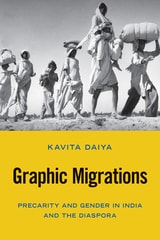
Graphic Migrations
Precarity and Gender in India and the DiasporaKavita Daiya
Temple University Press, 2020
In Graphic Migrations, Kavita Daiya provides a literary and cultural archive of refugee stories and experiences to respond to the question “What is created?” after decolonization and the 1947 Partition of India. She explores how stories of Partition migrations shape and influence the political and cultural imagination of secularism and contribute to gendered citizenship for South Asians in India and its diasporas.
Daiya analyzes modern literature, Bollywood films, Margaret Bourke-White’s photography, advertising, and print culture to show how they memorialize or erase refugee experiences. She also uses oral testimonies of Partition refugees from Hong Kong, South Asia, and North America to draw out the tensions of the nation-state, ethnic discrimination, and religious difference. Employing both Critical Refugee Studies and Feminist Postcolonial Studies frameworks, Daiya traces the cultural, affective, and political legacies of Partition migrations.
The precarity generated by modern migration and expressed through public culture prompts a rethinking of how dominant media represents gendered migrants and refugees. Graphic Migrations demands that we redraw the boundaries of how we tell the story of modern world history and the intricately interwoven, intimate production of statelessness and citizenship across the world’s communities.
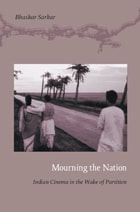
Mourning the Nation
Indian Cinema in the Wake of PartitionBhaskar Sarkar
Duke University Press, 2009
Sarkar tracks the initial reticence to engage with the trauma of 1947 and the subsequent emergence of a strong Partition discourse, revealing both the silence and the eventual “return of the repressed” as strands of one complex process. Connecting the relative silence of the early decades after Partition to a project of postcolonial nation-building and to trauma’s disjunctive temporal structure, Sarkar develops an allegorical reading of the silence as a form of mourning. He relates the proliferation of explicit Partition narratives in films made since the mid-1980s to disillusionment with post-independence achievements, and he discusses how current cinematic memorializations of 1947 are influenced by economic liberalization and the rise of a Hindu-chauvinist nationalism. Traversing Hindi and Bengali commercial cinema, art cinema, and television, Sarkar provides a history of Indian cinema that interrogates the national (a central category organizing cinema studies) and participates in a wider process of mourning the modernist promises of the nation form.

Nahum Goldman
His Missions to the GentileRaphael Patai
University of Alabama Press, 1980
Nahum Goldmann (1895-1982) was a major Zionist figure for the last half-century and the chief architect of the pact pledging West Germany to pay reparations to Israel and to individual Jews for acts committed during the Nazi regime. He was co-founder of the Eschkol Publishing House in Berlin and was co-publisher of the Encyclopedia Judaica, the only major Jewish encyclopedia published in Germany.
Patai’s study is the first to explore this brilliant, often irritating, and enormously successful Jewish politician and diplomat. Goldmann represented no government, yet he effected important international change. The book discusses Goldmann’s involvement with the partition controversy which led to the establishment of Israel, West German reparation payments amounting to over $36 billion, and a series of attempts to meet with Egyptian President Nasser in hopes of bringing peace to the Middle East.
Palestine between Politics and Terror, 1945–1947
Motti Golani
Brandeis University Press, 2013

Partitioning Palestine
Legal Fundamentalism in the Palestinian-Israeli ConflictJohn Strawson
Pluto Press, 2010
Law lies at the roots of the Palestinian-Israeli conflict. Jews sought a national home by “Public Law” while Palestinians reject the project as illegal. Britain, the League of Nations and the United Nations all mobilised international law to justify their interventions. After the 1967 war, Israel organised an occupation with excessive legalism that most of the world viewed, in fact, as illegal.
Partitioning Palestine focuses on three key moments in the Palestinian-Israeli conflict: the League of Nations Mandate, the United Nations partition plan and the Oslo agreements. None of these documents are neutral but, rather, encode a variety of meanings. The book traces the way in which these legal narratives have both shaped national identity and sharpened the conflict.
In this pioneering text, John Strawson argues that a committed attachment to the belief in legal justice has hampered the search for a settlement. Law, far from offering conflict resolution, has reinforced the trenches from which Palestinians and Israelis confront one another.
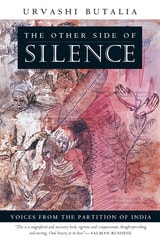
The Other Side of Silence
Voices from the Partition of IndiaUrvashi Butalia
Duke University Press, 2000
Through interviews conducted over a ten-year period and an examination of diaries, letters, memoirs, and parliamentary documents, Butalia asks how people on the margins of history—children, women, ordinary people, the lower castes, the untouchables—have been affected by this upheaval. To understand how and why certain events become shrouded in silence, she traces facets of her own poignant and partition-scarred family history before investigating the stories of other people and their experiences of the effects of this violent disruption. Those whom she interviews reveal that, at least in private, the voices of partition have not been stilled and the bitterness remains. Throughout, Butalia reflects on difficult questions: what did community, caste, and gender have to do with the violence that accompanied partition? What was partition meant to achieve and what did it actually achieve? How, through unspeakable horrors, did the survivors go on? Believing that only by remembering and telling their stories can those affected begin the process of healing and forgetting, Butalia presents a sensitive and moving account of her quest to hear the painful truth behind the silence.
Violent Belongings
Partition, Gender, and National Culture in Postcolonial IndiaKavita Daiya
Temple University Press, 2008
In addition to challenging the official narratives of independence and Partition, these narratives challenge our contemporary understanding of gender and ethnicity in history and politics. Violent Belongings argues that both male and female bodies, and heterosexual coupledom, became symbols of the nation in public life. In the newly independent Indian nation both men and women were transformed into ideal citizens or troubling bodies, immigrants or refugees, depending on whether they were ethnically Hindu, Muslim, Jewish or Sikh. The divisions set in motion during Partition continue into our own time and account for ethnic violence in South Asia.