Results by title
14 books match the query 'Party'
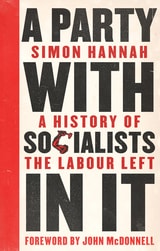
A Party with Socialists in It
A History of the Labour LeftSimon Hannah
Pluto Press, 2018
A Party with Socialists in It addresses those questions and more, telling the story of the Labour Party from its origins to today, showing how at every turn it has struggled with the tension between the rights and demands of workers and a more centrist position. As Jeremy Corbyn’s leadership attempts to revitalize the party after the initial success of the Blair years turned into disappointment and disenchantment, this clear-eyed history could not be more timely.

A Party with Socialists in It
A History of the Labour LeftSimon
Pluto Press, 2022
A smart and succinct history of the Labour left
*A Guardian Book of the Day*
The defeat of socialist firebrand Jeremy Corbyn as Labour Leader in 2019 confirmed Tony Benn's famous retort 'the Labour party has never been a socialist party, although there have always been socialists in it.'
For over a hundred years, the British Labour Party has been a bastion for working-class organization and struggle. However, has it ever truly been on the side of the workers? Where do its interests really lie? And can we rely on it to provide a barrier against right-wing forces?
Simon Hannah's smart and succinct history of the Labour left guides us through the twists and turns of the party, from the Bevanite movement and the celebrated government of Clement Attlee, through the emergence of a New Left in the 1970s and the Blairism of the 1990s, to Corbyn's defeat and his replacement by Keir Starmer.
This new edition is updated throughout, with a new final chapter and conclusion bringing the story up to date.

Bad News for Labour
Antisemitism, the Party and Public BeliefGreg Philo
Pluto Press, 2019

Machine Politics in Transition
Party and Community in ChicagoThomas M. Guterbock
University of Chicago Press, 1980
For three years, Thomas M. Guterbock participated in the daily activities of the Regular Democratic Organization in one North Side Chicago ward in order to discover how political machines win the support of the urban electorate. Guterbock's participant observation data, supplemented by a sample survey of ward residents' attitudes toward, and contacts with the machine, provide convincing evidence that the most widely accepted notions of how political machines work are no longer correct.
Contrary to conventional wisdom about the machine, Guterbock finds that the party does not secure votes by doing "favors" for people, nor do services rendered determine actual voting behavior. Instead, party loyalty is governed by such factors as social status, educational achievement, and bureaucratic competence. Guterbock finds that Democratic loyalists are drawn disproportionately from the ward's lowest strata. Ironically, the characteristics of these loyal Democrats contrast sharpely with the characteristics of those most likely to use party services.
What keeps the machine going, then? To answer this question, Guterbock takes us behind the scenes for a unique look inside the ward club. He shows how members develop loyalty and motivation beyond concern for their own pocketbooks. And he analyzes the public involvement of machine politicians in neighborhood affairs, describing the skillful—sometimes devious—ways in which they appeal to their constituents' sense of community. By focusing on the interplay of party loyalty and community attachments, Guterbock is able to explain the continued hegemony of Chicago's political machine and its enduring image of legitimacy.
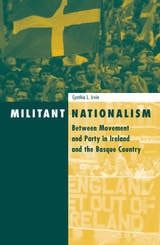
Militant Nationalism
Between Movement and Party in Ireland and the Basque CountryCynthia Irvin
University of Minnesota Press, 1999
A comparative analysis of two militant nationalist groups.
Why do some militant nationalists turn to electoral politics while others resist-and even seek to destroy-that arena? Cynthia L. Irvin examines two cases of electoral interventions by nationalist organizations engaged in violent political competition: in Northern Ireland and in the Basque provinces of Spain. Based on her findings, she offers insights into the circumstances that lead such groups to abandon violence in favor of institutional political struggle.
Using fieldwork done in Northern Ireland and the Basque Country, Irvin develops a model linking the internal dynamics of Sinn Fein and Herri Batasuna (the electoral arm of the militant Basque separatists) to changes in their external environments. In this unusual comparative analysis, she draws on interviews with more than 100 Sinn Fein and Herri Batasuna activists and on a unique survey of 140 Herri Batasuna activists. This approach moves Irvin’s work beyond previous analyses, which have relied on either descriptive and historical accounts or formal models of insurgent violence. This detailed account has broad implications for the study of social movements and ethnic identity, providing a valuable new perspective into the strategic interactions and often conflict-ridden relationship between social movements and political parties. ISBN 0-8166-3114-X Cloth £00.00 $49.95xxISBN 0-8166-3115-8 Paper £00.00 $19.95x304 Pages 26 Tables 5 7/8 x 9 MaySocial Movements, Protest, and Contention Series, volume 9Translation inquiries: University of Minnesota Press
Origins of Liberal Dominance
State, Church, and Party in Nineteenth-Century EuropeAndrew C. Gould
University of Michigan Press, 1999

Paid to Party
Working Time and Emotion in Direct Home SalesMullaney, Jamie L
Rutgers University Press, 2012
On any given night in living rooms across America, women gather for a fun girls’ night out to eat, drink, and purchase the latest products—from Amway to Mary Kay cosmetics. Beneath the party atmosphere lies a billion-dollar industry, Direct Home Sales (DHS), which is currently changing how women navigate work and family.
Drawing from numerous interviews with consultants and observations at company-sponsored events, Paid to Party takes a closer look at how DHS promises to change the way we think and feel about the struggles of balancing work and family. Offering a new approach to a flexible work model, DHS companies tell women they can, in fact, have it all and not feel guilty. In DHS, work time is not measured by the hands of the clock, but by the emotional fulfillment and fun it brings.

Palestine Is Throwing a Party and the Whole World Is Invited
Capital and State Building in the West BankKareem Rabie
Duke University Press, 2021

Party and Factional Division in Texas
By James R. Soukup, Clifton McCleskey, and Harry Holloway
University of Texas Press, 1964
Here is the first attempt by scholars to make a comprehensive analysis of voting patterns in Texas. Examining the results of fourteen elections from 1946 through 1962 and organizing a vast fund of statistics relative to Texas political parties and voters, the authors have laid a solid groundwork for further studies in this field.
The previously ineffectual Texas Republican Party made great strides in the twentieth century and became a competitor in state as well as national races. Specifically, the authors maintain that Texas in the 1960s was a “one and two-thirds party state.” Within the Democratic Party, factions analogous to warring camps immensely complicated the political struggle. Although the conservative elements within the Democratic Party still had a slight edge, growing liberal strength forced them to moderate their policies and tactics.
The authors also contend that there were significant changes in the nature of the issues and the modes of political operation. Though some of the old motivations and tactics lingered on in less significant rural areas, friendship-oriented campaigns appealing to regional and family-like sentiments were being quickly replaced by an organized politics in which political activists made strong ideological appeals to economic and social interests.
The Republicans, the conservative Democrats, and the liberal Democrats are each analyzed in relation to regionalism, demography, ethnic elements, and the economic system in Texas; and the history, present status, and future prospects of these factions are discussed in detail. Of special interest are the last two chapters, which analyze the 1962 elections and their bearings on evolving patterns of competition. The developments within the Republican Party and its challenge to the traditional Democratic Party are seen in the perspectives of the growing importance of minority groups and the impact of urbanization.
All those interested in Texas politics and the history of the rise of the Republican Party in the state will find this study indispensable for an intelligent appraisal of historical developments.

Party in the U.S.A.
A Song by Miley CyrusMike Barthel
Duke University Press, 2027
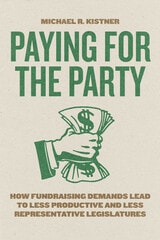
Paying for the Party
How Fundraising Demands Lead to Less Productive and Less Representative LegislaturesMichael R. Kistner
University of Chicago Press, 2026
A revealing, data-rich exploration of how American legislators transformed from active policymakers into party fundraisers.
Lawmakers in Congress and state legislatures across the United States spend enormous amounts of time and effort fundraising, not just for their own seats but for the party. Whether dialing for dollars or hosting high-priced fundraising events, the pursuit of campaign funds is now a massive part of the American legislator’s job description. What explains this transformation, and what are the consequences for public policy?
In Paying for the Party, Michael Kistner uses new theory and new data to answer these questions. He shows that state legislative party organizations—Democratic and Republican caucuses in capitols across the country—are responsible for turning their members into single-minded seekers of money. Parties reward legislators who contribute the most with powerful leadership and committee positions. Consequently, the members who now hold these agenda-setting positions are increasingly neither the most productive nor knowledgeable lawmakers, but rather those who can raise the most money. And when legislators are asked to raise more money, they skip committee hearings for fundraising events, enacting fewer substantive policies as a result. Paying for the Party shows that parties in contemporary American legislatures have hollowed out the policymaking capacity of their institutions and empowered a decidedly non-representative set of legislators.
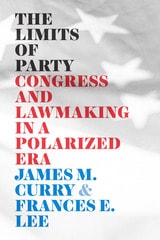
The Limits of Party
Congress and Lawmaking in a Polarized EraJames M. Curry and Frances E. Lee
University of Chicago Press, 2020
In The Limits of Party, James M. Curry and Frances E. Lee challenge this conventional wisdom. By constructing legislative histories of congressional majority parties’ attempts to enact their policy agendas in every congress since the 1980s and by drawing on interviews with Washington insiders, the authors analyze the successes and failures of congressional parties to enact their legislative agendas.
Their conclusions will surprise many congressional observers: Even in our time of intense party polarization, bipartisanship remains the key to legislative success on Capitol Hill. Congressional majority parties today are neither more nor less successful at enacting their partisan agendas. They are not more likely to ram though partisan laws or become mired in stalemate. Rather, the parties continue to build bipartisan coalitions for their legislative priorities and typically compromise on their original visions for legislation in order to achieve legislative success.

Where Women Run
Gender and Party in the American StatesKira Sanbonmatsu
University of Michigan Press, 2010
“Kira Sanbonmatsu has done a masterful job of linking the representation of women in elective office to the activities of party organizations in the states. She combines qualitative and quantitative data to show how women are navigating the campaign process to become elected leaders and the changing role of party organizations in their recruitment and election. It is a significant contribution to the study of representative democracy.”
--Barbara Burrell, Northern Illinois University
“Sanbonmatsu has produced an excellent study that will invigorate research on the role of political parties and the recruitment of women candidates. Using a variety of methods and data sources, she has crafted a tightly constructed, clearly argued, and exceedingly well-written study. A commendable and convincing job.”
--Gary Moncrief, Boise State University
“Sanbonmatsu offers important insights in two neglected areas of American politics: the role of political parties in recruiting candidates and the continued under-representation of women in elected office. Connecting the two subjects through careful qualitative and statistical methods, insightful interpretation of the literature and interesting findings, the book is a significant new addition to scholarship on parties, gender, and political recruitment.”
--Linda Fowler, Dartmouth College
Kira Sanbonmatsu is Associate Professor of Political Science at Rutgers University and Senior Scholar at the Eagleton Institute of Politics’ Center for American Women and Politics (CAWP). She was previously associate professor at Ohio State University. She is the author of Democrats, Republicans, and the Politics of Women’s Place.

Women, State, and Party in Eastern Europe
Sharon L. Wolchik and Alfred Meyer, eds.
Duke University Press, 1985