Results by title

5 books match the query 'Passive resistance'

cover of Direct Action: Radical Pacifism from the Union Eight to the Chicago Seven

Direct Action

Radical Pacifism from the Union Eight to the Chicago Seven

James Tracy

University of Chicago Press, 1996

Direct Action tells the story of how a small group of "radical pacifists"—nonviolent activists such as David Dellinger, Staughton Lynd, A.J. Muste, and Bayard Rustin—played a major role in the rebirth of American radicalism and social protest in the 1950s and 1960s. Coming together in the camps and prisons where conscientious objectors were placed during World War II, radical pacifists developed an experimental protest style that emphasized media-savvy, symbolic confrontation with institutions deemed oppressive. Due to their tactical commitment to nonviolent direct action, they became the principal interpreters of Gandhism on the American Left, and indelibly stamped postwar America with their methods and ethos. Genealogies of the Civil Rights, antiwar, and antinuclear movements in this period are incomplete without understanding the history of radical pacifism.

Taking us through the Vietnam war protests, this detailed treatment of radical pacifism reveals the strengths and limitations of American individualism in the modern era.
[more]
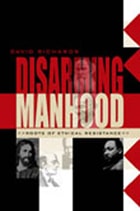
cover of Disarming Manhood: Roots of Ethical Resistance

Disarming Manhood

Roots of Ethical Resistance

David A.J. Richards

Ohio University Press, 2005
Masculine codes of honor and dominance often are expressed in acts of violence, including war and terrorism. In Disarming Manhood: Roots of Ethical Resistance, David A.J. Richards examines the lives of five famous men—great leaders and crusaders—who actively resisted violence and presented their causes with more humane alternatives.Richards argues that Winston Churchill, William Lloyd Garrison, Mohandas Gandhi, Martin Luther King, and Leo Tolstoy shared a psychology whose nonviolent roots were deeply influenced by a loving, maternalistic ethos deeply influenced by the teachings of Jesus of Nazareth. Drawing upon psychology, history, political theory, and literature, Richards threads a connection between these leaders and the maternal figures who profoundly shaped their responses to conflict. Their lives and work underscore how the outlook of maternal care givers and women enables some men to resist the violent responses characteristic of traditional manhood. The voice of nonviolent masculinity has empowered important democratic movements of ethical transformation, including civil disobedience in South Africa, India, and the United States. Disarming Manhood demonstrates that as Churchill, Garrison, Gandhi, King, and Tolstoy carried out their various missions they were galvanized by teachings whose ethical foundations rejected unjust violence and favored peaceful alternatives. Accessibly written and free of jargon, Disarming Manhood's exploration of human nature and maternal bonds will interest a wide audience as it furthers the understanding of human nature itself and contributes to the fields of developmental psychology and feminist scholarship.
[more]
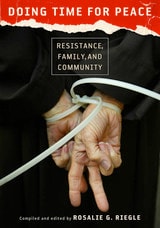
cover of Doing Time for Peace: Resistance, Family, and Community

Doing Time for Peace

Resistance, Family, and Community

Rosalie G. Riegle

Vanderbilt University Press, 2013

In this compelling collection of oral histories, more than seventy-five peacemakers describe how they say no to war-making in the strongest way possible--by engaging in civil disobedience and paying the consequences in jail or prison. These courageous resisters leave family and community and life on the outside in their efforts to direct U.S. policy away from its militarism. Many are Catholic Workers, devoting their lives to the works of mercy instead of the works of war. They are homemakers and carpenters and social workers and teachers who are often called "faith-based activists." They speak from the left of the political perspective, providing a counterpoint to the faith-based activism of the fundamentalist Right.


In their own words, the narrators describe their motivations and their preparations for acts of resistance, the actions themselves, and their trials and subsequent jail time. We hear from those who do their time by caring for their families and managing communities while their partners are imprisoned. Spouses and children talk frankly of the strains on family ties that a life of working for peace in the world can cause.


The voices range from a World War II conscientious objector to those protesting the recent war in Iraq. The book includes sections on resister families, the Berrigans and Jonah House, the Plowshares Communities, the Syracuse Peace Council, and Catholic Worker houses and communities.


The introduction by Dan McKanan situates these activists in the long tradition of resistance to war and witness to peace.
[more]
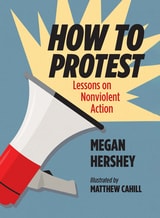
cover of How to Protest: Lessons on Nonviolent Action

How to Protest

Lessons on Nonviolent Action

Megan Hershey, Illustrations by Matthew Cahill

University of Wisconsin Press, 2026

Many people around the world are frustrated with their governments yet do not know what actions to take. Protest may feel out of reach, like something only seasoned activists can do. This accessible guide explores the creativity, joy, and accessibility of peaceful protest. Megan Hershey introduces readers to twenty-five specific and inspiring nonviolent protest methods through real-life examples from the past fifty years. Each chapter includes a short, vivid description of a bold nonviolent action taken by everyday people who demanded that their leaders listen to them. From patriotic choir concerts in Estonia to live painted pigs at the Ugandan parliament, these unique protest strategies will inspire those looking to effect change and offer encouragement from past successes.
[more]
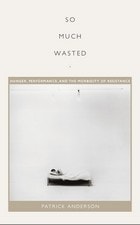
cover of So Much Wasted: Hunger, Performance, and the Morbidity of Resistance

So Much Wasted

Hunger, Performance, and the Morbidity of Resistance

Patrick Anderson

Duke University Press, 2010

In So Much Wasted, Patrick Anderson analyzes self-starvation as a significant mode of staging political arguments across the institutional domains of the clinic, the gallery, and the prison. Homing in on those who starve themselves for various reasons and the cultural and political contexts in which they do so, he examines the diagnostic history of anorexia nervosa, fasts staged by artists including Ana Mendieta and Marina Abramović, and a hunger strike initiated by Turkish prisoners. Anderson explores what it means for the clinic, the gallery, and the prison when one performs a refusal to consume as a strategy of negation or resistance, and the ways that self-starvation, as a project of refusal aimed, however unconsciously, toward death, produces violence, suffering, disappearance, and loss differently from other practices. Drawing on the work of Martin Heidegger, Sigmund Freud, Giorgio Agamben, Peggy Phelan, and others, he considers how the subject of self-starvation is refigured in relation to larger institutional and ideological drives, including those of the state. The ontological significance of performance as disappearance constitutes what Anderson calls the “politics of morbidity,” the embodied, interventional embrace of mortality and disappearance not as destructive, but rather as radically productive stagings of subject formations in which subjectivity and objecthood, presence and absence, and life and death are intertwined.
[more]