Results by title
24 books match the query 'Poet'
A Map of Mexico City Blues
Jack Kerouac as PoetJames T. Jones
Southern Illinois University Press, 1992
In this pioneering critical study of Jack Kerouac’s book-length poem, Mexico City Blues—apoetic parallel to the writer’s fictional saga, the Duluoz Legend—James T. Jones uses a rich and flexible neoformalist approach to argue his case for the importance of Kerouac’s rarely studied poem.
After a brief summary of Kerouac’s poetic career, Jones embarks on a thorough reading of Mexico City Blues from several different perspectives: he first focuses on Kerouac’s use of autobiography in the poem and then discusses how Kerouac’s various trips to Mexico, his conversion to Buddhism, his theory of spontaneous poetics, and his attraction to blues and jazz influenced the theme, structure, and sound of Mexico City Blues.
After the Death of Poetry
Poet and Audience in Contemporary AmericaVernon Shetley
Duke University Press, 1993
In exemplary case studies, Shetley identifies the very different ways in which three postwar poets—Elizabeth Bishop, James Merrill, and John Ashbery—try to restore some of the challenge and risk that characterized modernist poetry's relation to its first readers. Sure to be controversial, this cogent analysis offers poets and readers a clear sense of direction and purpose, and so, the hope of reaching each other again.
Bard of Iceland
Jonas Hallgrimsson, Poet and ScientistRichard Ringler
University of Wisconsin Press, 2002
Bard of Iceland makes available for the first time in any language other than Icelandic an extensive selection of works by Jónas Hallgrímsson (1807–1845), the most important poet of modern Iceland. Jónas was also Iceland’s first professionally trained geologist and an active contributor in a number of other scientific fields: geography, botany, zoology, and archaeology. He played a key role as well in Iceland’s struggle to gain independence from Denmark. "Descriptive power and fullness of spirit were the hallmarks of his soul," wrote a contemporary admirer.
Dick Ringler, one of the premier scholars of Icelandic literature in the world, offers a substantial biography of Jónas, a representative selection of his most important poems, and some of his prose work in science and belles lettres. Ringler also provides extended commentaries and an essay on Icelandic prosody.
The poems are translated into English equivalents of their original complex meters in Icelandic and Danish. As a poet Jónas was intimately familiar with his nation’s medieval literary inheritance—the sagas and eddas—and also with the groundbreaking work of contemporary German and Danish Romanticism (Chamisso, Heine, Oehlenschläger). A master of poetic form, Jónas not only exploited and enlarged the possibilities of traditional eddic and skaldic meters, but introduced the sonnet, triolet stanza, terza and ottava rima, and blank verse into the Icelandic metrical repertory.
Because the Light Will Not Forgive Me
Essays from a PoetShaun T, Griffin
University of Nevada Press, 2019
In this luminous and moving book of essays, award-winning author Shaun Griffin weaves together a poetic meditation on living meaningfully in this world. Anchored in the American West but reaching well beyond, he recounts his discoveries as a poet and devoted reader of poetry, a teacher of the disadvantaged, a friend of poets and artists, and a responsible member of the human family.
Always grounded in place, be it Nevada, South Africa, North Dakota, Spain, Zimbabwe, or Mexico, Griffin confronts the world with an openness that allows him to learn and grow from the people he meets. This is a meditation on how all of us can confront our own influences to achieve wholeness in our lives. Along with Griffin, readers will reflect on how they might respond to a homeless man walking through central Nevada, viewing the open desert as Thoreau might have viewed Walden, seeing the US-Mexico border as a region of lost identity, reconciling how poets who live west of the Hudson River find anonymity to be their laurel, and experiencing how writing poetry in prison becomes lifesaving.
Whether poets or places in the West or beyond, experiences with other cultures, or an acute awareness that poetry is the refuge of redress—all have influenced Griffin’s writing and thinking as a poet and activist in the Great Basin. The mindfulness of Because the Light Will Not Forgive Me demonstrates that even though the light does not forgive, it still reveals.

Becoming a Poet
Elizabeth Bishop with Marianne Moore and Robert LowellDavid Kalstone
University of Michigan Press, 2001
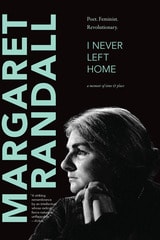
I Never Left Home
Poet, Feminist, RevolutionaryMargaret Randall
Duke University Press, 2020
From living among New York's abstract expressionists in the mid-1950s as a young woman to working in the Nicaraguan Ministry of Culture to instill revolutionary values in the media during the Sandinista movement, the story of Randall's life reads like a Hollywood production. Along the way, she edited a bilingual literary journal in Mexico City, befriended Cuban revolutionaries, raised a family, came out as a lesbian, taught college, and wrote over 150 books. Throughout it all, Randall never wavered from her devotion to social justice.
When she returned to the United States in 1984 after living in Latin America for twenty-three years, the U.S. Immigration and Naturalization Service ordered her to be deported for her “subversive writing.” Over the next five years, and with the support of writers, entertainers, and ordinary people across the country, Randall fought to regain her citizenship, which she won in court in 1989.
As much as I Never Left Home is Randall's story, it is also the story of the communities of artists, writers, and radicals she belonged to. Randall brings to life scores of creative and courageous people on the front lines of creating a more just world. She also weaves political and social analyses and poetry into the narrative of her life. Moving, captivating, and astonishing, I Never Left Home is a remarkable story of a remarkable woman.
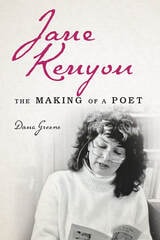
Jane Kenyon
The Making of a PoetDana Greene
University of Illinois Press, 2023
Pleasure-loving, sarcastic, stubborn, determined, erotic, deeply sad--Jane Kenyon’s complexity and contradictions found expression in luminous poems that continue to attract a passionate following. Dana Greene draws on a wealth of personal correspondence and other newly available materials to delve into the origins, achievement, and legacy of Kenyon’s poetry and separate the artist’s life story from that of her husband, the award-winning poet Donald Hall.
Impacted by relatives’ depression during her isolated childhood, Kenyon found poetry at college, where writers like Robert Bly encouraged her development. Her graduate school marriage to the middle-aged Hall and subsequent move to New Hampshire had an enormous impact on her life, moods, and creativity. Immersed in poetry, Kenyon wrote about women’s lives, nature, death, mystical experiences, and melancholy--becoming, in her own words, an “advocate of the inner life.” Her breakthrough in the 1980s brought acclaim as “a born poet” and appearances in the New Yorker and elsewhere. Yet her ongoing success and artistic growth exacerbated strains in her marriage and failed to stave off depressive episodes that sometimes left her non-functional. Refusing to live out the stereotype of the mad woman poet, Kenyon sought treatment and confronted her illness in her work and in public while redoubling her personal dedication to finding pleasure in every fleeting moment. Prestigious fellowships, high-profile events, residencies, and media interviews had propelled her career to new heights when leukemia cut her life short and left her husband the loving but flawed curator of her memory and legacy.
Revelatory and insightful, Jane Kenyon offers the first full-length biography of the elusive poet and the unquiet life that shaped her art.
Life of a Poet
Rainer Maria RilkeRalph Freedman
Northwestern University Press, 1998
Listen to the Poet
Writing, Performance, and Community in Youth Spoken Word PoetryWendy R. Williams
University of Massachusetts Press, 2019
Listen to the Poet investigates two Arizona spoken word poetry groups—a community group and a high school club—that are both part of the same youth organization. Exploring the writing lives and poetry of several members, Wendy R. Williams takes readers inside a writing workshop and poetry slam and reveals that schools have much to learn about writing, performance, community, and authorship from groups like these and from youth writers themselves.
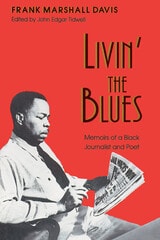
Livin' the Blues
Memoirs of a Black Journalist and PoetFrank Marshall Davis
University of Wisconsin Press, 1993
Frank Marshall Davis was a prominent poet, journalist, jazz critic, and civil rights activist on the Chicago and Atlanta scene from the 1920s through 1940s. He was an intimate of Langston Hughes and Richard Wright and an influential editor at the Chicago Evening Bulletin, the Chicago Whip, the Chicago Star, and the Atlanta World. He renounced his writing career in 1948 and moved to Hawaii, forgotten until the Black Arts Movement rediscovered him in the 1960s.
Because of his early self-exile from the literary limelight, Davis's life and work have been shrouded in mystery. Livin' the Blues offers us a chance to rediscover this talented poet and writer and stands as an important example of black autobiography, similar in form, style, and message to those of Langston Hughes and Richard Wright.
"Both a social commentary and intellectual exploration into African American life in the twentieth century."—Charles Vincent, Atlanta History
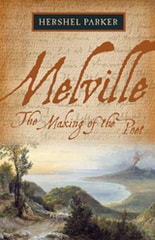
Melville
The Making of the PoetHershel Parker
Northwestern University Press, 2007
“Who would have looked for philosophy in whales, or for poetry in blubber?” the London John Bull remarked in October of 1851. And yet, the reviewer went on, “few books which professedly deal in metaphysics, or claim the parentage of the muses, contain as much true philosophy and as much genuine poetry as the tale of the Pequod's whaling expedition.” A decade and a half before surprising the world with a book of Civil war poetry, Melville was already confident of what was “poetic” in his prose. As Hershel Parker demonstrates in this book, Melville was steeped in poetry long before he called himself a poet.
Here Parker, the dean of Melville studies, gives a compelling, in-depth account of how one of America’s greatest writers grew into the vocation of a poet. His work corrects two of the most pernicious misconceptions about Melville perpetuated by earlier critics: that he repudiated fiction writing after Pierre, and that he hadn’t begun writing poetry (let alone had a book of poems ready for publication) as early as 1860. In clearing up these misapprehensions, Parker gives a thorough and thoroughly involving account of Melville’s development as a poet. Parker demonstrates for the first time just how crucial poetry was to Melville from childhood to old age, especially its re-emergence in his life after 1849. Drawing on Melville's shrewd annotations of great British poets and on his probing, skeptical engagement with commentaries on poetry (particularly by the great Scots reviewers), Parker paints a richly textured portrait of a hitherto unseen side of Herman Melville.
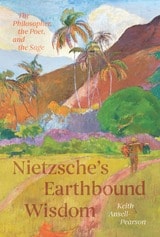
Nietzsche's Earthbound Wisdom
The Philosopher, the Poet, and the SageKeith Ansell-Pearson
University of Chicago Press, 2025
Today, Nietzsche is justly celebrated for his rich, philosophical naturalism, but Keith Ansell-Pearson warns that we must not overlook the visionary dimension of his thinking and his focus on the need to cultivate a new care of the self and care of life. In Nietzsche’s Earthbound Wisdom, Ansell-Pearson recovers Nietzsche’s love for a philosophy that guides us through our passions, one that opens us more fully to the possibilities of life and the joy of knowledge.
Ansell-Pearson offers close readings of Nietzsche’s texts in conversation with philosophical and literary figures including Augustine, Baudelaire, Carlyle, Dostoevsky, Emerson, Flaubert, Stendhal, and more. Throughout, Ansell-Pearson examines Nietzsche’s sophisticated critique of literary naturalism and his alternative conception of the poet as a seer who has a deep longing for a new earth.
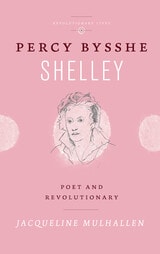
Percy Bysshe Shelley
Poet and RevolutionaryJaqueline Mulhallen
Pluto Press, 2015
An engaging look at one of English history and literature’s most compelling, complicated, and talented figures, Percy Bysshe Shelley will be a valuable contribution to our understanding of the man and his work.
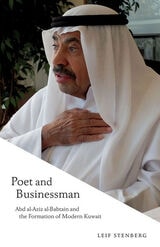
Poet and Businessman
Abd al-Aziz al-Babtain and the Formation of Modern KuwaitLeif Stenberg
Gingko, 2022
This book reviews and analyzes the modern history of Kuwait through the life of Abd al-Aziz Sa‘ud al-Babtain, a wealthy businessman, philanthropist, and poet. He is the head of a large, influential international cultural foundation based in Kuwait City. Abd al-Aziz’s life story tightly interweaves with modern discussions on the history of the state of Kuwait. There are very few books taking a collective grip on the history of the state of Kuwait. Likewise, there are very few studies about the generation of Gulf individuals who experienced, benefitted from, and even suffered from the discovery of oil, and who has been a crucial part of socioeconomic and cultural developments in countries like Kuwait in recent history. By constructing a cohesive overview of the modern history of Kuwait enriched by the life of an individual that has lived through the better part of that particular history, this book fills a lacuna in contemporary scholarship on the Middle East, and especially the Arabian or the Persian Gulf.
Realizing Metaphors
Alexander Pushkin and the Life of the PoetDavid M. Bethea
University of Wisconsin Press, 1998
Readers often have regarded with curiosity the creative life of the poet. In this passionate and authoritative new study, David Bethea illustrates the relation between the art and life of nineteenth-century poet Alexander Pushkin, the central figure in Russian thought and culture. Bethea shows how Pushkin, on the eve of his two-hundredth birthday, still speaks to our time. He indicates how we as modern readers might "realize"— that is, not only grasp cognitively, but feel, experience—the promethean metaphors central to the poet's intensely "sculpted" life. The Pushkin who emerges from Bethea's portrait is one who, long unknown to English-language readers, closely resembles the original both psychologically and artistically.
Bethea begins by addressing the influential thinkers Freud, Bloom, Jakobson, and Lotman to show that their premises do not, by themselves, adequately account for Pushkin's psychology of creation or his version of the "life of the poet." He then proposes his own versatile model of reading, and goes on to sketches the tangled connections between Pushkin and his great compatriot, the eighteenth-century poet Gavrila Derzhavin. Pushkin simultaneously advanced toward and retreated from the shadow of his predecessor as he created notions of poet-in-history and inspiration new for his time and absolutely determinative for the tradition thereafter.

Rimbaud and Jim Morrison
The Rebel as PoetWallace Fowlie
Duke University Press, 1994
In 1968 Jim Morrison, founder and lead singer of the rock band the Doors, wrote to Wallace Fowlie, a scholar of French literature and a professor at Duke University. Morrison thanked Fowlie for producing an English translation of the complete poems of Rimbaud. He needed the translation, he said, because, "I don’t read French that easily. . . . I am a rock singer and your book travels around with me." Fourteen years later, when Fowlie first heard the music of the Doors, he recognized the influence of Rimbaud in Morrison’s lyrics.
In Rimbaud and Jim Morrison Fowlie, a master of the form of the memoir, reconstructs the lives of the two youthful poets from a personal perspective. In their twinned stories he discovers an uncanny symmetry, a pattern far richer than the simple truth that both led lives full of adventure and both made poetry of their thirst for the liberation of the self. The result is an engaging account of the connections between an exceptional French symbolist who gave up writing poetry at the age of twenty, died young, and whose poems are still avidly read to this day, and an American rock musician whose brief career ignited an entire generation and has continued to fascinate millions around the world in the twenty years since his death in Paris. In this dual portrait, Fowlie gives us a glimpse of the affinities and resemblances between European literary traditions and American rock music and youth culture in the late twentieth century.
A personal meditation on two unusual, yet emblematic, cultural figures, this book also stands as a summary of a noted scholar’s lifelong reflections on creative artists.
The Image of the Poet in Ovid’s Metamorphoses
Barbara Pavlock
University of Wisconsin Press, 2009
The Image of the Poet explores issues central to Ovid’s poetics—the status of the image, the generation of plots, repetition, opposition between refined and inflated epic style, the reliability of the narrative voice, and the interrelation of rhetoric and poetry. The work explores the constructed author and complements recent criticism focusing on the reader in the text.
2009 Outstanding Academic Title, Choice Magazine
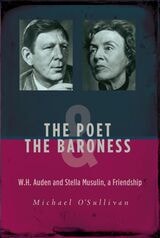
The Poet & the Baroness
W.H. Auden and Stella Musulin, a FriendshipMichael O'Sullivan
Central European University Press, 2023
For long periods in history, the Austrian capital found itself on the geographical edge of western civilisation. Yet from the 18th century on, Vienna has been a vibrant centre of European culture. This city is the scene of the formidable meeting of the two outstanding intellectuals that are at the core of this book.
The warm relationship between W.H. Auden, the celebrated British-American poet (1907–1973), and his fellow expatriate, the Welsh-Austrian journalist, translator and writer Stella Musulin (1915–1996) lasted while Auden resided in the nearby small town of Kirchstetten starting in 1958. It was here that the poet was laid to rest in the autumn of 1973. This book is based on the unpublished letters of Auden to Musulin and her private journals.
The study of this inspiring material yields new insights into Auden’s last, prolific, creative period and underscores the ‘Austrian Auden.’ In addition, Michael O’Sullivan pays tribute to the closest ‘Austrian’ friend of the poet. Baroness Stella von Musulin was an intellectual whose two books for Faber & Faber are acknowledged as classics: Vienna in the Age of Metternich and Austria: People & Landscape (with a foreword by Auden). The author situates the close relationship of two individuals in the context of Austria’s complex political, social, and cultural history in the Cold War years.
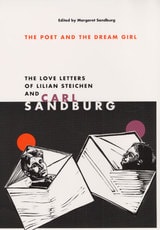
The Poet and Dream Girl
The Love Letters of Lilian Steichen and Carl SandburgEdited by Margaret Sandburg
University of Illinois Press, 1987
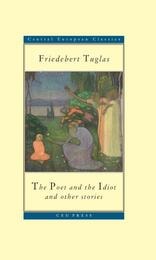
The Poet and the Idiot
Friedebert Tuglas
Central European University Press, 2007
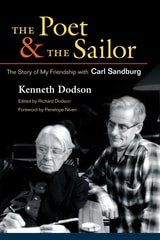
The Poet and the Sailor
The Story of My Friendship with Carl SandburgKenneth Dodson. Edited by Richard Dodson. Foreword by Penelope Niven
University of Illinois Press, 2006
Carl Sandburg first encountered Kenneth Dodson through a letter written at sea during World War II. Though Dodson wrote the letter to his wife, Letha, Sandburg read it in tears and told her, "I've got to meet this man." Composed primarily of their correspondence that continued until Sandburg's death in 1967, The Poet and the Sailor is a chronicle of the deep friendship that followed. Ranging over anything they found important, from writing to health and humor, the letters are arranged by Richard Dodson and are accompanied by a foreword from Sandburg's noted biographer, Penelope Niven.
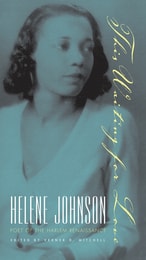
This Waiting for Love
Helene Johnson, Poet of the Harlem RenaissanceVerner D. Mitchell
University of Massachusetts Press, 2000
This volume brings together all of the known poetry and a selection of correspondence by an enormously talented but underappreciated poet of the Harlem Renaissance. Cousin of novelist Dorothy West and friend of Zora Neale Hurston, Helene Johnson (1905–1995) first gained literary prominence when James Weldon Johnson and Robert Frost selected three of her poems for prizes in a 1926 competition. During the late 1920s and early 1930s her poetry appeared in various small magazines, such as the Saturday Evening Quill, Palms, Opportunity, and Harlem. In 1933 Johnson married, and two years later her last published poem, “Let Me Sing My Song,” appeared in Challenge, the journal West had founded to revive the spirit of the Harlem Renaissance.
In his well-researched introduction, Verner D. Mitchell reconstructs Johnson's life, the details of which have long been veiled from public view, and places her in the context of a vital literary tradition. In addition to discussing her relationship with West, Hurston, and other black women writers, he explores the distinctive, at times radical, qualities of her work. Ever willing to defy the genteel conventions that governed women's writing, Johnson wrote poems on erotic themes and engaged the aesthetic, gender, and racial politics of her time.
Cheryl A. Wall's foreword also celebrates Johnson's talent, particularly the ease with which she moved among various verse forms—from the rigor of the sonnet to the improvisational creativity of free black vernacular. “An unexpected and most welcome gift,” This Waiting for Love, Wall writes, is “an enduring tribute” to “the vibrant poetry of Helene Johnson.”
What Is A Poet?
Hank Lazer
University of Alabama Press, 1987
This book discusses the extent of distrust and the extent of the misunderstandings that exist in the poetry world.
Whitman's Southern Sojourn
Rediscovering the Poet in New Orleans, 1848Stefan Schöberlein
University of Iowa Press, 2025
Far from some brief escape, New Orleans was a significant milestone in Whitman’s development as a political firebrand, as well as a major step for a professional journalist on the rise. Through a wealth of new texts, contexts, and personalities, Stefan Schöberlein and Zachary Turpin paint a vivid picture of a writer on the verge of Leaves of Grass, embracing the contradictions and the multitudes of New Orleans.