Results by title
8 books match the query 'Peddlers'

Chicago's Tough Jews
Peddlers, Street Brawlers, and Schoolyard CrewsDavid Farber
University of Chicago Press, 0
The untold story of the immigrant Jewish boys and men who fought back against violent neighborhood gangs in early twentieth-century Chicago.
In Chicago’s Tough Jews, Farber tells the story of how first- and second-generation Jewish immigrants from Eastern Europe fought their ethnic rivals on Chicago’s mean streets. These Jewish immigrants used their fists and, when necessary, bats and pipes to defend themselves and their neighborhoods.
Farber first heard these stories from his grandfather and his grandfather’s cronies. Jewish Chicagoans, he was told, tried to get the city authorities to stop the vicious antisemitic attacks on peddlers, merchants, and school kids. When that failed, they decided to physically fight to claim their place in the city. Farber vividly details these street battles, particularly with Polish and Irish gangs, up into the 1920s. Ultimately, he argues, “Jewish hard men” were part of a larger community-wide self-defense struggle against violent Jew bashers, antisemites, and an indifferent political and legal system.
Today, when questions of antisemitism and Jewish identity are again being fiercely debated across the country, this account of a past generation’s struggles in Chicago presents a thought-provoking recasting of American Jewish history.
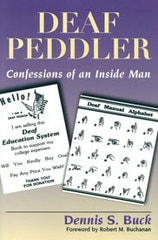
Deaf Peddler
Confessions of an Inside ManDennis S. Buck
Gallaudet University Press, 2000
In airports and train stations it is not unusual for waiting passengers to be approached by a person who will hand out a brochure or trinket, then indicate that he or she is deaf and ask for payment, anything they can afford. In many instances, the travelers feel pity for the poor unfortunate and dole out a dollar or two, yet most are utterly unaware that these pitiful beggars earn hundred of dollars this way in a matter of a few hours. Dennis Buck knows this unique form of panhandling intimately because, despite holding a degree in computer science and receiving Supplemental Security Income (SSI) and Social Security Disability Insurance (SSDI), he was a deaf peddler for 11 years.
In Deaf Peddler: Confessions of an Inside Man, Buck unveils all of the ins and outs of exploiting his “disabilities” to earn easy money. Buck details the day-to-day life of a deaf peddler, including where to go to make the most money in the least time (airports with their constant transient clientele, malls on weekends, and fast food restaurants), how to live on the cheap (wait for people checking out to leave their motel rooms, then sneak in to use the shower), and how to live well when business is good. He also explains how he organized his rounds using a spreadsheet program.
Deaf Peddler also provides a historical perspective on deaf peddling as a way for under-educated deaf people to make a living when jobs were hard to find, wages were low, and Social Security did not exist. The “no good” life served as the rationale to many deaf people for peddling, but many more in the Deaf community deplored their actions, and the National Association of the Deaf campaigned to discourage this behavior that reinforced deaf stereotypes. Buck abandoned peddling himself for this reason, but he points out that deaf peddling survives today, frequently in the highly exploitative form of rings of deaf workers completely controlled by oppressive deaf and hearing overseers. Deaf Peddler presents in engaging fashion a little-known cultural phenomenon that offers a revealing turn on the general issue of panhandling in our society today.
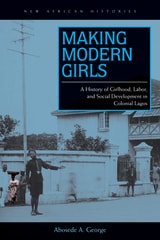
Making Modern Girls
A History of Girlhood, Labor, and Social Development in Colonial LagosAbosede A. George
Ohio University Press, 2014
Winner of the 2015 Aidoo-Snyder Book Prize for outstanding book on African women's experiences. (African Studies Association)
Honorable Mention, New York African Studies Association Book Prize
In Making Modern Girls, Abosede A. George examines the influence of African social reformers and the developmentalist colonial state on the practice and ideology of girlhood as well as its intersection with child labor in Lagos, Nigeria. It draws from gender studies, generational studies, labor history, and urban history to shed new light on the complex workings of African cities from the turn of the twentieth century through the nationalist era of the 1950s.
The two major schemes at the center of this study were the modernization project of elite Lagosian women and the salvationist project of British social workers. By approaching children and youth, specifically girl hawkers, as social actors and examining the ways in which local and colonial reformers worked upon young people, the book offers a critical new perspective on the uses of African children for the production and legitimization of national and international social development initiatives.
Making Modern Girls demonstrates how oral sources can be used to uncover the social history of informal or undocumented urban workers and to track transformations in practices of childhood over the course of decades. George revises conventional accounts of the history of development work in Africa by drawing close attention to the social welfare initiatives of late colonialism and by highlighting the roles that African women reformers played in promoting sociocultural changes within their own societies.

Pearls, Peaches, and Peddlers
Short Essays on Arkansas’s Amazing HistoryTom Dillard
University of Arkansas Press, 2027
In Pearls, Peaches, and Peddlers: Short Essays on Arkansas’s Amazing History, Tom Dillard offers a lively portrait of Arkansas that reveals how the state was shaped by ordinary people, unexpected industries, and moments of upheaval both grand and small.
The seventy-four essays collected here draw upon Dillard’s career as a historian, archivist, educator, and preservationist to challenge familiar myths, reveal overlooked stories, and demonstrate how the history of one state can illuminate the larger American experience.

Peddlers and Princes
Social Development and Economic Change in Two Indonesian TownsClifford Geertz
University of Chicago Press, 1968
"Peddlers and Princes is, like much of Geertz's other writing, eminently rewarding . . . Case study and broader theory are brought together in an illuminating marriage."—Donald Hindley, Annals of The American Academy of Political and Social Science
"What makes the book fascinating is the author's capacity to relate his anthropological findings to questions of central concern to the economist . . . "—H. G. Johnson, Journal of Political Economy

Peddlers of Hate
How the Ku Klux Klan Seized Power in 1920s OregonSteve Law
Oregon State University Press, 2026
The revived Knights of the Ku Klux Klan flourished in Oregon in the early 1920s. With more than sixty chapters established in both large and small communities like Portland, Medford, Astoria, and La Grande, the Klan’s power escalated in the region. Klan salesmen, working on commission, successfully enlisted Oregonians with a message of religious prejudice and racism. At the Klan’s peak, Portland was home to the sixth largest chapter in the country and there were more members per capita in Oregon than in any other state except one.
In Peddlers of Hate, journalist Steve Law draws on published and unpublished sources, new research, and interviews with leading scholars to provide a comprehensive account of how Oregon became one of the Klan’s strongest outposts. Representing the Klan as merely a fraternal lodge, Klan recruiters were trained to vilify Catholics, immigrants, Blacks, and Jews. They gained wide support, toppling an incumbent governor and congressman, persuading voters to ban Catholic schools, and winning control of the legislature and several local governments. From stories of “escaped nuns” to fiery crosses at mass Klan rallies at Salem’s state fairgrounds and Portland’s Mount Tabor Park, Law examines this divisive and forgotten time in Oregon’s history. He shows how it was finally greed, hypocrisy, and corruption that spurred the hate group’s demise—providing historical lessons that will resonate today.
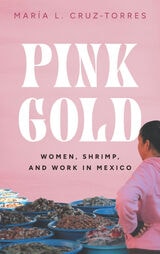
Pink Gold
Women, Shrimp, and Work in MexicoMaria L. Cruz-Torres
University of Texas Press, 2023
A rich, long-term ethnography of women seafood traders in Mexico.
The "shrimp ladies," locally known as changueras in southern Sinaloa, Mexico, sell seafood in open-air markets, forming an extralegal but key part of the economy built around this "pink gold.” Over time, they struggled to evolve from marginalized peddlers to local icons depicted in popular culture, even as they continue to work at an open-air street market.
Pink Gold documents the shrimp traders' resilience and resourcefulness, from their early conflicts with the city, state, and federal authorities and forming a union, to carving out a physical space for a seafood market, and even engaging in conflicts with the Mexican military. Drawing from her two decades of fieldwork, María L. Cruz-Torres explores the inspiring narrative of this overlooked group of women involving grassroots politics, trans-border and familial networking, debt and informal economic practices, personal sacrifices, and simple courage. She argues that, amid intense economic competition, their success relies on group solidarity that creates interlocking networks of mutual trust, or confianza, that in turn enable them to cross social and political boundaries that would typically be closed to them. Ultimately, Pink Gold offers fresh insights into issues of gender and labor, urban public space, the street economy, commodities, and globalization.

Pioneers, Peddlers, and Tsadikim
The Story of Jews in ColoradoIda Libert Uchill
University Press of Colorado, 2000