Results by title
10 books match the query 'Peloponnesian War, 431-404 B.C'

A Historical Commentary on Thucydides
A Companion to Rex Warner's Penguin TranslationDavid Cartwright
University of Michigan Press, 1997
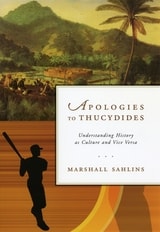
Apologies to Thucydides
Understanding History as Culture and Vice VersaMarshall Sahlins
University of Chicago Press, 2004
Sahlins begins by confronting Thucydides' account of the Peloponnesian War with an analogous "Polynesian War," the fight for the domination of the Fiji Islands (1843-55) between a great sea power (like Athens) and a great land power (like Sparta). Sahlins draws parallels between the conflicts with an eye to their respective systems of power and sovereignty as well as to Thucydides' alternation between individual (Pericles, Themistocles) and collective (the Athenians, the Spartans) actors in the making of history. Characteristic of most histories ever written, this alternation between the agency of "Great Men" and collective entities leads Sahlins to a series of incisive analyses ranging in subject matter from Bobby Thomson's "shot heard round the world" for the 1951 Giants to the history-making of Napoleon and certain divine kings to the brouhaha over Elián Gonzalez. Finally, again departing from Thucydides, Sahlins considers the relationship between cultural order and historical contingency through the recounting of a certain royal assassination that changed the course of Fijian history, a story of fratricide and war worthy of Shakespeare.
In this most convincing presentation yet of his influential theory of culture, Sahlins experiments with techniques for mixing rich narrative with cultural explication in the hope of doing justice at once to the actions of persons and the customs of people. And he demonstrates the necessity of taking culture into account in the creation of history—with apologies to Thucydides, who too often did not.
Commentary on Thucydides, Book 3
Rachel Bruzzone
University of Michigan Press, 2025
Commentary on Thucydides, Book 3 remedies this situation by offering detailed linguistic explanations and grammatical clarifications designed to appeal both to seasoned Classicists and to a broader group of non-specialist readers who may still be developing their Greek language skills. Starting with 428 BCE, Book 3 covers a critical period of the Peloponnesian War in which the conflict began to manifest its extraordinary violence and scale. The book contains influential and controversial discussions, including Thucydides’ own analysis of the nature of war and the ways that it teaches “lessons of violence” to individuals and states. Book 3 also features the famous Mytilenean Debate, an argument premised on the thesis that all international relations are, or should be, fundamentally amoral. Educated readers have always looked to Thucydides in turbulent times, and this commentary will open up his text to a wider audience.
Diodorus Siculus, The Persian Wars to the Fall of Athens
Books 11-14.34 (480-401 BCE)Translated with Introduction and Notes by Peter Green
University of Texas Press, 2010
Only one surviving source provides a continuous narrative of Greek history from Xerxes' invasion to the Wars of the Successors following the death of Alexander the Great—the Bibliotheke, or "Library," produced by Sicilian historian Diodorus Siculus (ca. 90–30 BCE). Yet generations of scholars have disdained Diodorus as a spectacularly unintelligent copyist who only reproduced, and often mangled, the works of earlier historians. Arguing for a thorough critical reappraisal of Diodorus as a minor but far from idiotic historian himself, Peter Green published Diodorus Siculus, Books 11-12.37.1, a fresh translation, with extensive commentary, of the portion of Diodorus's history dealing with the period 480–431 BCE, the so-called "Golden Age" of Athens.
This is the only recent modern English translation of the Bibliotheke in existence. In the present volume—the first of two covering Diodorus's text up to the death of Alexander—Green expands his translation of Diodorus up to Athens' defeat after the Peloponnesian War. In contrast to the full scholarly apparatus in his earlier volume (the translation of which is incorporated) the present volume's purpose is to give students, teachers, and general readers an accessible version of Diodorus's history. Its introduction and notes are especially designed for this audience and provide an up-to-date overview of fifth-century Greece during the years that saw the unparalleled flowering of drama, architecture, philosophy, historiography, and the visual arts for which Greece still remains famous.

Lysistrata
A New Verse TranslationAristophanes, Translated by David Mulroy, with Introduction and Notes
University of Wisconsin Press, 2020
A perennial classroom and stage favorite as well as the basis of Spike Lee’s Chi-Raq, the play is as relevant today as it was 2,500 years ago. The premise is simplicity itself: to end the Peloponnesian War, women decide to withhold sex from their husbands until the fighting stops.
The play is by turns raucous, bawdy, frantic, and funny. David Mulroy’s exciting new translation retains the original’s verse format, racy jokes, and vibrancy—setting it apart from previous efforts, which are typically reproduced as prose or depart from meaning and meter. His introduction offers a concise summary of Aristophanes’ life and social milieu, including a brief overview of the Peloponnesian War, which took place during the playwright’s lifetime. The appendices include guides on translating meter and Greek pronunciation for aspiring thespians.

READING THUCYDIDES
James V. Morrison
The Ohio State University Press, 2006
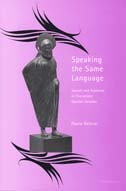
Speaking the Same Language
Speech and Audience in Thucydides' Spartan DebatesPaula Debnar
University of Michigan Press, 2002
Speaking the Same Language seeks to recover the role played by the audiences within the History. By restoring the internal audiences to a more prominent place, Debnar emphasizes the perspective of the participants in the war and heightens the dramatic immediacy of the debates. She thoroughly analyzes twelve speeches delivered by or to the Spartans, demonstrating how the earlier speeches illustrate the role of discourse in the construction of Sparta's identity and the unification of her Dorian allies in the face of their primarily Ionian adversaries.
Combining close textual analysis with an examination of narrative and historical context, Debnar bridges the gap between literary and historical studies of Thucydides. Accessible to specialists and nonspecialists alike, her work will interest those working in the fields of Greek literature, ancient historiography, rhetoric, political science, and ethnic studies.
Paula Debnar is Associate Professor of Classics, Mount Holyoke College.
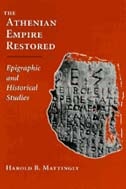
The Athenian Empire Restored
Epigraphic and Historical StudiesHarold B. Mattingly
University of Michigan Press, 1996
This volume collects Harold B. Mattingly's most important essays on the question, and offers them in updated form together with a new introduction and notes, and a concordance of inscriptions. A preface by Mortimer Chambers helps place the volume amid the decades- long controversy about events in and around Athens, and describes the scientific technique that has proven Mattingly's argument.
In the process of establishing a sounder methodology for investigating this crucial period of Greek--and Western--history, Mattingly in these groundbreaking essays turns a beacon of light on many aspects of Greek and Athenian society and history.
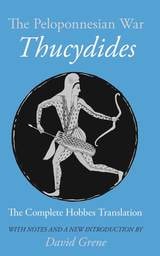
The Peloponnesian War
Thucydides
University of Chicago Press, 1989
The classic account of the struggle between Athens and Sparta that has fascinated readers of history for centuries
Thucydides’s account of the war between Athens and Sparta, begun in 431 BCE when the war commenced, is considered by many to be the first work of serious history. Applying then-new standards of evidence, impartiality, and cause and effect—and, crucially, banishing the gods from his tale—Thucydides created a gripping, detailed narrative of the civilization-shaking clash of two imperial powers that brings to life the ancient world and its conflict.
This powerful translation by Thomas Hobbes has long been considered the truest to the original Greek. Hobbes’s eloquent and lucid style captures Thucydides’s use of language in recreating the conflict, as well as Thucydides’s special ability to portray and enliven that led to his revealing accounts of the people and events in that long war: Pericles’s funeral oration, the plague, the civil war in Corcyra, the debate between Cleon and Diodotus over the fate of Mitylene, the Melian Dialogue, and above all the ruin of the Sicilian expedition. Hobbes’s rendering of The Peloponnesian War is one of those rare translations that are works of art in their own right.
David Grene’s notes clarify the few mistranslations of which Hobbes is guilty, the occasional difficulties of Hobbes’s seventeenth-century English, and passages involving facts and circumstances not familiar to those who cannot read Greek. This edition also includes Hobbes’s essay “On the Life and History of Thucydides,” his address to his general readers and dedicatory epistle, and a new Introduction by Grene. Written before Hobbes’s works on political philosophy, this translation sheds light on his later Leviathan and other works and, above all, displays the intensity of the relation between the Greek historian and the seventeenth-century philosopher.
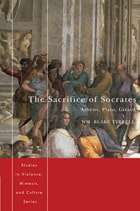
The Sacrifice of Socrates
Athens, Plato, GirardWm. Blake Tyrrell
Michigan State University Press, 2012
When Athenians suffered the shame of having lost a war from their own greed and foolishness, around 404 BCE the public’s blame was directed at Socrates, a man whose unique appearance and behavior, as well as his disapproval of the democracy, made him a ready target. Socrates was subsequently put on trial and sentenced to death. However, as René Girard has pointed out, no individual can be held responsible for a communal crisis. Plato’s Apology depicts Socrates as both the bane and the cure of Greek society, while his Crito shows a sacrificial Socrates, what some might consider a pharmakos figure, the human drug through whom Plato can dispense his philosophical remedies. With tremendous insight and satisfying complexity, this book analyzes classical texts through the lens of Girard’s mimetic mechanism.