Results by title
9 books match the query 'Pensions'
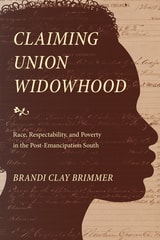
Claiming Union Widowhood
Race, Respectability, and Poverty in the Post-Emancipation SouthBrandi Clay Brimmer
Duke University Press, 2020
Issues in Pension Economics
Edited by Zvi Bodie, John B. Shoven, and David A. Wise
University of Chicago Press, 1987
The papers in this volume cover such issues as the interaction of pension-funding decisions and corporate finances; the role of pensions in providing adequate and secure retirement income, including the integration of pension plans with social security and significant drops in the U.S. saving rate; and the incentive effects of pension plans on labor market behavior and the implications of plans on labor market behavior and the implications of plans for different demographic groups.
Issues in Pension Economics offers important empirical studies and makes valuable theoretical contributions to current thinking in an area that will most likely continue to be a source of controversy and debate for some time to come. The volume should prove useful to academics and policymakers, as well as to members of the business and labor communities.
Pensions in the American Economy
Laurence J. Kotlikoff and Daniel E. Smith
University of Chicago Press, 1984
The picture that emerges of the "typical" plan and its significant variations is crucial to all those with a financial stake in pensions. The reader can compare pension vesting, retirement, and benefit provisions by plan type, plan size, industry, union status, and many more characteristics. With this information, workers can evaluate just how generous their employer is; job applicants can compare fringe benefits of prospective employers; personnel directors can judge their competitive edge.
The financial community will find especially interesting the analysis of the unfunded liabilities of private, state, and local pension funds. The investment decisions of private and public pension funds and their return performances are described as well.
Government officials and social scientists will find the analysis of pension coverage, the receipt of pension income by the elderly, cost-of-living adjustments, and disability insurance of special importance in evaluating the proper degree of public intervention in the area of old age income support.
Pensions in the American Economy is comprehensive and easy to use. Every reader, from small-business owners and civil servants to pension fund specialists, will find in it essential information about this increasingly important part of labor compensation and retirement finances.
Pensions in the U.S. Economy
Edited by Zvi Bodie, John B. Shoven, and David A. Wise
University of Chicago Press, 1988
Steven F. Venti and David A. Wise offer a careful analysis of who contributes to IRAs and why. Benjamin M. Friedman and Mark Warshawsky look at the reasons more retirement saving is not used to purchase annuities. Personal saving through pension contribution is discussed by B. Douglas Bernheim and John B. Shoven in the context of recent government and corporate pension funding changes. Michael J. Boskin and John B. Shoven analyze indicators of the economic well-being of the elderly, addressing the problem of why a large fraction of the elderly remain poor despite a general improvement in the economic status of the group as a whole. The relative merits of defined contribution versus defined benefit plans, with emphasis on the risk aspects of the two types of plans for the individual, are examined by Zvi Bodie, Alan J. Marcus, and Robert C. Merton. In the final paper, pension plans and worker turnover are the focus of the discussion by Edward P. Lazear and Robert L. Moore, who propose pension option value rather than the commonly used accrued pension wealth as a measure of pension value.
Pensions, Labor, and Individual Choice
David A. Wise
University of Chicago Press, 1985
Previous books on private pensions have largely neglected behavioral implications of the features of pension plans. The papers in this volume, developed from material presented at a recent National Bureau of Economic Research conference, address two aspects of the relation between varieties of labor coverage and participation in the labor force. First, age at retirement may be correlated with kind of pension coverage. The papers, in fact, provide strong evidence that individual decisions about when to retire are directly influenced by pension options. Second, pension plans usually impose a high cost on workers who change jobs, which suggests that pension coverage reduces instances of job change. Pensions, Labor, and Individual Choice quantifies these correlations and proposes a conceptual framework within which to view them.
Social Security Pension Reform in Europe
Edited by Martin Feldstein and Horst Siebert
University of Chicago Press, 2002
The essays here highlight the problems that the European pension reform process faces and how it differs from that of the United States. This timely volume will significantly enrich the debate on pension reform worldwide.
The Gender Impact of Social Security Reform
Estelle James, Alejandra Cox Edwards, and Rebeca Wong
University of Chicago Press, 2008
The Gender Impact of Social Security Reform compares the gendered outcomes of social security systems in Chile, Argentina, and Mexico, and presents empirical findings from Eastern and Central European transition economies as well as several OECD countries. Women’s positions have improved relative to men in countries where joint pensions have been required, widows who have worked can keep the joint pension in addition to their own benefit, the public benefit has been targeted toward low earners, and women’s retirement age has been raised to equality with that of men. The Gender Impact of Social Security Reform will force economists and policy makers to reexamine the design features that enable social security systems to achieve desirable gender outcomes.
The People's Money
Pensions, Debt, and Government ServicesEdited by Michael A. Pagano
University of Illinois Press, 2019
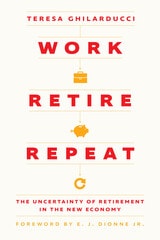
Work, Retire, Repeat
The Uncertainty of Retirement in the New EconomyTeresa Ghilarducci
University of Chicago Press, 2024
A damning portrait of the dire realities of retirement in the United States—and how we can fix it.
While the French went on strike in 2023 to protest the increase in the national retirement age, workers in the United States have all but given up on the notion of dignified retirement for all. Instead, Americans—whose elders face the highest risk of poverty compared to workers in peer nations—are fed feel-good stories about Walmart clerks who can finally retire because a customer raised the necessary funds through a GoFundMe campaign.
Many argue that the solution to the financial straits of American retirement is simple: people need to just work longer. Yet this call to work longer is misleading in a multitude of ways, including its endangering of the health of workers and its discrimination against people who work in lower-wage occupations. In Work, Retire, Repeat, Teresa Ghilarducci tells the stories of elders locked into jobs—not because they love to work but because they must.
But this doesn’t need to be the reality. Work, Retire, Repeat shows how relatively low-cost changes to how we finance and manage retirement will allow people to truly choose how they spend their golden years.