Results by title
7 books match the query 'People with disabilities in mass media'
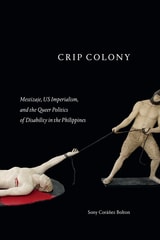
Crip Colony
Mestizaje, US Imperialism, and the Queer Politics of Disability in the PhilippinesSony Coráñez Bolton
Duke University Press, 2023

Cripping Girlhood
Anastasia Todd
University of Michigan Press, 2024
2025 National Women's Studies Association Alison Piepmeier Book Prize Winner
- 2026 Society for Disability Studies First Book Award Honorable Mention
- 2022 Tobin Siebers Prize Winner
Cripping Girlhood offers a new theorization of disabled girlhood, tracing how and why representations of disabled girls emerge with frequency in twenty-first century U.S. media culture. It uncovers how the exceptional figure of the disabled girl most often appears as a resource to work through post-Americans with Disabilities Act (ADA) anxieties about the family, healthcare, labor, citizenship, and the precarity of the bodymind. In paying critical attention to disabled girlhood, the book uses feminist disability studies to rupture the unwitting assumption in girls’ studies that girlhood is necessarily non-disabled.
By closely examining the ways that disabled girls represent themselves, Anastasia Todd goes beyond a critique of the figure of the privileged, disabled girl subject in the national imagination to explore how disabled girls circulate their own capacious re-envisioning of what it means to be a disabled girl. In analyzing a range of cultural sites, including YouTube, TikTok, documentaries, and GoFundMe campaigns, Todd shows how disabled girls actively upend what we think we know about them and their experience, recasting the meanings ascribed to their bodyminds in their own terms. By analyzing disabled girls’ self-representational practices and cultural productions, Todd shows how disabled girls deftly theorize their experiences of ableism, sexism, racism, and ageism, and cultivate communities online, creating archives of disability knowledge and politicizing other disabled people in the process.
Curative Violence
Rehabilitating Disability, Gender, and Sexuality in Modern KoreaEunjung Kim
Duke University Press, 2017
Disability and the Media
Prescriptions for ChangeCharles A. Riley
University Press of New England, 2005
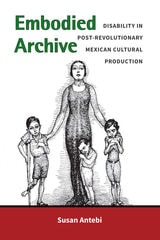
Embodied Archive
Disability in Post-Revolutionary Mexican Cultural ProductionSusan Antebi
University of Michigan Press, 2021
Embodied Archive focuses on perceptions of disability and racial difference in Mexico’s early post-revolutionary period, from the 1920s to the 1940s. In this period, Mexican state-sponsored institutions charged with the education and health of the population sought to strengthen and improve the future of the nation, and to forge a more racially homogeneous sense of collective identity and history. Influenced by regional and global movements in eugenics and hygiene, Mexican educators, writers, physicians, and statesmen argued for the widespread physical and cognitive testing and categorization of schoolchildren, so as to produce an accurate and complete picture of “the Mexican child,” and to carefully monitor and control forms of unwanted difference, including disability and racialized characteristics. Differences were not generally marked for eradication—as would be the case in eugenics movements in the US, Canada, and parts of Europe—but instead represented possible influences from a historically distant or immediate reproductive past, or served as warnings of potential danger haunting individual or collective futures.
Weaving between the historical context of Mexico’s post-revolutionary period and our present-day world, Embodied Archive approaches literary and archival documents that include anti-alcohol and hygiene campaigns; projects in school architecture and psychopedagogy; biotypological studies of urban schoolchildren and indigenous populations; and literary approaches to futuristic utopias or violent pasts. It focuses in particular on the way disability is represented indirectly through factors that may have caused it in the past or may cause it in the future, or through perceptions and measurements that cannot fully capture it. In engaging with these narratives, the book proposes an archival encounter, a witnessing of past injustices and their implications for the disability of our present and future.
Embodied Rhetorics
Disability in Language and CultureEdited by James C. Wilson and Cynthia Lewiecki-Wilson
Southern Illinois University Press, 2001
Presenting thirteen essays, editors James C. Wilson and Cynthia Lewiecki-Wilson unite the fields of disability studies and rhetoric to examine connections between disability, education, language, and cultural practices. Bringing together theoretical and analytical perspectives from rhetorical studies and disability studies, these essays extend both the field of rhetoric and the newer field of disability studies.
The contributors span a range of academic fields including English, education, history, and sociology. Several contributors are themselves disabled or have disabled family members. While some essays included in this volume analyze the ways that representations of disability construct identity and attitudes toward the disabled, other essays use disability as a critical modality to rethink economic theory, educational practices, and everyday interactions. Among the disabilities discussed within these contexts are various physical disabilities, mental illness, learning disabilities, deafness, blindness, and diseases such as multiple sclerosis and AIDS.
The Matter of Disability
Materiality, Biopolitics, Crip AffectDavid T. Mitchell, Susan Antebi, and Sharon L. Snyder, Editors
University of Michigan Press, 2019