Results by title

7 books match the query 'People with disabilities in motion pictures'
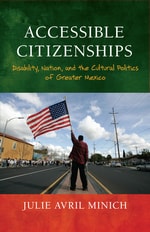
cover of Accessible Citizenships: Disability, Nation, and the Cultural Politics of Greater Mexico

Accessible Citizenships

Disability, Nation, and the Cultural Politics of Greater Mexico

Julie Avril Minich

Temple University Press, 2013

Accessible Citizenships examines Chicana/o cultural representations that conceptualize political community through images of disability. Working against the assumption that disability is a metaphor for social decay or political crisis, Julie Avril Minich analyzes literature, film, and visual art post-1980 in which representations of non-normative bodies work to expand our understanding of what it means to belong to a political community.
 
Minich shows how queer writers like Arturo Islas and Cherríe Moraga have reconceptualized Chicano nationalism through disability images. She further addresses how the U.S.-Mexico border and disabled bodies restrict freedom and movement. Finally, she confronts the changing role of the nation-state in the face of neoliberalism as depicted in novels by Ana Castillo and Cecile Pineda. 
 
Accessible Citizenships illustrates how these works gesture towards less exclusionary forms of citizenship and nationalism. Minich boldly argues that the corporeal images used to depict national belonging have important consequences for how the rights and benefits of citizenship are understood and distributed.

A volume in the American Literatures Initiative
[more]
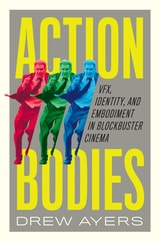
cover of Action Bodies: VFX, Identity, and Embodiment in Blockbuster Cinema

Action Bodies

VFX, Identity, and Embodiment in Blockbuster Cinema

Drew Ayers

University of Texas Press, 2026

Exploring how digital visual effects have changed the representations of the body and identity in action films.

When Harrison Ford appeared digitally de-aged in Indiana Jones and the Dial of Destiny, audiences witnessed more than a technical feat; they saw how visual effects are reshaping what bodies can be on screen. In Action Bodies, Drew Ayers examines how the contemporary action genre redefines embodiment across human, superhuman, animal, and machine forms. Ayers argues that action films are a crucial site for understanding how popular media both reflect and shape cultural debates about identity, citizenship, disability, and ethics in the era of big data and algorithmic culture.

Through case studies including Top Gun: Maverick, The Woman King, The Fast & the Furious franchise, and Avatar: The Way of Water, Ayers explores how VFX-altered bodies carry ideological weight. While the action genre has long leaned conservative in its politics of identity, its digitally mediated bodies also generate unexpected opportunities: glimpses of more inclusive and flexible modes of embodiment. As artificial intelligence and synthetic imagery continue to transform film production, Action Bodies demonstrates why careful attention to action cinema is essential for understanding how contemporary culture imagines and engineers the future of the body.

[more]
cover of Crip Love Onscreen: Representations of Love, Sex, and Disability

Crip Love Onscreen

Representations of Love, Sex, and Disability

Sarah Rainey-Smithback

The Ohio State University Press, 2026

Crip Love Onscreen: Representations of Love, Sex, and Disability examines how disabled people’s sexual lives—including pleasure/sex, love, pregnancy, and sexual violence—are represented in popular film and television. Analyzing a variety of films and TV shows from the United States, Canada, and the United Kingdom, Sarah Rainey-Smithback traces patterns in disability representation that ignore or distort many of the realities of crip sexuality. These patterns of sexual representation tend to uphold compulsory able-bodiedness, heteronormativity, and privacy norms—what Rainey-Smithback terms “neoliberal love values,” or standards that celebrate normative forms of sexual desire, bodies, and intimacy practices.

As disability representation increases, though, new possibilities are emerging. Crip Love Onscreen also draws attention to the exceptional through a close reading of screen narratives (such as 50 First Dates,Love and Other Drugs,American Horror Story: Freak Show, and more) that push against neoliberal, heteronormative, and ableist values. Drawing on the work of queer/crip scholars and activists, Rainey-Smithback uncovers glimpses of what Tobin Siebers calls a “sexual culture for disabled people”—a space and way of being that expands sexual access and sexual experience.
[more]
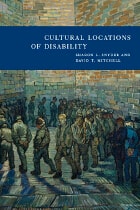
cover of Cultural Locations of Disability

Cultural Locations of Disability

Sharon L. Snyder and David T. Mitchell

University of Chicago Press, 2006

In Cultural Locations of Disability, Sharon L. Snyder and David T. Mitchell trace how disabled people came to be viewed as biologically deviant. The eugenics era pioneered techniques that managed "defectives" through the application of therapies, invasive case histories, and acute surveillance techniques, turning disabled persons into subjects for a readily available research pool. In its pursuit of normalization, eugenics implemented disability regulations that included charity systems, marriage laws, sterilization, institutionalization, and even extermination. Enacted in enclosed disability locations, these practices ultimately resulted in expectations of segregation from the mainstream, leaving today's disability politics to focus on reintegration, visibility, inclusion, and the right of meaningful public participation.

Snyder and Mitchell reveal cracks in the social production of human variation as aberrancy. From our modern obsessions with tidiness and cleanliness to our desire to attain perfect bodies, notions of disabilities as examples of human insufficiency proliferate. These disability practices infuse more general modes of social obedience at work today. Consequently, this important study explains how disabled people are instrumental to charting the passage from a disciplinary society to one based upon regulation of the self.
[more]
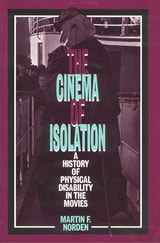
cover of The Cinema of Isolation: A History of Physical Disability in the Movies

The Cinema of Isolation

A History of Physical Disability in the Movies

Norden, Martin F

Rutgers University Press, 1994

Filmmakers have often encouraged us to regard people with physical disabilities in terms of pity, awe, humor, or fearas "Others" who somehow deserve to be isolated from the rest of society. In this first history of the portrayal of physical disability in the movies, Martin Norden examines hundreds of Hollywood movies (and notable international ones), finds their place within mainstream society, and uncovers the movie industry's practices for maintaining the status quokeeping people with disabilities dependent and "in their place."

Norden offers a dazzling array of physically disabled characters who embody or break out of the stereotypes that have both influenced and been symptomatic of societys fluctuating relationship with its physically disabled minority. He shows us "sweet innocents" like Tiny Tim, "obsessive avengers" like Quasimodo, variations on the disabled veteran, and many others. He observes the arrival of a new set of stereotypes tied to the growth of science and technology in the 1970s and 1980s, and underscores movies like My Left Foot and The Waterdance that display a newfound sensitivity. Nordens in-depth knowledge of disability history makes for a particularly intelligent and sensitive approach to this long-overlooked issue in media studies.
[more]
cover of The Problem Body: Projecting Disability on Film

The Problem Body

Projecting Disability on Film

Edited by Sally Chivers and Nicole Markotic

The Ohio State University Press, 2010

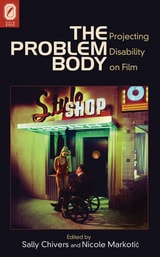
In The Problem Body, editors Sally Chivers and Nicole Markotic bring together the work of eleven of the best disability scholars from the U.S., the U.K., Canada, and South Korea to explore a new approach to the study of film by concentrating on cinematic representations of what they term “the problem body.” The book is a much-needed exploration of the projection of disability on film combined with a much-needed rethinking of hierarchies of difference. The editors turned to the existing corpus of disability theory with its impressive insights about the social and cultural mediation of disabled bodies. They then sought, from scholars at every stage of their careers, new ideas about how disabled bodies coexist with a range of other bodies (gendered, queered, racialized, classed, etc.).

To call into question why certain bodies invite the label “problem” more frequently than other bodies, the contributors draw on scholarship from feminist, race, queer, cultural studies, disability, and film studies arenas. In Chivers and Markotic’s introduction, they draw on disability theory and a range of cinematic examples to explain the term “problem body” in relation to its projection. In explorations of film noir, illness narratives, classical Hollywood film, and French film, the essays reveal the “problem body” as a multiplication of lived circumstances constructed both physically and socially.
[more]
cover of Why I Burned My Book

Why I Burned My Book

Paul Longmore

Temple University Press, 2003

This wide-ranging book shows why Paul Longmore is one of the most respected figures in disability studies today. Understanding disability as a major variety of human experience, he urges us to establish it as a category of social, political, and historical analysis in much the same way that race, gender, and class already have been. The essays here search for the often hidden pattern of systemic prejudice and probe into the institutionalized discrimination that affects the one in five Americans with disabilities.Whether writing about the social critic Randolph Bourne, contemporary political activists, or media representations of people with disabilities, Longmore demonstrates that the search for heroes is a key part of the continuing struggle of disabled people to gain a voice and to shape their destinies. His essays on bioethics and public policy examine the conflict of agendas between disability rights activists and non-disabled policy makers, healthcare professionals, euthanasia advocates, and corporate medical bureaucracies. The title essay, which concludes the book, demonstrates the necessity of activism for any disabled person who wants access to the American dream.
[more]