Results by title
6 books match the query 'Lucan'
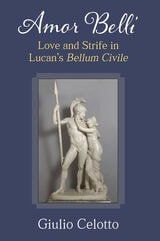
Amor Belli
Love and Strife in Lucan's Bellum CivileGiulio Celotto
University of Michigan Press, 2022
Compelled by the emperor Nero to commit suicide at age 25 after writing uncomplimentary poems, Latin poet Lucan nevertheless left behind a significant body of work, including the Bellum Civile (Civil War). Sometimes also called the Pharsalia, this epic describes the war between Julius Caesar and Pompey.Author Giulio Celotto provides an interpretation of this civil war based on the examination of an aspect completely neglected by previous scholarship: Lucan’s literary adaptation of the cosmological dialectic of Love and Strife.
According to a reading that has found favor over the last three decades, the poem is an unconventional epic that does not conform to Aristotelian norms: Lucan composes a poem characterized by fragmentation and disorder, lacking a conventional teleology, and whose narrative flow is constantly delayed. Celotto’s study challenges this interpretation by illustrating how Lucan invokes imagery of cosmic dissolution, but without altogether obliterating epic norms. The poem transforms them from within, condemning the establishment of the Principate and the Julio-Claudian dynasty.
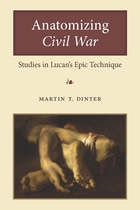
Anatomizing Civil War
Studies in Lucan's Epic TechniqueMartin T. Dinter
University of Michigan Press, 2013
Imperial Latin epic has seen a renaissance of scholarly interest. This book illuminates the work of the poet Lucan, a contemporary of the emperor Nero who as nephew of the imperial adviser Seneca moved in the upper echelons of Neronian society. This young and maverick poet, whom Nero commanded to commit suicide at the age of 26, left an epic poem on the civil war between Caesar and Pompey that epitomizes the exuberance and stylistic experimentation of Neronian culture. This study focuses on Lucan's epic technique and traces his influence through the Middle Ages and the Renaissance.
Martin T. Dinter's newest volume engages with Lucan's use of body imagery, sententiae, Fama (rumor), and open-endedness throughout his civil war epic. Although Lucan's Bellum Civile is frequently decried as a fragmented as well as fragmentary epic, this study demonstrates how Lucan uses devices other than teleology and cohesive narrative structure to bind together the many parts of his epic body.
Anatomizing Civil War places at center stage characteristics of Lucan's work that have so far been interpreted as excessive, or as symptoms of an overly rhetorical culture indicating a lack of substance. By demonstrating that they all contribute to Lucan's poetic technique, Martin T. Dinter shows how they play a fundamental role in shaping and connecting the many episodes of the Bellum Civile that constitute Lucan's epic body. This important volume will be of interest to students of classics and comparative literature as well as literary scholars. All Greek and Latin passages have been translated.
FEELING HISTORY
LUCAN, STOICISM, AND THE POETICS OF PASSIONFrancesca D’Alessandro Behr
The Ohio State University Press, 2007
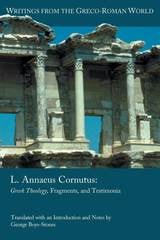
L. Annaeus Cornutus
Greek Theology, Fragments, and TestimoniaGeorge Boys-Stones
SBL Press, 2018
The first English translation of Greek Theology
The first-century CE North African philosopher Cornutus lived in Rome as a philosopher and is best known today for his surviving work Greek Theology, which explores the origins and names of the Greek gods. However, he was also interested in the language and literature of the poets Persius and Lucan and wrote one of the first commentaries on Virgil. This book collects and translates all of our evidence for Cornutus for the first time and includes the first published English translation of Greek Theology. This collection offers entirely fresh insight into the intellectual world of the first century.
Features
- Translation based on the latest critical text
- The first truly holistic picture of Cornutus’s intellectual profile
- A new account of the early debate over Aristotle’s Categories and the Stoic contribution to it
The Commerce of War
Exchange and Social Order in Latin EpicNeil Coffee
University of Chicago Press, 2009
Latin epics such as Virgil’s Aeneid, Lucan’s Civil War, and Statius’s Thebaid addressed Roman aristocrats whose dealings in gifts, favors, and payments defined their conceptions of social order. In The Commerce of War, Neil Coffee argues that these exchanges play a central yet overlooked role in epic depictions of Roman society.
Tracing the collapse of an aristocratic worldview across all three poems, Coffee highlights the distinction they draw between reciprocal gift giving among elites and the more problematic behaviors of buying and selling. In the Aeneid, customary gift and favor exchanges are undermined by characters who view human interaction as short-term and commodity-driven. The Civil War takes the next logical step, illuminating how Romans cope once commercial greed has supplanted traditional values. Concluding with the Thebaid, which focuses on the problems of excessive consumption rather than exchange, Coffee closes his powerful case that these poems constitute far-reaching critiques of Roman society during its transition from republic to empire.
The Taste for Nothingness
A Study of Virtus and Related Themes in Lucan's Bellum CivileR. Sklenar
University of Michigan Press, 2003
The Taste for Nothingness traces Lucan's own analytical method by showing how virtus and related concepts operate--or rather, fail to operate--in Lucan's appropriations and distortions of the traditional epic-battle narrative; in the philosophical commitment of Cato the Younger; and in the personalities of the two antagonists, Pompey and Caesar. Much recent scholarship has reached a consensus that Lucan's literary method is mimetic, that his belief in a chaotic cosmos produces a poetics of chaos. While accepting many of the recent findings about Lucan's view of language and the universe, The Taste for Nothingness also allows an even bolder Lucan to emerge: a committed aesthete who regards art as the only realm in which order is possible.
Robert Sklenár is Visiting Assistant Professor of Classical Studies, Tulane University.