Results by title
10 books match the query 'People with mental disabilities'
Capturing Labor
A History of Unfree Work in the SouthwestEdited by Jessica R. Pliley and John Mckiernan-González
University of Texas Press, 2026
A collection of essays grappling with the many, often overlooked, forms of unfree labor in the West.
When Americans think of unfree labor—coerced, extracted from workers unable to freely enter and exit contracts—what comes to mind is Black slavery and peonage in the South. But other forms of unfree labor also built the United States. Collecting a diverse range of sharply argued historical essays, Capturing Labor shares the story of unfree labor in the Southwest, affecting mainly Indigenous people, Mexican Americans, and people of color.
In Texas and elsewhere, state agents developed various methods for directing the movement of workers, seizing their time, and controlling the products of their efforts. Case studies highlight the detention during World War I of Indigenous children and unaccompanied women, who were placed in boarding schools, fined, and obligated to work off the resulting debt. Other essays expose authorities forcing workers to break strikes and jailing Americans who supported labor uprisings in rural Mexico and the United States. Prisons and asylums supplied coerced agricultural workers and musicians who were never compensated for their labor or by the labels that took their recordings.
Editors Jessica Pliley and John Mckiernan-González contend that unfree labor continues to shape American life, and is all around us today. Understanding its history aids us in recognizing and bringing attention to the grim realities of the present.
Madness and Enterprise
Psychiatry, Economic Reason, and the Emergence of Pathological ValueNima Bassiri
University of Chicago Press, 2024
Madness and Enterprise reveals the economic norms embedded within psychiatric thinking about mental illness in the North Atlantic world. Over the course of the nineteenth century, various forms of madness were subjected to a style of psychiatric reasoning that was preoccupied with money. Psychiatrists across Western Europe and the United States attributed financial and even moral value to an array of pathological conditions, such that some mental disorders were seen as financial assets and others as economic liabilities. By turning to economic conduct and asking whether potential patients appeared capable of managing their financial affairs or even generating wealth, psychiatrists could often bypass diagnostic uncertainties about a person’s mental state.
Through an exploration of the intertwined histories of psychiatry and economic thought, Nima Bassiri shows how this relationship transformed the very idea of value in the modern North Atlantic, as the most common forms of social valuation—moral value, medical value, and economic value—were rendered equivalent and interchangeable. If what was good and what was healthy were increasingly conflated with what was remunerative (and vice versa), then a conceptual space opened through which madness itself could be converted into an economic form and subsequently redeemed—and even revered.

Making Life Work
Freedom and Disability in a Community Group HomeJack Levinson
University of Minnesota Press, 2010

Mental Disorder, Work Disability, and the Law
Edited by Richard J. Bonnie and John Monahan
University of Chicago Press, 1996
This book will be of great value to scholars in law and the mental health professions and to policy makers and the administrators of disability programs.
On the Margins of Citizenship
Intellectual Disability and Civil Rights in Twentieth-Century AmericaAllison C. Carey
Temple University Press, 2010
Carey addresses the segregation of people with intellectual disabilities in schools and institutions along with the controversies over forced sterilization, eugenics, marriage and procreation, and protection from the death penalty. She chronicles the rise of the parents’ movement and the influence of the Kennedy family, as well as current debates that were generated by the impact of the Americans with Disabilities Act passed in 1990.
Presenting the shifting constitutional and legal restrictions for this marginalized group, Carey argues that policies tend to sustain an ambiguity that simultaneously promises rights yet also allows their retraction.
Pain and Shock in America
Politics, Advocacy, and the Controversial Treatment of People with DisabilitiesJan Nisbet
Brandeis University Press, 2021
For more than forty years, professionals in the field of disability studies have engaged in debates over the use of aversive interventions (such as electric shock) like the ones used at the Judge Rotenberg Center. Advocates and lawyers have filed complaints and lawsuits to both use them and ban them, scientists have written hundreds of articles for and against them, and people with disabilities have lost their lives and, some would say, lived their lives because of them. There are families who believe deeply in the need to use aversives to control their children’s behavior. There are others who believe the techniques used are torture. All of these families have children who have been excluded from numerous educational and treatment programs because of their behaviors. For most of the families, placement at the Judge Rotenberg Center is the last resort.
This book is a historical case study of the Judge Rotenberg Center, named after the judge who ruled in favor of keeping its doors open to use aversive interventions. It chronicles and analyzes the events and people involved for over forty years that contributed to the inability of the state of Massachusetts to stop the use of electric shock, and other severe forms of punishment on children and adults with disabilities. It is a long story, sad and tragic, complex, filled with intrigue and questions about society and its ability to protect and support its most vulnerable citizens.
The Capacity Contract
Intellectual Disability and the Question of CitizenshipStacy Clifford Simplican
University of Minnesota Press, 2015
In the first sustained examination of disability through the lens of political theory, The Capacity Contract shows how the exclusion of disabled people has shaped democratic politics. Stacy Clifford Simplican demonstrates how disability buttresses systems of domination based on race, sex, and gender. She exposes how democratic theory and politics have long blocked from political citizenship anyone whose cognitive capacity falls below a threshold level⎯marginalization with real-world repercussions on the implementation of disability rights today.
Simplican’s compelling ethnographic analysis of the self-advocacy movement describes the obstacles it faces. From the outside, the movement must confront stiff budget cuts and dwindling memberships; internally, self-advocates must find ways to demand political standing without reinforcing entrenched stigma against people with profound cognitive disabilities. And yet Simplican’s investigation also offers democratic theorists and disability activists a more emancipatory vision of democracy as it relates to disability⎯one that focuses on enabling people to engage in public and spontaneous action to disrupt exclusion and stigma.
Taking seriously democratic promises of equality and inclusion, The Capacity Contract rejects conceptions of political citizenship that privilege cognitive capacity and, instead, centers such citizenship on action that is accessible to all people.
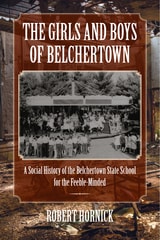
The Girls and Boys of Belchertown
A Social History of the Belchertown State School for the Feeble-MindedRobert Hornick
University of Massachusetts Press, 2012
During much of the twentieth century, people labeled “feeble-minded,” “mentally deficient,” and “mentally retarded” were often confined in large, publicly funded, residential institutions located on the edges of small towns and villages some distance from major population centers. At the peak of their development in the late 1960s, these institutions—frequently called “schools” or “homes”—housed 190,000 men, women, and children in the United States.
The Girls and Boys of Belchertown offers the first detailed history of an American public institution for intellectually disabled persons. Robert Hornick recounts the story of the Belchertown State School in Belchertown, Massachusetts, from its beginnings in the 1920s to its closure in the 1990s following a scandalous exposé and unprecedented court case that put the institution under direct supervision of a federal judge. He draws on personal interviews, private letters, and other unpublished sources as well as local newspapers, long out-of-print materials, and government reports to re-create what it was like to live and work at the school. More broadly, he gauges the impact of changing social attitudes toward intellectual disability and examines the relationship that developed over time between the school and the town where it was located.
What emerges is a candid and complex portrait of the Belchertown State School that neither vilifies those in charge nor excuses the injustices perpetrated on its residents, but makes clear that despite the court-ordered reforms of its final decades, the institution needed to be closed.
The Kennedy Family
Edward Shorter
Temple University Press, 2000
Long a generous benefactor of MR-related organizations, Joseph P. Kennedy made MR the special charitable interest of the family foundation he set up in the 1950s. Although he gave all of his children official roles, he involved his daughter Eunice in performing its actual work -- identifying appropriate recipients of awards and organizing the foundation's activities. With unique access to family and foundation papers, Shorter brings to light the Kennedy family's strong commitment to public service, showing that Rose and Joe taught their children by precept and example that their wealth and status obligated them to perform good works. Their parents expected each of them to apply their considerable energies to making a difference.
Eunice Kennedy Shriver took up that charge and focused her organizational and rhetorical talent on putting MR on the federal policy agenda. As a sister of the President of the United States, she had access to the most powerful people in the country and drew their attention to the desperate situation of families affected by mental retardation. Her efforts made an enormous difference, resulting in unprecedented public attention to MR and new approaches to coordinating medical and social services. Along with her husband, R. Sargent Shriver, she made the Special Olympics an international, annual event in order to encourage people with mental retardation to develop their skills and discover the joy of achievement. She emerges from these pages as a remarkable and dedicated advocate for people with developmental disabilities.
Shorter's account of mental retardation presents an unfamiliar view of the Kennedy family and adds a significant chapter to the history of disability in this country.
The Unlikely Celebrity
Bill Sackter's Triumph over DisabilityThomas Walz. Foreword by Barry Morrow
Southern Illinois University Press, 1998
Thomas Walz tells the story of Bill Sackter, a man who spent nearly half a century in a Minnesota mental institution and emerged to blossom into a most unlikely celebrity. Bill Sackter was committed to the Faribault State Hospital at the age of seven, there to remain until he was in his fifties. At the time of his commitment, Bill’s father had recently died; thus his sole contact with his family came through rare letters from his mother.
Some years after his discharge from Faribault as a result of the movement to deinstitutionalize the mentally ill in the 1960s, Bill enjoyed a serendipitous encounter with a young college student and part-time musician, Barry Morrow. Bill became part of the Morrow family and a regular in Morrow’s music group. When Morrow accepted a job at the School of Social Work at the University of Iowa, Bill followed him to Iowa City and was put in charge of a small coffee service.
Bill became an important part of the University of Iowa community, and Wild Bill’s Coffeeshop developed into an institution. A cheerful man of great good will who was a harmonica virtuoso, Bill began to inspire affectionate legends, and his life as a celebrity began in earnest. He was named Iowa’s Handicapped Person of the Year in 1977, and two television movies were made about his life—Bill, which earned Emmy awards for cowriter Barry Morrow and Mickey Rooney (as Bill) in 1981, and Bill on His Own in 1983. Years later, Morrow would earn an Oscar for his script of Rain Man.
Through vignettes ranging from hilarious to near tragic. Walz reveals a remarkable human being. An account of Bill's life in an institution is necessarily part of the story, but there is much more: Bill’s role in helping a young child recover from a coma, his menagerie of friends, his love for a pet parakeet, his late-life Bar Mitzvah, his failure as a woodworker, his success as Santa, and his dignified death at the age of seventy.