Results by title
6 books match the query 'Peril'
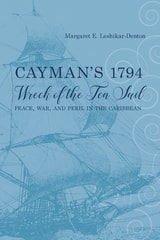
Cayman's 1794 Wreck of the Ten Sail
Peace, War, and Peril in the CaribbeanMargaret E. Leshikar-Denton
University of Alabama Press, 2020
The story has been passed through generations for more than two centuries. Details vary depending on who is doing the telling, but all refer to this momentous maritime event as the Wreck of the Ten Sail. Sometimes misunderstood as the loss of a single ship, it was in fact the wreck of ten vessels at once, comprising one of the most dramatic maritime disasters in all of Caribbean naval history. Surviving historical documents and the remains of the wrecked ships in the sea confirm that the narrative is more than folklore. It is a legend based on a historical event in which HMS Convert, formerly L’Inconstante, a recent prize from the French, and 9 of her 58-ship merchant convoy sailing from Jamaica to Britain, wrecked on the jagged eastern reefs of Grand Cayman in 1794.
The incident has historical significance far beyond the boundaries of the Cayman Islands. It is tied to British and French history during the French Revolution, when these and other European nations were competing for military and commercial dominance around the globe. The Wreck of the Ten Sail attests to the worldwide distribution of European war and trade at the close of the eighteenth century.
In Cayman’s 1794 Wreck of the Ten Sail: Peace, War, and Peril in the Caribbean, Margaret E. Leshikar-Denton focuses on the ships, the people, and the wreck itself to define their place in Caymanian, Caribbean, and European history. This well-researched volume weaves together rich oral folklore accounts, invaluable supporting documents found in archives in the United Kingdom, Jamaica, and France, and tangible evidence of the disaster from archaeological sites on the reefs of the East End.
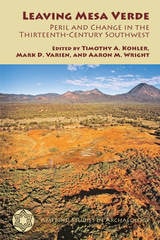
Leaving Mesa Verde
Peril and Change in the Thirteenth-Century SouthwestEdited by Timothy A. Kohler, Mark D. Varien, and Aaron M. Wright
University of Arizona Press, 2012
Much new paleoenvironmental data, and a great deal of archaeological survey and excavation, permit the fifteen scientists represented here much greater precision in determining the timing of the depopulation, the number of people affected, and the ways in which northern Pueblo peoples coped—and failed to cope—with the rapidly changing environmental and demographic conditions they encountered throughout the 1200s. In addition, some of the scientists in this volume use models to provide insights into the processes behind the patterns they find, helping to narrow the range of plausible explanations.
What emerges from these investigations is a highly pertinent story of conflict and disruption as a result of climate change, environmental degradation, social rigidity, and conflict. Taken as a whole, these contributions recognize this era as having witnessed a competition between differing social and economic organizations, in which selective migration was considerably hastened by severe climatic, environmental, and social upheaval. Moreover, the chapters show that it is at least as true that emigration led to the collapse of the northern Southwest as it is that collapse led to emigration.
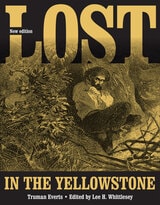
Lost in the Yellowstone
"Thirty-Seven Days of Peril" and a Handwritten Account of Being LostTruman Everts; Edited by Lee H. Whittlesey
University of Utah Press, 2015
In 1870, Truman Everts visited what would two years later become Yellowstone National Park, traveling with an exploration party intent on mapping and investigating that mysterious region. Scattered reports of a mostly unexplored wilderness filled with natural wonders had caught the public’s attention and the fifty-four-year-old Everts, near-sighted and an inexperienced woodsman, had determined to join the expedition. He was soon separated from the rest of the party and from his horse, setting him on a grueling quest for survival. For over a month he wandered Yellowstone alone and injured, with little food, clothing, or other equipment. In “Thirty-seven Days of Peril” he recounted his experiences for the readers of Scribner’s Monthly.
In June 1996, Everts’s granddaughter arrived at Mammoth Hot Springs in Yellowstone National Park to meet with park archivist Lee Whittlesey. She brought two documents that her father had kept hidden and both were handwritten by Everts. One was a brief autobiography that gave new insight into his early life. The other was a never-published alternative account of his confused 1870 journey through Yellowstone. Both have been added to this volume, further enhancing Everts’s unlikely tale of survival.
Peril in the Ponds
Deformed Frogs, Politics, and a Biologist's QuestJudy Helgen
University of Massachusetts Press, 2012
By the 1990s, wetlands across the United States were endangered from pollution and decades of drainage to convert them into farmland and urban developments. But when deformed frogs—many with missing legs or eyes, footless stumps, or misshapen jaws—began to emerge from Minnesota wetlands, alarm bells went off. What caused such deformities? Pollution? Ultraviolet rays? Biological agents? And could the mysterious cause also pose a threat to humans?
Judy Helgen writes with passionate concern about vulnerable frogs and wetlands as she navigates through a maze of inquisitive media and a reluctant government agency. She reports on the complexity of a growing catastrophe for frogs and broadens the issue as she researches and meets with scientists from around the world. She affirms the importance of examining aquatic life to understand pollution and the need to rescue our remaining wetlands. She also shares the fears expressed by the teachers, students, and other citizens who found these creatures, sensed a problem, and looked to her for answers. Ultimately, this is a story about the biological beauty of wetlands and our need to pay attention to the environment around us.

Planets in Peril
A Critical Study of C. S. Lewis's Ransom TrilogyDavid C. Downing
University of Massachusetts Press, 1992
A critical study of C.S. Lewis's “Ransom Trilogy” which analyses Lewis's methods and meanings, concentrating on this trilogy but also including relevant secondary work. Lewis's literary scholarship and display of Christian values are incorporated into this discussion.
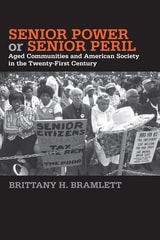
Senior Power or Senior Peril
Aged Communities and American Society in the Twenty-First CenturyBrittany H Bramlett
Temple University Press, 2015
In Senior Power or Senior Peril, Bramlett examines the assertions that the increasing number of older adult-concentrated communities across the United States form a growing bloc of senior power that will influence the redistribution of particularized welfare benefits to older adults at the expense of younger people. However, others suggest that political influence declines with old age. Bramlett uses interviews and on-site research at various senior communities to explore what qualities make an aged community politically unique, and the impact of the local aged context on residents' political knowledge, safety-net policy attitudes, efficacy, and political activity.
This path-breaking book identifies the political behaviors, attitudes, and political consciousness of both older and younger residents as it recounts the perceived and actual political power of seniors.
In the series The Social Logic of Politics, edited by Scott McClurg