Results by title
10 books match the query 'Perry, John'
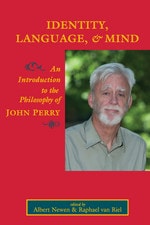
Identity, Language, and Mind
An Introduction to the Philosophy of John PerryEdited by Albert Newen and Raphael van Riel
CSLI, 2012
As one of the world’s most eminent living philosophers, John Perry has covered a remarkable breadth of subjects in his published work, including semantics, indexicality, self-knowledge, personal identity, and consciousness. Looking particularly at the way in which he deals with issues of self, communication, and reality, this volume is organized in seven chapters that highlight a different aspect of Perry’s work on the intersection of these subjects. A fundamental work for students and scholars, Identity, Language, and Mind explores questions that are not only essential in understanding Perry’s writings, but also contemporary philosophy as a whole.
[more]
Reference and Reflexivity
2nd EditionJohn Perry
CSLI, 2012
In this volume John Perry develops his “reflexive-referential” account of indexicals, demonstratives, and proper names. For this new second edition, Perry has added a new preface and two chapters on the distinction between semantics and pragmatics and on attitude reports. He reveals a coherent and structured family of contents—from reflexive contents that place conditions on their actual utterance to fully incremental contents that place conditions only on the objects of reference—reconciling the legitimate insights of both the referentialist and descriptivist traditions.
[more]
Referencialismo critico
le teoria reflexivo-referencial del significadoJohn Perry
CSLI, 2006
[more]
Revisiting the Essential Indexical
John Perry
CSLI, 2020
In this book, renowned philosopher John Perry responds to criticisms of his influential writing on “the essential indexical.” He begins by explaining the conclusions of his past articles. He then argues that many criticisms are based on confusions about the relation between the issues of opacity and cognitive significance, and other basic misunderstandings of his views. While dealing with criticisms, Perry makes a number of points about self-knowledge, the issue that motivated his original papers.
[more]
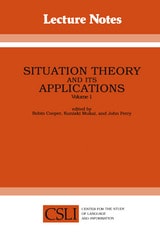
Situation Theory and Its Applications, Volume 1
Edited by Robin Cooper, Kuniaki Mukai, and John Perry
CSLI, 1990
Situation Theory grew out of attempts by Jon Barwise in the late 1970s to provide semantics for "naked-infinitive" perceptual reports such as 'Claire saw Jon run'. Barwise's intuition was that Claire didn't just see Jon, an individual, but Jon doing something, a situation. Situations are individuals having properties and standing in relations. A theory of situations would allow us to study and compare various types of situations or situation-like entities, such as facts, events and scenes.
One of the central themes of situation theory is that a theory of meaning and reference should be set within a general theory of information, one moreover that is rich enough to do justice to perception, communication and thought. By now many people have contributed to the development and application of situation theory, constrained by the need to account for certain kinds of semantic phenomena, and by the need to give a rigorous mathematical account of the principles of information that underwrite the theory.
This volume presents work that evolved out of the First Conference on Situation Theory and Its Applications held by CSLI at Asilomar, California, in March 1989. The nineteen papers included here fall into three categories. Those in Part I explore logical and mathematical issues that arise within situation theory. The papers in Part II connect situation theory with other approaches to logical issues, while those in Part III apply various version of situation theory to a number of linguistic issues.
[more]
Situations and Attitudes
Jon Barwise and John Perry
CSLI, 1983
In this provocative book, Barwise and Perry tackle the slippery subject of "meaning," a subject that has long vexed linguists, language philosophers, and logicians. Meaning does not exist solely within words and sentences but resides largely in the situation and the attitudes brought to it by those involved. The authors present an unusually lucid treatment of important innovations in the field of natural semantics, contending that the standard view of logic (as derived from Frege, Russell, and work in mathematics and logic) is inappropriate for many of the uses to which it has been put by scholars. In Situations and Attitudes they provide the basics of a realistic model-theoretic semantics of natural language, explain the main ideas of the theory, and contrast them with those of competing theories.
[more]
Studies in Language and Information
John Perry
CSLI, 2019
This book gathers together in one volume many influential papers by renowned philosopher of language John Perry.
[more]
The Problem of the Essential Indexical and Other Essays, Expanded Edition
John Perry
CSLI, 2000
No word in English is shorter than the word ``I.'' And yet no word is more important in philosophy. When Descartes said ``I think therefore I am'' he produced something that was both about himself and a universal formula. The word ``I'' is called an ``indexical'' because its meaning always depends on who says it. Other examples of indexicals are ``you,'' ``here,'' ``this'' and ``now.''
John Perry discusses how these kinds of words work, and why they express important philosophical thoughts. He shows that indexicals pose a challenge to traditional assumptions about language and thought. Over the years a number of these papers, now included in this book, have sparked lively debates and have been influential in philosophy, linguistics and other areas of cognitive science.
With seven new papers, including the previously unpublished ``What Are Indexicals?,'' the present volume expands on an earlier version of this book published in the early nineties. Also included are the well-known papers ``Frege on Demonstratives,'' ``Cognitive Significance and New Theories of Reference,'' ``Evading the Slingshot,'' ``The Prince and the Phone booth'' (coauthored with Mark Crimmins), ``Fodor on Psychological Explanations'' (coauthored with David Israel), and related papers on situation semantics, direct reference, and the structure of belief. This book also includes afterwords written by the author that discuss responses to his work by Gareth Evans, Robert Stalnaker, Barbara Partee, Howard Wettstein and others.
[more]
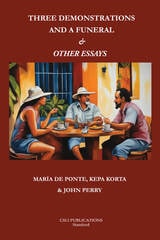
Three Demonstrations and a Funeral and Other Essays
Maria de Ponte, Kepa Korta, and John Perry
CSLI, 2024
A collaboration between three distinguished professors of linguistics and philosophy.
The result of the collaboration between three distinguished philosophers, this book comprises the best sample of one of the most original theories in contemporary philosophy of language and communication—Critical Pragmatics. They present the development of the theory from its initial sprout, with “Three Demonstrations and a Funeral” (2006) as its first visible result, to a critical clarification of its tenets in “Critical Pragmatics: Nine Misconceptions” (2023). After Korta and Perry’s Critical Pragmatics (2011), this is the most important book on Critical Pragmatics, as it was conceived, developed and applied by its creators. Having de Ponte, Korta and Perry’s most important papers together on one place will be of great value to both philosophers and linguists.
The result of the collaboration between three distinguished philosophers, this book comprises the best sample of one of the most original theories in contemporary philosophy of language and communication—Critical Pragmatics. They present the development of the theory from its initial sprout, with “Three Demonstrations and a Funeral” (2006) as its first visible result, to a critical clarification of its tenets in “Critical Pragmatics: Nine Misconceptions” (2023). After Korta and Perry’s Critical Pragmatics (2011), this is the most important book on Critical Pragmatics, as it was conceived, developed and applied by its creators. Having de Ponte, Korta and Perry’s most important papers together on one place will be of great value to both philosophers and linguists.
[more]
Words and Contents
Richard Vallée
CSLI, 2018
The papers collected in Richard Vallée’s Words and Contents span twenty-one years of research. Beginning with referring expressions and later addressing context sensitivity, the book examines how specific words contribute to the contents of utterances and the philosophical issues that surround them. Within these papers, Vallée navigates the discovery and exploration of different modes of expression and perspectives on language.
[more]