Results by title

14 books match the query 'Persecution'
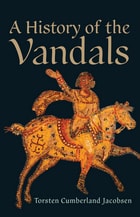
cover of A History of the Vandals

A History of the Vandals

Torsten Cumberland Jacobsen

Westholme Publishing, 2012

The First General History in English of the Germanic People Who Sacked Rome in the Fifth Century AD and Established a Kingdom in North Africa

The fifth century AD was a time of great changes in the Mediterranean world. In the early 400s, the Roman Empire ranged from the lowlands of Scotland to the Upper Nile and from Portugal to the Caucasus. It was almost at its widest extent, and although ruled by two emperors—one in the West and one in the East—it was still a single empire. One hundred years later, Roman control of Western Europe and Western North Africa had been lost. In its place, a number of Germanic kingdoms had been established in these regions, with hundreds of thousands of Germanic and other peoples settling permanently inside the former borders of the Western Roman Empire.

            One of the most fascinating of these tribes of late antiquity were the Vandals, who over a period of six hundred years had migrated from the woodland regions of Scandinavia across Europe and ended in the deserts of North Africa. In A History of the Vandals, the first general account in English covering the entire story of the Vandals from their emergence to the end of their kingdom, historian Torsten Cumberland Jacobsen pieces together what we know about the Vandals, sifting fact from fiction. In the middle of the fifth century the Vandals, who professed Arianism, a form of Christianity considered heretical by the Roman emperor, created the first permanent Germanic successor state in the West and were one of the deciding factors in the downfall of the Western Roman Empire. Later Christian historians described their sack of Rome in 455 and their vehement persecution of Catholics in their kingdom, accounts that were sensationalized and gave birth to the term “vandalism.”

            In the mid-sixth century, the Vandals and their North African kingdom were the first target of Byzantine Emperor Justinian’s ambitious plan to reconquer the lost territories of the fallen Western Empire. In less than four months, what had been considered one of the strongest Germanic kingdoms had been defeated by a small Roman army led by the general Belisarius. Despite later rebellions, this was the end of the Germanic presence in North Africa, and in many ways the end of the Arian heresy of Christianity. For the Romans it was the incredibly successful start of the reconquest of the lost lands of the Western Empire.

[more]
cover of Contraception and Persecution

Contraception and Persecution

Charles E. Rice

St. Augustine's Press, 2014
“Contraceptive sex,” wrote social science researcher Mary Eberstadt in 2012, “is the fundamental social fact of our time.” In this important and pointed book, Charles E. Rice, of the Notre Dame Law School, makes the novel claim that the acceptance of contraception is a prelude to persecution. He makes the striking point that contraception is not essentially about sex. It is a First Commandment issue: Who is God? It was at the Anglican Lambeth Conference of 1930 when for the first time a Christian denomination said that contraception could ever be a moral choice. The advent of the Pill in the 1960s made the practice of contraception practically universal. This involved a massive displacement of the Divine Law as a normative measure of conduct, not only on sex but across the board. Nature abhors a vacuum. The State moved in to occupy the place formerly held by God as the ultimate moral Lawgiver. The State put itself on a collision course with religious groups and especially with the Catholic Church, which continues to insist on that traditional teacher. A case in point is the Obama Regime’s Health Care Mandate, coercing employees to provide, contrary to conscience, abortifacients and contraceptives to their employees. The first chapter describes that Mandate, which the Catholic bishops have vowed not to obey. Rice goes on to show that the duty to disobey an unjust law that would compel you to violate the Divine Law does not confer a general right to pick and choose what laws you will obey. The third chapter describes the “main event,” which is the bout to determine whether the United States will conform its law and culture to the homosexual (LGBTQ) lifestyle in all its respects. “The main event is well underway and LGBTQ is well ahead on points.” Professor Rice follows with a clear analysis of the 2013 Supreme Court decision on same-sex marriage. Part II presents some “underlying causes” of the accelerating persecution of the Catholic Church. The four chapter headings in this part outline the picture: The Dictatorship of Relativism; Conscience Redefined; The Constitution: Moral Neutrality; and The Constitution: Still Taken Seriously? The answer to the last question, as you might expect, is: No. Part III, the controversial heart of the book, prese nts contraception as “an unacknowledged cause” of persecution. The first chapter argues that contraception is not just a “Catholic issue.” The next chapter describes the “consequences” of contraception and the treatment of women as objects. The third chapter spells out in detail the reality that contraception is a First Commandment issue and that its displacement of God as the ultimate moral authority opened the door for the State to assume that role, bringing on a persecution of the Church. The last chapter, “A Teaching Untaught,” details the admitted failure of the American Catholic bishops to teach Pope Paul VI’s 1968 encyclical, Humanae Vitae. But Rice offers hope that the bishops are now getting their act together Part IV offers as a “response” to the persecution of the Church three remedies: Speak the Truth with clarity and charity; Trust God; and, most important, Pray. As the last sentence in the book puts it: “John Paul II wrote in a letter to U.S. bishops in 1993: ‘America needs much prayer – lest it lose its soul.’” This readable and provocative book is abundantly documented with a detailed index of names and subjects.
[more]
cover of Cultural Genocide

Cultural Genocide

Davidson, Lawrence

Rutgers University Press, 2012

Most scholars of genocide focus on mass murder. Lawrence Davidson, by contrast, explores the murder of culture. He suggests that when people have limited knowledge of the culture outside of their own group, they are unable to accurately assess the alleged threat of others around them. Throughout history, dominant populations have often dealt with these fears through mass murder. However, the shock of the Holocaust now deters today’s great powers from the practice of physical genocide. Majority populations, cognizant of outside pressure and knowing that they should not resort to mass murder, have turned instead to cultural genocide as a “second best” politically determined substitute for physical genocide.

In Cultural Genocide, this theory is applied to events in four settings, two events that preceded the Holocaust and two events that followed it: the destruction of American Indians by uninformed settlers who viewed these natives as inferior and were more intent on removing them from the frontier than annihilating them; the attack on the culture of Eastern European Jews living within Russian-controlled areas before the Holocaust; the Israeli attack on Palestinian culture; and the absorption of Tibet by the People’s Republic of China.

In conclusion, Davidson examines the mechanisms that may be used to combat today’s cultural genocide as well as the contemporary social and political forces at work that must be overcome in the process.
[more]
cover of Global Visions of Violence: Agency and Persecution in World Christianity

Global Visions of Violence

Agency and Persecution in World Christianity

Jason Bruner

Rutgers University Press, 2023
In Global Visions of Violence, the editors and contributors argue that violence creates a lens, bridge, and method for interdisciplinary collaboration that examines Christianity worldwide in the twentieth and twenty-first centuries. By analyzing the myriad ways violence, persecution, and suffering impact Christians and the imagination of Christian identity globally, this interdisciplinary volume integrates the perspectives of ethicists, historians, anthropologists, and ethnographers to generate new conversations. Taken together, the chapters in this book challenge scholarship on Christian growth that has not accounted for violence while analyzing persecution narratives that can wield data toward partisan ends.  This allows Global Visions of Violence to push urgent conversations forward, giving voice to projects that illuminate wide and often hidden landscapes that have been shaped by global visions of violence, and seeking solutions that end violence and turn toward the pursuit of justice, peace, and human rights among suffering Christians. 
[more]
cover of Imagining Persecution: Why American Christians Believe There Is a Global War against Their Faith

Imagining Persecution

Why American Christians Believe There Is a Global War against Their Faith

Jason Bruner

Rutgers University Press, 2021
Many American Christians have come to understand their relationship to other Christian denominations and traditions through the lens of religious persecution. This book provides a historical account of these developments, showing the global, theological, and political changes that made it possible for contemporary Christians to claim that there is a global war on Christians. This book, however, does not advocate on behalf of particular repressed Christian communities, nor does it argue for the genuineness (or lack thereof) of certain Christians’ claims of persecution. Instead, this book is the first to examine the idea that there is a “global war on Christians” and its analytical implications. It does so by giving a concise history of the categories (like “martyrs”), evidence (statistics and metrics), and theologies that have come together to produce a global Christian imagination premised upon the notion of shared suffering for one’s faith. The purpose in doing so is not to deny certain instances of suffering or death; rather, it is to reflect upon the consequences for thinking about religious violence and Christianity worldwide using terms such as a “global war on Christians.”
[more]
cover of Patience and Salvation in Third Century North Africa: A Christian Latin Reader

Patience and Salvation in Third Century North Africa

A Christian Latin Reader

Sarah Wear

Catholic University of America Press, 2022

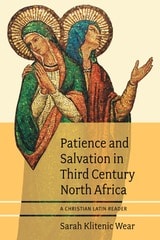
Patience and Salvation in Third Century North Africa: A Christian Latin Reader features the entirety of Tertullian’s To Martyrs and The Passion of Perpetua and Felicity, with selections from Cyprian’s On the Good of Patience and a short appendix on Augustine’s Commentary on Psalm 121.6. The Latin text has facing vocabulary and theological, historical, philosophical, and grammatical notes. In the first three centuries, Roman Carthage produced some of the earliest literature composed originally in Latin by Christians. Tertullian’s Ad Martyras (197); Passio Perpetuae et Felicitatis (203), and Cyprian’s De Bono Patientiae (256) all embody the force of this new genre of Latin literature. With this literature, we see a variant of Latin often denoted “Christian Latin.” Christian Latin featured linguistic elements marked by characteristics of biblical Latin, later Latin, as well as vulgarisms. In addition to converging philologically, Tertullian, the author of the Passio, and Cyprian align themselves in topos: they all ask the question of how one can endure torment and anxiety in this world. Patience (patientia), derived from the verb for “to suffer” (patior), is a virtue that allows one to endure troubles, anxieties, and physical pains with the hope of eternal happiness and salvation in heaven. In this Reader, the student will find three different literary perspectives on this theme. The book also draws parallels to the works of Seneca and Cicero on patience and suffering.
[more]
cover of Persecution and Rescue: The Politics of the “Final Solution” in France, 1940-1944

Persecution and Rescue

The Politics of the “Final Solution” in France, 1940-1944

Wolfgang Seibel

University of Michigan Press, 2016

In 1942, two years after invading France, the Germans implemented their policy of exterminating the Jews. In contrast to Jews in many parts of German-occupied Europe, however, the majority of Jews in France survived, thanks to opposition to the Nazi extermination policy from Church dignitaries and the moral indignation of the average Frenchmen. Seeking to maintain popular support, the Vichy Regime bargained with the Germans over the substance and extent of its collaboration, which the Germans needed in order to hold France.

Drawing on German and French sources, Wolfgang Seibel traces the twisted process of political decision-making that shaped the fate of the Jews in German-occupied France during World War II. By analyzing the German-French negotiations, he reveals the underlying logic as well as the actual course of the bargaining process as both the Vichy Regime and the Germans sought a stable relationship. Yet that relationship was continually reshaped by the progress of the war, Germany’s deteriorating prospects, France’s economic and geopolitical position, and the Vichy government’s quest for domestic political support. The Jews’ suffering intensified when the Germans had the upper hand; but when the French felt empowered, the Vichy Regime stopped collaborating in the completion of the “final solution.” Persecution and Rescue: The Politics of the “Final Solution” in France, 1940–1944 demonstrates the ways in which political circumstances can mitigate—or foster—mass crime.

[more]
cover of Persecution and the Art of Writing

Persecution and the Art of Writing

Leo Strauss

University of Chicago Press, 1988
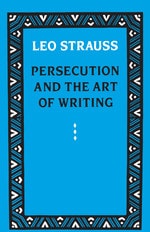
The essays collected in Persecution and the Art of Writing all deal with one problem—the relation between philosophy and politics. Here, Strauss sets forth the thesis that many philosophers, especially political philosophers, have reacted to the threat of persecution by disguising their most controversial and heterodox ideas.
[more]
cover of Persecution, Plague, and Fire: Fugitive Histories of the Stage in Early Modern England

Persecution, Plague, and Fire

Fugitive Histories of the Stage in Early Modern England

Ellen MacKay

University of Chicago Press, 2011

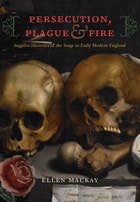
The theater of early modern England was a disastrous affair. The scant record of its performance demonstrates as much, for what we tend to remember today of the Shakespearean stage and its history are landmark moments of dissolution: the burning down of the Globe, the forced closure of playhouses during outbreaks of the plague, and the abolition of the theater by its Cromwellian opponents.


 Persecution, Plague, and Fire is a study of these catastrophes and the theory of performance they convey. Ellen MacKay argues that the various disasters that afflicted the English theater during its golden age were no accident but the promised end of a practice built on disappearance and erasure—a kind of fatal performance that left nothing behind but its self-effacing poetics. Bringing together dramatic theory, performance studies, and theatrical, religious, and cultural history, MacKay reveals the period’s radical take on the history and the future of the stage to show just how critical the relation was between early modern English theater and its public.
[more]
cover of Propaganda and Persecution

Propaganda and Persecution

Renée Poznanski

University of Wisconsin Press, 2024

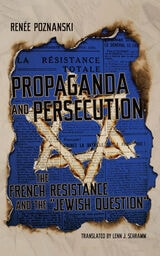
Renée Poznanski’s magisterial history of the French Resistance during World War II offers a comprehensive exploration of the most significant issue in that period’s social imaginary: the “Jewish question.” With extraordinary nuance, she analyzes the discourse around Jews and Judaism that pervaded the Resistance’s propaganda and debates, while closely examining the fate of Jews under Vichy and after. 

Poznanski argues that Jews in France suffered a double persecution: one led by the Vichy government, the other imposed by the Nazis. Marginalization and exclusion soon led to internment and deportation to terrifying places. Meanwhile, a propaganda war developed between the Resistance and the official voice of Vichy. Poznanski draws on a breathtaking array of sources, especially clandestine publications and French-language BBC transmissions, to show how the Resistance both fought and accommodated the deeply entrenched antisemitism within French society. Her close readings of propaganda texts against public opinions probe ambiguities and silences in Resistance writing about the persecution of the Jews and, in parallel, the numerous and detailed denunciations that could be read in the Jewish clandestine press. This extensive synthesis extends to the post-Liberation period, during which the ongoing persecution of Jews in Europe and North Africa would be portrayed as secondary to the suffering of the nation.

The winner of the 2009 Henri Hertz Prize by the Chancellerie des Universités de Paris, Sorbonne, Propaganda and Persecution makes major contributions to the study of the Resistance and of antisemitism. Lenn J. Schramm’s English translation brings Poznanski’s dynamic prose to life.
[more]
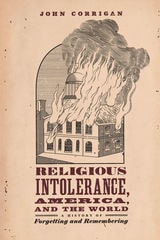
cover of Religious Intolerance, America, and the World: A History of Forgetting and Remembering

Religious Intolerance, America, and the World

A History of Forgetting and Remembering

John Corrigan

University of Chicago Press, 2020

As the news shows us every day, contemporary American culture and politics are rife with people who demonize their enemies by projecting their own failings and flaws onto them. But this is no recent development. Rather, as John Corrigan argues here, it’s an expression of a trauma endemic to America’s history, particularly involving our long domestic record of religious conflict and violence.

Religious Intolerance, America, and the World spans from Christian colonists’ intolerance of Native Americans and the role of religion in the new republic’s foreign-policy crises to Cold War witch hunts and the persecution complexes that entangle Christians and Muslims today. Corrigan reveals how US churches and institutions have continuously campaigned against intolerance overseas even as they’ve abetted or performed it at home. This selective condemnation of intolerance, he shows, created a legacy of foreign policy interventions promoting religious freedom and human rights that was not reflected within America’s own borders. This timely, captivating book forces America to confront its claims of exceptionalism based on religious liberty—and perhaps begin to break the grotesque cycle of projection and oppression.
[more]
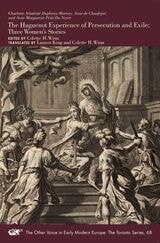
cover of The Huguenot Experience of Persecution and Exile: Three Women’s Stories

The Huguenot Experience of Persecution and Exile

Three Women’s Stories

Charlotte Arbaleste Duplessis-Mornay, Anne de Chaufepié, and Anne Marguerite Petit Du Noyer

Iter Press, 2019

This volume provides an English translation of firsthand testimonies by three early modern French women. It illustrates the Huguenot experience of persecution and exile during the bloodiest times in the history of Protestantism: the St. Bartholomew’s Day Massacre, the dragonnades, and the Huguenot exodus following the Revocation of the Edict of Nantes. The selections given here feature these women’s experiences of escape, the effects of religious strife on their families, and their reliance on other women amid the terrors of war.

Edited by Colette H. Winn. Translated by Lauren King and Colette H. Winn
The Other Voice in Early Modern Europe: The Toronto Series, Vol. 68
[more]
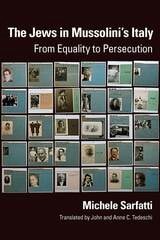
cover of The Jews in Mussolini's Italy: From Equality to Persecution

The Jews in Mussolini's Italy

From Equality to Persecution

Michele Sarfatti; Translated by John and Anne C. Tedeschi

University of Wisconsin Press, 2006
      Often overshadowed by the persecution of Jews in Germany, the treatment of Jews in fascist Italy comes into sharp focus in this volume by Italian historian Michele Sarfatti. Using thorough and careful statistical evidence to document how the Italian social climate changed from relatively just to irredeemably prejudicial, Sarfatti begins with a history of Italian Jews in the decades before fascism—when Jews were fully integrated into Italian national life—and provides a deft and comprehensive history from fascism’s rise in 1922 to its defeat in 1945. 
 
 
Outstanding Academic Title, Choice Magazine
    
[more]
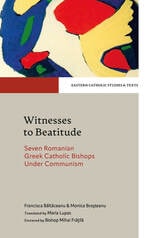
cover of Witnesses to Beatitude: Seven Romanian Greek Catholic Bishops Under Communism

Witnesses to Beatitude

Seven Romanian Greek Catholic Bishops Under Communism

Francisca Băltăceanu

Catholic University of America Press, 2026

Veteran authors Francisca Băltăceanu and Monica Broşteanu render extensive archival research into a readable, stand-alone volume about seven key figures in the outlawed Romanian Greek Catholic Church. Prefaced by the Greek Catholic bishop of Bucharest, the book synthesizes indispensable background information for reading the story of these twentieth-century church leaders from Transylvania where in 1700 an agreement of union was reached between the Romanian Orthodox leadership and the Catholic Church in Rome, forming the Romanian Church United to Rome, Greek Catholic. In 1948 the Soviet-imposed government in Romania determined that the Romanian Greek Catholic Church no longer existed and detained its bishops: Vasile Aftenie, Valeriu Traian Frenţiu, Ioan Suciu, Ioan Bălan, Alexandru Rusu, and Iuliu Hossu. At the same time, it detained numerous priests including Tit Liviu Chinezu who was secretly consecrated bishop at the request of the papal nuncio. I>Witnesses to Beatitude traces the bishops’ various origins and the extensive pressures put on them to cut their ties with the Vatican. For creatively resisting these pressures the seven men were put in the infamous Sighet prison and under house arrest where in 1969 Iuliu Hossu, the last to survive, was made a cardinal in pectore by Pope Paul VI. The book garnered a large bipartisan Catholic and Orthodox readership in Romania where it was a bestseller at the 2019 Bookfest. Drawing from the casefile submitted to the Holy See to recognize the martyrdom of the seven bishops who were beatified in June 2019, the book documents how the Communist government conducted a fierce campaign to ban the Greek Catholic Church and made the Orthodox leadership look responsible. The book includes oral testimonies suggesting the life force and humor that brought the bishops through the storm. It also contains the full bibliography of the casefile and an introduction and updated bibliography for English-language readers.
[more]