Results by title
18 books match the query 'Person'
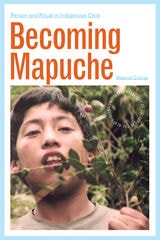
Becoming Mapuche
Person and Ritual in Indigenous ChileMagnus Course
University of Illinois Press, 2011
Christian faith & human understanding
studies on the Eucharist, Trinity, and the human personRobert Sokolowski
Catholic University of America Press, 2006
Form, Power, and Person in Robert Creeley’s Life and Work
Stephen Fredman
University of Iowa Press, 2010
By any measure—international reputation, influence upon fellow writers and later generations, number of books published, scholarly and critical attention—Robert Creeley (1926–2005) is a literary giant, an outstanding, irreplaceable poet. For many decades readers have remarked upon the almost harrowing emotional nakedness of Creeley’s writing. In the years since his death, it may be that the disappearance of the writer allows that nakedness to be observed more readily and without embarrassment.
Written by the foremost critics of his poetry, Form, Power, and Person in Robert Creeley’s Life and Work is the first book to treat Creeley’s career as a whole. Masterfully edited by Stephen Fredman and Steve McCaffery, the essays in this collection have been gathered into three parts. Those in “Form” consider a variety of characteristic formal qualities that differentiate Creeley from his contemporaries. In “Power,” writers reflect on the pressure exerted by emotions, gender issues, and politics in Creeley’s life and work. In “Person,” Creeley’s unique artistic and psychological project of constructing a person—reflected in his correspondence, teaching, interviews, collaborations, and meditations on the concept of experience—is excavated. While engaging these three major topics, the authors remain, as Creeley does, intent upon the ways such issues appear in language, for Creeley’s nakedness is most conspicuously displayed in his intimate relationship with words.
Contributors
Charles Altieri
Rachel Blau DuPlessis
Stephen Fredman
Benjamin Friedlander
Alan Golding
Michael Davidson
Steve McCaffery
Peter Middleton
Marjorie Perloff
Peter Quartermain
Libbie Rifkin

Homework Help from the Library
In Person and OnlineCarol American Library Association
American Library Association, 2011
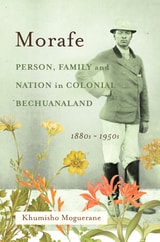
Morafe
Person, Family, and Nation in Colonial Bechuanaland, 1880s–1950sKhumisho Moguerane
Ohio University Press, 2024
In Morafe, Khumisho Moguerane has written a luminous exploration of two generations of the prominent Molema family. They were “border people” who straddled what would become present-day South Africa and Botswana. The book begins in the 1880s at the frontier of the new British territories of Bechuanaland (North West and Northern Cape provinces) and the Bechuanaland Protectorate (Botswana), where the political boundary between these two territories was negligible and where skin color did not yet necessarily connect with a particular social or political status or affect economic opportunity.
Morafe ends in the 1950s, when the political boundary mattered profoundly, dividing two very different colonial dispensations of racial ordering and classification, and two separate traditions of nationalist politics. With this landmark publication, Moguerane reveals that “the nation” is less “out there,” in public institutions and political struggles, and more “in here,” in the everyday drama of personal and ordinary lives.
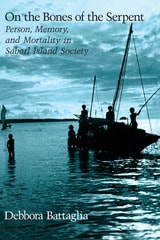
On the Bones of the Serpent
Person, Memory, and Mortality in Sabarl Island SocietyDebbora Battaglia
University of Chicago Press, 1990
The creative focus of Sabarl cultural life is a series of mortuary feasts and rituals known as segaiya. In assembling and disassembling commemorative food and objects in segaiya exchanges, Sabarl also assemble and disassemble the critical social relations such objects stand for. These commemorative acts create a collective memory yet also a collective experience of forgetting social bonds that are of no future use to the living. Sabarl anticipate this disaggregation in patterns of everyday life, which reveal the importance of categorical distinctions mapped in beliefs about the physical and metaphysical person.
Using remembrance and forgetting as an analytic lens, Battaglia is able to ask questions critical to understanding Melanesian social process. One of the "new ethnographies" addressing the limits of ethnographic representation and the fragmented nature of knowledge from an indigenous perspective, her finely wrought study explores the dynamics of cultural practices in which decontruction is integral to construction, allowing a new perspective on the ephermeral nature of sociality in Melanesia and new insight into the efficacy of cultural images more generally.
One Kind of Everything
Poem and Person in Contemporary AmericaDan Chiasson
University of Chicago Press, 2007
One Kind of Everything elucidates the uses of autobiography and constructions of personhood in American poetry since World War II, with helpful reference to American literature in general since Emerson. Taking on one of the most crucial issues in American poetry of the last fifty years, celebrated poet Dan Chiasson explores what is lost or gained when real-life experiences are made part of the subject matter and source material for poetry. In five extended, scholarly essays—on Robert Lowell, Elizabeth Bishop, Frank Bidart, Frank O’Hara, and Louise Glück—Chiasson looks specifically to bridge the chasm between formal and experimental poetry in the United States. Regardless of form, Chiasson argues that recent American poetry is most thoughtful when it engages most forcefully with autobiographical material, either in an effort to embrace it or denounce it.
Person and Act and Related Essays
Karol Wojtyla
Catholic University of America Press, 2021

Person and Myth
Maurice Leenhardt in the Melanesian WorldJames Clifford
Duke University Press, 1992
Person and Psyche
Kenneth L. Schmitz
Catholic University of America Press, 2009
Person, Being, and History
Michael Baur
Catholic University of America Press, 2011
Saint Thomas Aquinas
The Person and His WorkJean-Pierre Torrell, OP
Catholic University of America Press, 2022
The Ethical Condition
Essays on Action, Person, and ValueMichael Lambek
University of Chicago Press, 2015
Organized chronologically, the essays begin among Malagasy speakers on the island of Mayotte and in northwest Madagascar. Building from ethnographic accounts there, they synthesize Aristotelian notions of practical judgment and virtuous action with Wittgensteinian notions of the ordinariness of ethical life and the importance of language, everyday speech, and ritual in order to understand how ethics are lived. They illustrate the multiple ways in which ethics informs personhood, character, and practice; explore the centrality of judgment, action, and irony to ethical life; and consider the relation of virtue to value. The result is a fully fleshed-out picture of ethics as a deeply rooted aspect of the human experience.
The Soul of the Person
A Contemporary Philosophical PsychologyAdrian J. Reimers
Catholic University of America Press, 2006
The Three Ages of Government
From the Person, to the Group, to the WorldJos C.N. Raadschelders
University of Michigan Press, 2020
The person and the polis
faith and values within the secular stateCraig Steven Titus
Catholic University of America Press, 2006

What Is a Person?
AN ETHICAL EXPLORATIONJames W. Walters
University of Illinois Press, 1997
important to understand what constitutes a person. What are the medical,
ethical, moral, mental, legal, and philosophical criteria that determine
protectable human life?
Following immediately on the publication of his highly praised book Choosing
Who's to Live, James Walters addresses with depth and wisdom another
ambitious and complicated matter: determining the nature of personhood.
By providing a much-needed religious/philosophical context for the discussion--examining
contemporary thinking on just what constitutes valuable life--Walters
broadens his inquiry beyond the human to include other animals and deals
with the phenomenon of anencephalic infants, those who are born without
higher brains.
Searching for a measurable and humane standard of personhood, Walters
looks at the current definition of it and declares it inadequate--offering
instead the idea of proximate personhood, with criteria for helping to
determine which individuals possess a unique claim to life.
What Is a Person?
Rethinking Humanity, Social Life, and the Moral Good from the Person UpChristian Smith
University of Chicago Press, 2010
What is a person? This fundamental question is a perennial concern of philosophers and theologians. But, Christian Smith here argues, it also lies at the center of the social scientist’s quest to interpret and explain social life. In this ambitious book, Smith presents a new model for social theory that does justice to the best of our humanistic visions of people, life, and society.
Finding much current thinking on personhood to be confusing or misleading, Smith finds inspiration in critical realism and personalism. Drawing on these ideas, he constructs a theory of personhood that forges a middle path between the extremes of positivist science and relativism. Smith then builds on the work of Pierre Bourdieu, Anthony Giddens, and William Sewell to demonstrate the importance of personhood to our understanding of social structures. From there he broadens his scope to consider how we can know what is good in personal and social life and what sociology can tell us about human rights and dignity.
Innovative, critical, and constructive, What Is a Person? offers an inspiring vision of a social science committed to pursuing causal explanations, interpretive understanding, and general knowledge in the service of truth and the moral good.