Results by title
111 books match the query 'Personal narratives, American' and 17 start with a
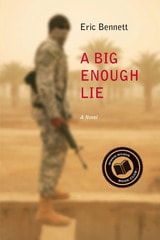
A Big Enough Lie
A NovelEric Bennett
Northwestern University Press, 2015
Awaiting a TV talk show appearance, John Townley is quaking with dread. He has published a best-selling memoir about the Iraq War, a page-turner climaxing in atrocity. In a green room beyond the soundstage, he braces himself to confront the charismatic soldier at the violent heart of it. But John has never actually seen the man before—nor served in Iraq, nor the military. Even so, and despite the deception, he knows his fabricated memoir contains stunning truths.
By turns comic, suspenseful, bitingly satirical, and emotionally potent, A Big Enough Lie pits personal mistruths against national ones of life-and-death consequence. Tracking a writer from the wilds of Florida to New York cubicles to Midwestern workshops to the mindscapes of Baghdad—and from love to heartbreak to solitary celebrity—Bennett’s novel probes our endlessly frustrated desire to grab hold of something (or somebody) true.
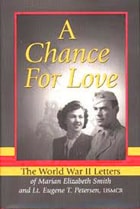
A Chance for Love
The World War II Letters of Marian Elizabeth Smith and Lt. Eugene T. Petersen, USMCREugene Peterson
Michigan State University Press, 1998
In mid-February 1944 Marian Elizabeth Smith, a young Wisconsin woman, met Marine Corps Lieutenant Eugene T. Petersen on the passenger train, El Capitan, as it made its 42-hour run from Los Angeles to Chicago. After a brief acquaintance, he left the United States to join the Third Marine Division on Guam and eventually to take part in the battle for Iwo Jima in February and March of 1945. The collected letters of their subsequent 18-month correspondence reveal much about wartime life at home and abroad. This correspondence represents a time capsule of current events as Smith and Petersen discuss Franklin Roosevelt, the United Nations, internationalism, popular movies, the French aviator and poet Antoine de St. Exupery, the comic strip Barnaby, and the frustrations of dealing with sometimes less-than- enlightened parents. The loss of Marian's brother during the bombing of Ploesti, Rumania, in June 1944, brought Petersen and Smith closer together, and after hundreds of letters the "chance for love" Marian had suggested early in their correspondence evolved into a marriage that has endured for more than half a century.
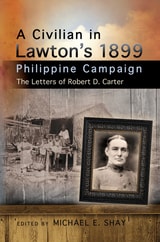
A Civilian in Lawton's 1899 Philippine Campaign
The Letters of Robert D. CarterEdited by Michael E. Shay
University of Missouri Press, 2013
In the midst of the Philippine-American War, twenty-two-year-old Robert Dexter Carter served in Manila as a civilian quartermaster clerk. Through his letters to his family, he provided a vivid picture of army life in Manila—the sights, the smells, and his responses to the native culture. In addition to his letters, his diary and several related articles present a firsthand account of the historic voyage of the United States Army Transport Grant through the Suez Canal to Manila in early 1899. Carter’s writings not only tell of his sometimes harrowing experiences, but also reveal the aspirations and fears of a young man not quite sure of his next steps on life’s journey.
Carter’s father, Robert Goldthwaite Carter, was a war hero and a longtime friend of Maj. Gen. Henry W. Lawton. Carter obtained his position through Lawton’s influence, and his respect for Lawton is clear throughout his writings. A frequent guest in the Lawton home, the young clerk was introduced to many notable figures both military and civilian. Carter’s letters, particularly to his father, are full of news and gossip related to his commander. In other letters, he reveals the kindness and generosity of Mrs. Lawton, who took time to look out for Carter while he was in the hospital and often loaned him books.
This well-researched and expertly edited work casts light on the role of support troops in war, a subject too often minimized or ignored. Shay begins each chapter with an introduction that establishes the setting, the context of events, and the disposition of Carter and his compatriots and provides notes and commentary to place the letters in context. By choosing not to edit the offensive expletives of a sometimes arrogant and racist young man, Shay presents a fully nuanced portrait of a young American exploring the larger world in a time of turmoil.
Enhanced by photographs from collections at the Library of Congress and the Military History Institute, as well as many of Carter’s own whimsical drawings, the book will appeal to armchair historians and scholars alike.
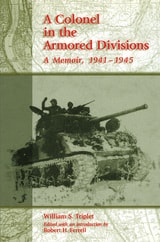
A Colonel in the Armored Divisions
A Memoir, 1941-1945William S. Triplet, Edited by Robert H. Ferrell
University of Missouri Press, 2001
In this fascinating memoir William S. Triplet continues the saga begun in his earlier book, A Youth in the Meuse-Argonne: A Memoir, 1917-1918. After serving in World War I, Triplet chose to become a career military man and entered West Point. Upon graduation in 1924, his assignments were routine—to regiments in the Southwest and in Panama or as an officer in charge of Reserve Officers' Training Corps units or of men sent to a tank school. All this changed, however, when a new war opened in Europe.
From 1940 to1942, Triplet was assigned to the Infantry Board at Fort Benning, Georgia, where he engaged in testing new weapons and machines for the expanding army. He became a full colonel in December 1942. After leaving Benning he received posts with four armored forces: the Thirteenth Armored Division forming in the United States, an amphibious tank and troop carrier group training at Fort Ord, California, and the Second and Seventh Armored Divisions in Europe. His extraordinary abilities as a tank commander became evident in the Seventh Armored, where he took over a four-thousand-man unit known as Combat Command A. He was soon moving from triumph to triumph as he led his unit into Germany. Here was much room for professional judgment and decision, and the colonel was in his element. In the war's last days Triplet and his men fought their way to the Baltic, preventing many German troops from joining in the defense of Berlin against the advancing Soviet army.
Although Triplet was recommended for brigadier general, Dwight D. Eisenhower believed the U.S. Army had enough generals to finish the war; thus, the indomitable Triplet served out the few remaining years of his career as a colonel. After retiring in 1954, Triplet moved to Leesburg, Virginia, where he soon began to mull over his military experiences. Fascinated by the history he had witnessed, engaged by the attraction of writing about it, he recorded his memories with a combination of verve, thoughtfulness, and harsh judgments concerning ranking officers he considered incompetent— generals not excluded.
Through his annotations, Robert H. Ferrell provides the historical context for Triplet's experiences. Well written and completely absorbing, A Colonel in the Armored Divisions provides readers the rare opportunity to see firsthand what a real professional in the U.S. Army thought about America's preparation for and participation in the war against Germany and Japan.
A Different Face of War
Memories of a Medical Service Corps Officer in VietnamJames G. Van Straten
University of North Texas Press, 2015

A Machine-Gunner in France
The Memoirs of Ward Schrantz, 35th Division, 1917-1919Ward Schrantz
University of North Texas Press, 2019
A Marine Dive-bomber Pilot at Guadalcanal
John Howard McEniry
University of Alabama Press, 1987
This book chronicles the World War II experiences of the author, who served as a Marine Corps pilot in the South Pacific. Colonel McEniry describes the organization and deployment of a Marine dive-bombing squadron (VMSB-132) in the early days of the war and follows the squadron through its actions in November and December of 1942.
The participation by the squadron in the naval battle of Guadalcanal, November 12-15, 1942, is related in detail and includes the personal experiences of the author on several bombing missions. This battle, described by Admiral Ernest J. King, the Chief of Naval Operations, as “the fiercest naval battle ever fought,” resulted in the loss by the Japanese of two battleships, ten transport ships, and numerous cruisers and destroyers.
A Morning in June
Defending Outpost HarryJames W. Evans, with a foreword by John S. D. Eisenhower
University of Alabama Press, 2010
Exploring the strategic and human dimensions of the defense of Outpost Harry.
By June 1953 the Korean War, marked at the outset by extremely fluid advances and retreats up and down the peninsula, had settled into position warfare very near the original pre-war demarcation line between North and South Korea. At this point both sides were fighting to win a peace, to achieve incremental advantages that could be translated into gains at the peace negotiations in Panmunjom. The battle at Outpost Harry devolved into hand-to-hand combat during a period of constant, intense fighting that lasted two days. The author, although seriously wounded that night, refused evacuation and remained on the hill to successfully lead his company in defense of the outpost. It wasn’t romantic; it wasn’t chivalrous; and many died or were badly wounded. Some of the survivors never fully overcame the mental and physical damage they suffered during the nightmare.
With this book, one of those scarred by that experience recounts the events of the battle and his lifelong efforts to deal with the residual horrors. The Korean Conflict may be called "the forgotten war" by some, but not by those who were on the front lines.
A Private War
An American Code Officer in the Belgian CongoRobert Laxalt
University of Nevada Press, 1998
In this vivid memoir, Laxalt recalls his service during WWII as a code officer in the Belgian Congo. In this remote jungle outpost, a secret war was being fought for control of the world’s future. Deep in the Congo lay a mine that produced a little-known substance called uranium, and for reasons no one then understood, the Allies and the Germans were struggling ferociously to control this mine and its ore. The cloth edition is a limited numbered, signed edition.
A Soldier in World War I
The Diary of Elmer W. SherwoodRobert H. Ferrell
Indiana Historical Society Press, 2004
A-Train
Memoirs of a Tuskegee AirmanCharles W. Dryden
University of Alabama Press, 1997
A moving personal account of a man’s flight for freedom—above the clouds and beyond prejudice—by one of the first Tuskegee airmen.
A-Train is the story of one of the black Americans who, during World War II, graduated from Tuskegee (AL) Flying School and served as a pilot in the Army Air Corps’ 99th Pursuit Squadron. Charles W. Dryden presents a fast-paced, balanced, and personal account of what it was like to prepare for a career traditionally closed to African Americans, how he coped with the frustrations and dangers of combat, and how he, along with many fellow black pilots, navigators, bombardiers, and crewmen, emerged with a magnificent war record.
Under the command of Colonel Benjamin O. Davis Jr., the Tuskegee airmen fought over North Africa, Sicily, and Europe, escorting American bomber crews who respected their "no-losses" record. Some were shot down, many of them were killed or captured by the enemy, and several won medals of valor and honor. But the airmen still faced great barriers of racial prejudice in the armed forces and at home. As a member of that elite group of young pilots who fought for their country overseas while being denied civil liberties at home, Dryden presents an eloquent story that will touch every reader.
All the Hometown Boys
Wisconsin's 150th Machine Gun Battalion in World War IBrad Larson
University of Wisconsin Press, 2019
American Commander in Spain
Robert Hale Merriman and the Abraham Lincoln BrigadeMarion Merriman
University of Nevada Press, 1986
Among the Americans was Robert Hale Merriman, a scholar who had been studying international economics in Europe. He and his wife, Marion, joined volunteers from fifty-four countries in International Brigades. Merriman became the first commander of the Americans; Abraham Lincoln Battalion and a leader among the International Brigades. Now available in a new paperback edition, American Commander in Spain is based on Merriman and Marion's diaries and personal correspondence, Marion's own service at his side in Spain, as well as Warren Lerude's extensive research and interviews with people who knew Merriman and Marion, government records, and contemporary news reports. This critically acclaimed work is both the biography of a remarkable man who combined his idealism with life-risking action to fight fascism threatening Europe and Marion's vivid first-hand account of life in Spain during the civil war that became a prologue to the Second World War.
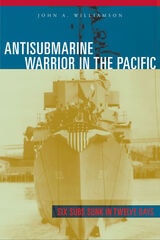
Antisubmarine Warrior in the Pacific
Six Subs Sunk in Twelve DaysJohn A. Williamson
University of Alabama Press, 2005
A commanding firsthand account of the most successful antisubmarine campaign in U.S. Naval History.
The USS England was a 1200-ton, 306-foot, long-hull destroyer escort. Commissioned into service in late 1943 and dispatched to the Pacific the following February, the England and its crew, in one 12-day period in 1944, sank more submarines than any other ship in U.S. naval history: of the six targets attacked, all six were destroyed. For this distinction, legendary in the annals of antisubmarine warfare, the ship and her crew were honored with the Presidential Unit Citation.
After convoying in the Atlantic, John A. Williamson was assigned to the England—first as its executive officer, then as its commanding officer—from the time of her commissioning until she was dry-docked for battle damage repairs in the Philadelphia Naval Yard fifteen months later. Besides being a key participant in the remarkable antisubmarine actions, Williamson commanded the England in the battle of Okinawa, where she was attacked by kamikaze planes.
Williamson narrates his memoir with authority and authenticity, describes naval tactics and weaponry precisely, and provides information gleaned from translations of the orders from the Japanese high command to Submarine Squadron 7. The author details the challenges of communal life aboard ship and explains the intense loyalty that bonds crew members for life. Ultimately, Williamson offers a compelling portrait of himself, an inexperienced naval officer who, having come of age in Alabama during the Depression, rose to become the most successful World War II antisubmarine warfare officer in the Pacific.
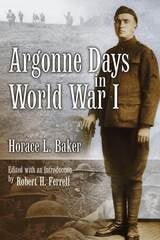
Argonne Days in World War I
Horace L. Baker, Edited & Intro by Robert H. Ferrell
University of Missouri Press, 2007
This poignant memoir recalls the great battle of the Meuse-Argonne, an epic conflict waged by well over a million men that saw casualties of 26,277 killed and 95,786 wounded. Many books have been written about General Pershing’s planning of the offensive; this one tells what happened to the soldiers who had to carry out his orders.
The Thirty-second was a shock division made up largely of National Guard units—farm boys from the Upper Midwest. But as casualties mounted, replacements were rushed into battle with little training—and devastating results. Baker knew friends and tent mates who were alive one day, dead the next, and he kept track of the battle in diary entries tucked into his Bible—and made evasively short in case of capture.
He shares his and his comrades’ thoughts about fighting in a harsh climate and terrain, relates their ongoing problems with short supplies, and tells how they managed to overcome their fears. It is a straightforward narrative that doesn’t glorify battle or appeal to patriotism yet conveys the horrors of warfare with striking accuracy. Historian Robert Ferrell’s new introduction puts Baker’s recollections in the context of the larger theater of war.
Baker fleshed out his diary in a book that saw limited publication in 1927 but has remained essentially unknown. Argonne Days in World War I is a masterpiece brimming with insight about the ordinary doughboys who fought in the European trenches. It conveys the spirit of a man who did his duty in a time of trouble—and is a testament to the spirit shared by thousands like him.
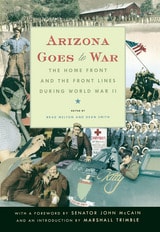
Arizona Goes to War
The Home Front and the Front Lines during World War IIBrad Melton
University of Arizona Press, 2003
Arizona Goes to War takes readers back to a time when military installations sprang up all over the state as thousands of airmen arrived to train in Arizona's clear desert skies, and when soldiers destined for North Africa came to get their first taste of desert sands. In its pages, readers will learn not only of the green recruits who passed through Arizona, but also of the state's Native Americans who registered for the draft in record numbers, of Japanese Americans unjustly incarcerated in desert detention centers, and of ordinary citizens who did their bit for the war effort. Included in the book are some of World War II's most incredible stories, such as the testing of tank engines in Arizona dust storms for the North Africa campaign, the interrogation of Japanese consular diplomats from Honolulu at the Triangle T Guest Ranch near Dragoon, and the escape of 25 German POWs from a detention camp outside of Phoenix—called the greatest escape by Axis prisoners from a U.S. compound during the war. A separate chapter pays tribute to Arizona's war heroes: not only Silvestre Herrera, but also fighter ace Grant Turley, Midway hero John C. Butler, and Pima Indian Ira Hayes, who helped raise the flag on Iwo Jima. A host of profiles and sidebars bring people and events of the wartime era to life, and a useful appendix provides a traveler's guide to Arizona's World War II sites.
World War II may have transformed Arizona more than it did any other state; not only did Arizona's industry blossom, its population did as well when servicemen who had been stationed there returned to put down stakes. Arizona Goes to War recaptures the glory and spirit of that era and reminds us that the people who lived through those years are well worth commemorating.
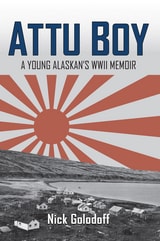
Attu Boy
A Young Alaskan's WWII MemoirNick Golodoff
University of Alaska Press, 2015
One of those survivors, Nick Golodoff, became a prisoner of war at just six years old. He was among the dozens of Unangan Attu residents swept away to Hokkaido, and one of only twenty-five to survive. Attu Boy tells Golodoff’s story of these harrowing years as he found both friendship and cruelty at the hands of the Japanese. It offers a rare look at the lives of civilian prisoners and their captors in WWII-era Japan. It also tells of Golodoff’s bittersweet return to a homeland torn apart by occupation and forced internments. Interwoven with other voices from Attu, this richly illustrated memoir is a testament to the struggles, triumphs, and heartbreak of lives disrupted by war.