Results by title
16 books match the query 'Persuasion'
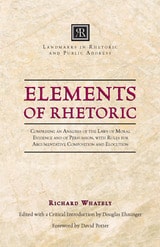
Elements of Rhetoric
Comprising an Analysis of the Laws of Moral Evidence and of Persuasion, with Rules for Argumentative Composition and ElocutionRichard Whately. Edited with a Critical Introduction by Douglas Ehninger. Foreword by David Potter.
Southern Illinois University Press, 1963
Direct, comprehensive, well organized, simple in statement, Elements of Rhetoric is in all respects well fitted to fulfill its assigned role as a textbook. The remarks on practical problems and the examples and analogies confirm contemporary reports that Whately was himself a talented and stimulating teacher.
The modern field of speech was born near the beginning of the twentieth century, some seventy years after Whately wrote. But influential leaders in the new field endorsed Whately’s judgments, and courses and textbooks in public address have remained strongly influenced by his ideas. Whately’s views on a number of major questions in rhetoric have proved sound and fruitful during many decades of practice, and his book remains one of the most influential works on the subject.
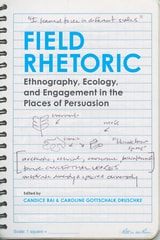
Field Rhetoric
Ethnography, Ecology, and Engagement in the Places of PersuasionEdited by Candice Rai and Caroline Gottschalk Druschke
University of Alabama Press, 2018
A survey of the innovative scholarship emerging at the intersections of rhetoric, and fieldwork
A variety of research areas within rhetorical studies—including everyday and public rhetorics, space and place-based work, material and ecological approaches, environmental communication, technical communication, and critical and participatory action research, among others—have increasingly called for ethnographic fieldwork that grounds the study of rhetoric within the contexts of its use and circulation. Employing field methods more commonly used by ethnographers allows researchers to capture rhetoric in action and to observe the dynamic circumstances that shape persuasion in ordinary life.
Field Rhetoric: Ethnography, Ecology, and Engagement in the Places of Persuasion gathers new essays that describe and theorize this burgeoning transdisciplinary mode of field-based scholarship. Contributors document and support this ethnographic turn in rhetorical studies through sustained examination of the diverse trends, methods, tools, theories, practices, and possibilities for engaging in rhetorical field research.
This fascinating volume offers an introduction to these inquiries and serves as both a practical resource and theoretical foundation for scholars, teachers, and students interested in the intersection of rhetoric and field studies. Editors Candice Rai and Caroline Gottschalk Druschke have assembled scholars working in diverse field sites to map and initiate key debates on the practices, limitations, and value of rhetorical field methods and research. Working synthetically at the junction of rhetorical theory and field practices, the contributors to this collection build from myriad field-based cases to examine diverse theoretical and methodological considerations. The volume also serves as a useful reference for interdisciplinary qualitative researchers interested in doing research from a rhetorical or discursive perspective in various disciplines and fields, such as English, composition, communication, natural resources, geography, sociology, urban planning, anthropology, and more.

Fighting the Death Penalty
A Fifty-Year Journey of Argument and PersuasionEugene G. Wanger
Michigan State University Press, 2019
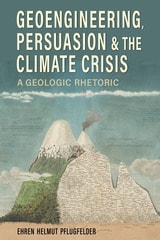
Geoengineering, Persuasion, and the Climate Crisis
A Geologic RhetoricEhren Helmut Pflugfelder
University of Alabama Press, 2023
A rhetorical exploration of an underexamined side of climate change—the ongoing research into and development of geoengineering strategies
Geoengineering, Persuasion, and the Climate Crisis: A Geologic Rhetoric exposes the deeply worrying state of discourse over geoengineering—the intentional manipulation of the earth’s climate as means to halt or reverse global warming. These climate-altering projects, which range from cloud-whitening to carbon dioxide removal and from stratospheric aerosol injection to enhanced weathering, are all technological solutions to more complex geosocial problems.
Geoengineering represents one of the most alarming forms of deliberative discourse in the twenty-first century. Yet geoengineering could easily generate as much harm as the environmental traumas it seeks to cure. Complicating these deliberations is the scarcity of public discussion. Most deliberations transpire within policy groups, behind the closed doors of climate-oriented startups, between subject-matter experts at scientific conferences, or in the disciplinary jargon of research journals. Further, much of this conversation occurs primarily in the West.
Ehren Helmut Pflugfelder makes clear how the deliberative rhetorical strategies coming from geoengineering advocates have been largely deceptive, hegemonic, deterministic, and exploitative. In this volume, he investigates how geoengineering proponents marshal geologic actors into their arguments—and how current discourse could lead to a greater exploitation of the earth in the future.
Pflugfelder’s goal is to understand the structure, content, purpose, and effect of these discourses, raise the alarm about their deliberative directions, and help us rethink our approach to the climate. In highlighting both the inherent problems of the discourses and the ways geologic rhetoric can be made productive, he attempts to give “the geologic” a place at the table to better understand the roles that all earth systems continue to play in our lives, now and for years to come.
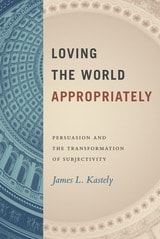
Loving the World Appropriately
Persuasion and the Transformation of SubjectivityJames L. Kastely
University of Chicago Press, 2022
What is persuasion? For some, it is the ideal alternative to violence. For others, persuasion is simply a neutral instrumentality—a valued source of soft power. Both positions rest on a fundamental belief: persuasion is a power that resides in a speaker acting on an audience. Loving the World Appropriately asks a different, more fundamental, question: why does an audience need persuasion? In shifting our focus, James Kastely delivers a provocative new history of rhetoric and philosophy, one that describes rhetoric as more than a matter of effective communication and recasts persuasion as a philosophical concern central to notions of human subjectivity. Ultimately, Kastely insists, persuasion enables us to love the world appropriately.

Nahua Horizons
Writing, Persuasion, and Futurities in Colonial MexicoEzekiel G. Stear
University of Arizona Press, 2025
Nahua Horizons: Writing, Persuasion, and Futurities in Colonial Mexico investigates how Nahuas conceptualized their futures in the early colonial period. Scholar Ezekiel G. Stear delves deeply into canonical texts such as the Florentine Codex and the Crónica mexicayotl as well as understudied texts such as the Lienzo de Quauhquechollan, the Tira de Tepechpan, and the Anales de Juan Bautista. The study does more than describe how Nahuas conceived of their own futures: it also shows their specific plans for moving into the coming years.
The book examines how Nahua writers in Central Mexico and other Mesoamerican voices in colonial Spanish America played an active, decisive role in shaping culture, using writing to persuade their communities to mold their own destinies, even amid colonial upheaval. This work opens up new directions for research and teaching, shifting inquiry from how Nahuas preserved cultural continuity to how they envisioned their roles as pathfinders toward times to come.
Nahua Horizons challenges the notion that the Spanish erased Nahua culture. The book emphasizes the ways people kept sovereignty over the futures they envisioned for themselves and their communities. Stear’s bold new approach follows the paths that Nahuas forged ahead into unknown times.
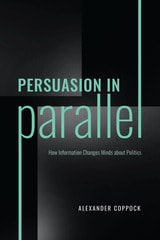
Persuasion in Parallel
How Information Changes Minds about PoliticsAlexander Coppock
University of Chicago Press, 2022
Many mistakenly believe that it is fruitless to try to persuade those who disagree with them about politics. However, Persuasion in Parallel shows that individuals do, in fact, change their minds in response to information, with partisans on either side of the political aisle updating their views roughly in parallel. This book challenges the dominant view that persuasive information can often backfire because people are supposedly motivated to reason against information they dislike. Drawing on evidence from a series of randomized controlled trials, the book shows that the backfire response is rare to nonexistent. Instead, it shows that most everyone updates in the direction of information, at least a little bit. The political upshot of this work is that the other side is not lost. Even messages we don't like can move us in the right direction.

Propaganda and Persuasion
The Cold War and the Canadian-Soviet Friendship SocietyJennifer Anderson
University of Manitoba Press, 2017
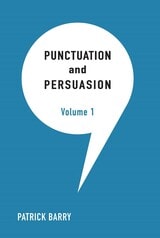
Punctuation and Persuasion
Patrick Barry
Michigan Publishing Services, 2022
With a little knowledge and a lot of practice, you can do more than just sound more professional when you skillfully use commas, semicolons, and other forms of punctuation. You can, importantly, become more persuasive.
That’s what students who have taken Professor Patrick Barry’s classes at the University of Michigan Law School, the University of Chicago Law School, and the UCLA School of Law have learned, as have the over 100,000 people who have enrolled in his online course “Good with Words: Writing and Editing” on the educational platforms Coursera and FutureLearn.
Now, thanks to this book, you can undergo that same rhetorical transformation. Punctuation doesn’t have to be a pain point. When properly mastered, it can be a powerful tool for all kinds of advocates.

Rethinking Racism
Emotion, Persuasion, and Literacy Education in an All-White High SchoolJennifer Seibel Trainor
Southern Illinois University Press, 2008
In Rethinking Racism: Emotion, Persuasion, and Literacy Education in an All-White High School, Jennifer Seibel Trainor proposes a new understanding of the roots of racism, one that is based on attention to the role of emotion and the dynamics of persuasion. This one-year ethnographic study argues against previous assumptions about racism, demonstrating instead how rhetoric and emotion, as well as the processes and culture of schools, are involved in the formation of racist beliefs.
Telling the story of a year spent in an all-white high school, Trainor suggests that contrary to prevailing opinion, racism often does not stem from ignorance, a lack of exposure to other cultures, or the desire to protect white privilege. Rather, the causes of racism are frequently found in the realms of emotion and language, as opposed to rational calculations of privilege or political ideologies. Trainor maintains that racist assertions often originate not from prejudiced attitudes or beliefs but from metaphorical connections between racist ideas and nonracist values. These values are reinforced, even promoted by schooling via "emotioned rules" in place in classrooms: in tacit, unexamined lessons, rituals, and practices that exert a powerful—though largely unacknowledged—persuasive force on student feelings and beliefs about race.
Through in-depth analysis of established anti-racist pedagogies, student behavior, and racial discourses, Trainor illustrates the manner in which racist ideas are subtly upheld through social and literacy education in the classroom—and are thus embedded in the infrastructures of schools themselves. It is the emotional and rhetorical framework of the classroom that lends racism its compelling power in the minds of students, even as teachers endeavor to address the issue of cultural discrimination. This effort is continually hindered by an incomplete understanding of the function of emotions in relation to antiracist persuasion and cannot be remedied until the root of the problem is addressed.
Rethinking Racism calls for a fresh approach to understanding racism and its causes, offering crucial insight into the formative role of schooling in the perpetuation of discriminatory beliefs. In addition, this highly readable narrative draws from white students' own stories about the meanings of race in their learning and their lives. It thus provides new ways of thinking about how researchers and teachers rep- resent whiteness. Blending narrative with more traditional forms of ethnographic analysis, Rethinking Racism uncovers the ways in which constructions of racism originate in literacy research and in our classrooms—and how these constructions themselves can limit the rhetorical positions students enact.
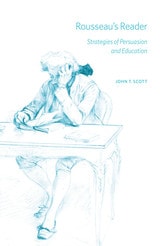
Rousseau's Reader
Strategies of Persuasion and EducationJohn T. Scott
University of Chicago Press, 2020
In Rousseau’s Reader, John T. Scott looks at the different strategies Rousseau used to engage and persuade the readers of his major philosophical works, including the Social Contract, Discourse on Inequality, and Emile. Considering choice of genre; textual structure; frontispieces and illustrations; shifting authorial and narrative voice; addresses to readers that alternately invite and challenge; apostrophe, metaphor, and other literary devices; and, of course, paradox, Scott explores how the form of Rousseau’s writing relates to the content of his thought and vice versa. Through this skillful interplay of form and content, Rousseau engages in a profoundly transformative dialogue with his readers.
While most political philosophers have focused, understandably, on Rousseau’s ideas, Scott shows convincingly that the way he conveyed them is also of vital importance, especially given Rousseau’s enduring interest in education. Giving readers the key to Rousseau’s style, Scott offers fresh and original insights into the relationship between the substance of his thought and his literary and rhetorical techniques, which enhance our understanding of Rousseau’s project and the audiences he intended to reach.
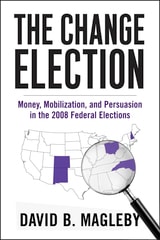
The Change Election
Money, Mobilization, and Persuasion in the 2008 Federal ElectionsEdited by David Magleby
Temple University Press, 2010
The 2008 election was an extraordinary event that represented change at many levels. The candidates’ innovative campaigns changed how funds were raised, how voters were mobilized, and how messages were communicated through advertising and the internet. Parties and interest groups played their own important role in this historic election. In The Change Election, David Magleby assembles a team of accomplished political scientists to provide an in-depth analysis of this groundbreaking presidential election. These scholars through a set of compelling case studies examine the competition for votes in a dozen competitive House and Senate contests and for the White House in five states: Ohio, North Carolina, New Hampshire, Colorado, and New Mexico.
Backed by a wealth of data, and extensive interviews, the contributors offer an up-close look at the interactions of candidates' individual skills and personalities with the larger political forces at work in the election year. The book offers insights into the rapidly evolving organizational and technical aspects of campaigning. The dramatic success Obama and other candidates had in raising money—especially from small donors—is addressed along with how money was raised and spent by the candidates, party committees, and interest groups competing for votes.
Building on a tested methodology, The Change Election explores the interplay of money and electioneering. Magleby builds on more than a decade of prior studies to show the ways participants in our electoral process have adapted to statutory and judicial decisions and how the 2008 election has the potential to transform American electoral politics.
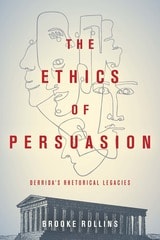
The Ethics of Persuasion
Derrida's Rhetorical LegaciesBrooke Rollins
The Ohio State University Press, 2020
Drawing on Derrida’s (non)definition of ethics and his pointed accounts of performativity, Rollins argues that this vital ethical component of many ancient theories, practices, and pedagogies of persuasion has been undertheorized for more than two millennia. Through deconstructive readings of some of these texts, she shows us that we are not simply sovereign beings who both wield and guard against linguistic techniques of rule. Our persuasive endeavors, rather, are made possible by an ethics—an always prior encounter with otherness that interrupts self-presence.
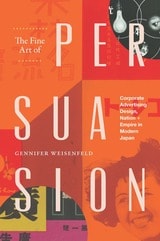
The Fine Art of Persuasion
Corporate Advertising Design, Nation, and Empire in Modern JapanGennifer Weisenfeld
Duke University Press, 2025
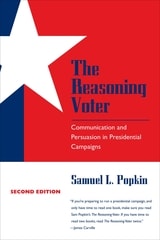
The Reasoning Voter
Communication and Persuasion in Presidential CampaignsSamuel L. Popkin
University of Chicago Press, 1991
"Professor Popkin has brought V.O. Key's contention that voters are rational into the media age. This book is a useful rebuttal to the cynical view that politics is a wholly contrived business, in which unscrupulous operatives manipulate the emotions of distrustful but gullible citizens. The reality, he shows, is both more complex and more hopeful than that."—David S. Broder, The Washington Post
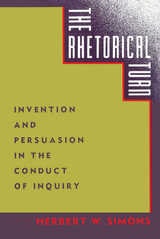
The Rhetorical Turn
Invention and Persuasion in the Conduct of InquiryEdited by Herbert W. Simons
University of Chicago Press, 1990
The Rhetorical Turn moves from biology to politics via excursions into the rhetorics of psychoanalysis, decision science, and conversational analysis. Topics explored include how rhetorical invention guides scientific invention, how rhetoric assists political judgment, and how it integrates varying approaches to meta-theory. Concluding with four philosophical essays, this volume of case studies demonstrates how the inventive and persuasive dimensions of scholarly discourse point the way to forms of argument appropriate to our postmodern age.