Results by title
4 books match the query 'Petropulos, William'

A Friendship That Lasted a Lifetime
The Correspondence Between Alfred Schutz and Eric VoegelinEdited by Gerhard Wagner and Gilbert Weiss, Translated by William Petropulos
University of Missouri Press, 2011
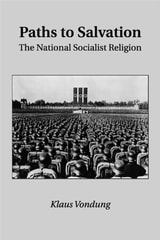
Paths to Salvation
The National Socialist ReligionKlaus Vondung
St. Augustine's Press, 2017
In order to understand National Socialism one must recognize its religious nature. Many Germans were attracted to the party by its pledge to re-establish a true community of the people, a goal that was celebrated as “holy”.
Not only did Hitler promise to solve political, social, and economic problems, he also responded to a widely felt need for salvation. The prospect of salvation elevated politics into the realm of religion and lent meaning to the lives of those who embraced it.
In this work Klaus Vondung explores the various forms in which the elevation of politics into the sphere of religion was expressed in the Third Reich: in the faith of committed National Socialists, in the party’s cult events which celebrated the “community of the people” as a “community of faith” and the Fuhrer as “savior”, and in the persecution of the Jews that was ‘justified’ in religious terms by demonizing Jews as the “evil enemies of humanity” responsible for the world’s ills. This apocalyptic worldview was the extreme manifestation of the religious nature of National Socialism and, in the final analysis, the only plausible explanation for the intention of exterminating the Jews that led to the holocaust.
The Drama of Humanity and Other Miscellaneous Papers, 1939-1985 (CW33)
Eric Voegelin, Edited & Intro by William Petropulos & Gilbert Weiss
University of Missouri Press, 2004
Theory of Governance and Other Miscellaneous Papers, 1921-1938 (CW32)
Eric Voegelin, Edited & Intro by William Petropulos & Gilbert Weiss, & Translated by William Petropulos, Jodi Cockerill, M. J. Hanak, Ingrid Heldt, Elisabeth von Lochner, & Sue Bollans
University of Missouri Press, 2004
This first of two volumes of Voegelin's miscellaneous papers brings together crucial writings, published for the first time, from the early, formative period of this scholar's thought. The book begins with Voegelin's dissertation on sociological method, completed under the direction of Othmar Spann and Hans Kelsen at the University of Vienna in 1922. It reveals an intimate knowledge of the writings of Georg Simmel and a skillful use of insights gained from Edmund Husserl's Logical Investigations and Ideas.
The dissertation, and other smaller pieces written at this time, addresses problems that remained of great importance to Voegelin throughout his life: the relation of insight to language, the structure of the human being, and the human's spiritual center. They disclose both Voegelin's theoretical reference points during these early years, including the thought of Henri Bergson, Othmar Spann, Georg Simmel, and Edmund Husserl, as well the young scholar's remarkably independent approach to theoretical problems.
Moreover, this volume includes a work that is fundamental to an understanding of Voegelin's theoretical development: his extended study on the "theory of governance," written between 1930 and 1932. It follows the issues that confront political society to their roots in the soul and in the soul's relationship to the ground of being.
The Theory of Governance and Other Miscellaneous Papers presents a meditative-exegetic study of texts from Augustine, Descartes, and Husserl, early examples of the meditations that became central to Voegelin's later work. Other essays included in this volume such as "Theory of Law" and "Political Theory as Human Science" develop these theoretical insights and refine Voegelin's methodological tools. This volume will be of interest to all scholars of the work of Eric Voegelin and of the refoundation of political philosophy in the twentieth century in general.