Results by title
35 books match the query 'Philosophy, German'
Aesthetics and Marxism
Chinese Aesthetic Marxists and Their Western ContemporariesKang Liu
Duke University Press, 2000
Far from being secondary considerations in Chinese Marxism, aesthetics and culture are in fact principal concerns. In this respect, such Marxists are similar to their Western counterparts, although Europeans have had little understanding of the Chinese experience. Liu traces the genealogy of aesthetic discourse in both modern China and the West since the era of classical German thought, showing where conceptual modifications and divergences have occurred in the two traditions. He examines the work of Mao Zedong, Lu Xun, Li Zehou, Qu Qiubai, and others in China, and from the West he discusses Kant, Schiller, Schopenhauer, and Marxist theorists including Horkheimer, Adorno, Benjamin, and Marcuse. While stressing the diversity of Marxist positions within China as well as in the West, Liu explains how ideas of culture and aesthetics have offered a constructive vision for a postrevolutionary society and have affected a wide field of issues involving the problems of modernity.
Forcefully argued and theoretically sophisticated, this book will appeal to students and scholars of contemporary Marxism, cultural studies, aesthetics, and modern Chinese culture, politics, and ideology.
After the Death of God
Secularization as a Philosophical Challenge from Kant to NietzscheEspen Hammer
University of Chicago Press, 2025
The secularization thesis, which held that religious belief would gradually yield to rationality, has been thoroughly debunked. What, then, can we learn from philosophers for whom the death of God seemed so imminent? In this book, Espen Hammer offers a sweeping analysis of secularization in nineteenth-century German philosophy, arguing that the persistence of religion (rather than its absence) animated this tradition. Hammer shows that Kant, Hegel, Feuerbach, Marx, and Nietzsche, each in their own way, sought to preserve and transform religion’s ethical and communal aspirations for modern life. A renewed appreciation for this tradition’s generous thought, Hammer argues, can help us chart a path through needlessly destructive conflicts between secularists and fundamentalists today.
An Unnatural Attitude
Phenomenology in Weimar Musical ThoughtBenjamin Steege
University of Chicago Press, 2021
An Unnatural Attitude traces a style of musical thought that coalesced in the intellectual milieu of the Weimar Republic—a phenomenological style that sought to renew contact with music as a worldly circumstance. Deeply critical of the influence of naturalism in aesthetics and ethics, proponents of this new style argued for the description of music as something accessible neither through introspection nor through experimental research, but rather in an attitude of outward, open orientation toward the world. With this approach, music acquires meaning in particular when the act of listening is understood to be shared with others.
Benjamin Steege interprets this discourse as the response of a young, post–World War I generation amid a virtually uninterrupted experience of war, actual or imminent—a cohort for whom disenchantment with scientific achievement was to be answered by reasserting the value of imaginative thought. Steege draws on a wide range of published and unpublished texts from music theory, pedagogy, criticism, and philosophy of music, some of which appear for the first time in English translation in the book’s appendixes. An Unnatural Attitude considers the question: What are we thinking about when we think about music in non-naturalistic terms?
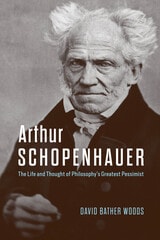
Arthur Schopenhauer
The Life and Thought of Philosophy’s Greatest PessimistDavid Bather Woods
University of Chicago Press, 2025
Arthur Schopenhauer (1788–1860) almost wasn’t one of the greatest philosophers of the nineteenth century. Born in the Free City of Danzig to a family of shipping merchants, he was destined for a life of imports and exports until his father died in a suspected suicide. After much deliberation, the young Schopenhauer invested his inheritance in himself and his philosophical vocation. But the long road to recognition was a difficult one, with Schopenhauer spending all but the last decade of his life in total obscurity. Yet his ideas and style went on to influence great thinkers, including Friedrich Nietzsche, Ludwig Wittgenstein, and Sigmund Freud, as well as artists such as the composer Richard Wagner and writers Marcel Proust, Thomas Mann, Samuel Beckett, and many more.
A singular and remarkably influential thinker, Schopenhauer is usually described as an extreme pessimist. He questioned the purpose of existence in a world where pain and suffering are inescapable and happiness is all too brief. In this engaging philosophical biography, David Bather Woods reevaluates Schopenhauer’s pessimism in the context of his life experiences, revealing the philosopher’s relentless fascination with the world and making a case for his contemporary relevance. Bather Woods weaves together Schopenhauer’s ideas with the story of how he came to be, including such topics as love, loneliness, morality, politics, gender, sexuality, death, suicide, fame, and madness. In doing so, this book answers some of life’s most challenging questions about how to deal with pain and loss, and how to live with ourselves and each other.
Despite his pessimistic outlook on human existence, Schopenhauer didn’t give up on life. Rather, he recognized that the question of how to live becomes even more pressing, and he worked to provide an answer. Bather Woods shows how Schopenhauer’s life informed his ideas and how they still resonate today.
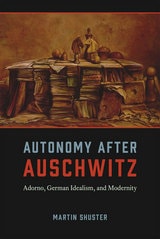
Autonomy After Auschwitz
Adorno, German Idealism, and ModernityMartin Shuster
University of Chicago Press, 2014
Shuster uncovers dangers in the notion of autonomy as it was originally conceived by Kant. Putting Adorno into dialogue with a range of European philosophers, notably Kant, Hegel, Horkheimer, and Habermas—as well as with a variety of contemporary Anglo-American thinkers such as Richard Rorty, Stanley Cavell, John McDowell, and Robert Pippin—he illuminates Adorno’s important revisions to this fraught concept and how his different understanding of autonomous agency, fully articulated, might open up new and positive social and political possibilities. Altogether, Autonomy after Auschwitz is a meditation on modern evil and human agency, one that demonstrates the tremendous ethical stakes at the heart of philosophy.
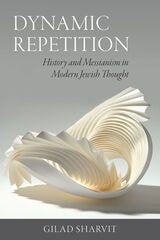
Dynamic Repetition
History and Messianism in Modern Jewish ThoughtGilad Sharvit
Brandeis University Press, 2022
Dynamic Repetition proposes a new understanding of modern Jewish theories of messianism across the disciplines of history, theology, and philosophy. The book explores how ideals of repetition, return, and the cyclical occasioned a new messianic impulse across an important swath of late nineteenth- and early twentieth-century German Jewish thought. To grasp the complexities of Jewish messianism in modernity, the book focuses on diverse notions of “dynamic repetition” in the works of Franz Rosenzweig, Walter Benjamin, Franz Kafka, and Sigmund Freud, and their interrelations with basic trajectories of twentieth-century philosophy and critical thought.
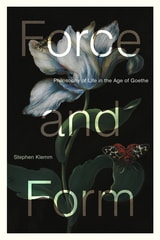
Force and Form
Philosophy of Life in the Age of GoetheStephen Klemm
Bucknell University Press, 2027
This book offers a bold rethinking of how modern ideas of life, nature, and subjectivity took shape in late-eighteenth- and early-nineteenth-century German thought. Moving beyond familiar narratives based on Kantian autonomy or Romantic irrationalism, it uncovers a vitalist tradition stretching from Herder to Schiller and Goethe, one that understood nature as dynamic, self-forming, and internally animated by life-force. Drawing on philosophy, the life sciences, and aesthetics, this innovative study reveals how these thinkers challenged mechanistic models of matter and resisted strict divisions between mind and nature. In doing so, they developed a historically contingent and embodied concept of subjectivity in which reason emerges from natural, cultural, and physiological processes rather than standing outside them. By situating this tradition within debates about epigenesis, form, and development, the book not only reshapes our understanding of German intellectual history but also sheds new light on contemporary debates about naturalism, posthumanism, and theories of life.
Published by Bucknell University Press. Distributed worldwide by Rutgers University Press.
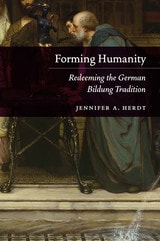
Forming Humanity
Redeeming the German Bildung TraditionJennifer A. Herdt
University of Chicago Press, 2019
Kant’s proclamation of humankind’s emergence from “self-incurred immaturity” left his contemporaries with a puzzle: What models should we use to sculpt ourselves if we no longer look to divine grace or received authorities? Deftly uncovering the roots of this question in Rhineland mysticism, Pietist introspection, and the rise of the bildungsroman, Jennifer A. Herdt reveals bildung, or ethical formation, as the key to post-Kantian thought. This was no simple process of secularization, in which human beings took responsibility for something they had earlier left in the hands of God. Rather, theorists of bildung, from Herder through Goethe to Hegel, championed human agency in self-determination while working out the social and political implications of our creation in the image of God. While bildung was invoked to justify racism and colonialism by stigmatizing those deemed resistant to self-cultivation, it also nourished ideals of dialogical encounter and mutual recognition. Herdt reveals how the project of forming humanity lives on in our ongoing efforts to grapple with this complicated legacy.

Friedrich Nietzsche and the Politics of Transfiguration (expanded ed.)
Tracy B. Strong
University of Illinois Press, 2000
German Idealism as Constructivism
Tom Rockmore
University of Chicago Press, 2016
Since ancient Greece philosophers have tried to know the world in itself, an effort that Kant believed had failed. His alternative strategy—which came to be known as the Copernican revolution—was that the world as we experience and know it depends on the mind. Rockmore shows that this project was central to Kant’s critical philosophy and the later German idealists who would follow him. He traces the different ways philosophers like Fichte, Schelling, and Hegel formulated their own versions of constructivism. Offering a sweeping but deeply attuned analysis of a crucial part of the legacy of German idealism, Rockmore reinvigorates this school of philosophy and opens up promising new avenues for its study.
Hegel's Realm of Shadows
Logic as Metaphysics in “The Science of Logic”Robert B. Pippin
University of Chicago Press, 2018
Robert B. Pippin offers here a bold, original interpretation of Hegel’s claim that only now, after Kant’s critical breakthrough in philosophy, can we understand how logic can be a metaphysics. Pippin addresses Hegel’s deep, constant reliance on Aristotle’s conception of metaphysics, the difference between Hegel’s project and modern rationalist metaphysics, and the links between the “logic as metaphysics” claim and modern developments in the philosophy of logic. Pippin goes on to explore many other facets of Hegel’s thought, including the significance for a philosophical logic of the self-conscious character of thought, the dynamism of reason in Kant and Hegel, life as a logical category, and what Hegel might mean by the unity of the idea of the true and the idea of the good in the “Absolute Idea.” The culmination of Pippin’s work on Hegel and German idealism, this is a book that no Hegel scholar or historian of philosophy will want to miss.
Hegel's Sole Idea
The Last Great Metaphysical SystemMark Alznauer
University of Chicago Press, 2026
An accessible reconstruction of Hegel’s attempt to derive all reality from a single concept.
In the early decades of the nineteenth century, G. W. F. Hegel came to believe that philosophy was finally in a position to achieve something it had striven for since ancient Greece: becoming an objective, demonstrative science. But to achieve this aim, he thought philosophical knowledge needed to be reconceived in a radically new way—as content contained in a single concept just as the oak tree is hidden in the acorn. In Hegel’s Sole Idea, Mark Alznauer reads Hegel’s mature philosophical system as the unprecedented attempt to comprehend the entire world as the full unfolding of that single concept, which he mysteriously calls “the absolute idea.”
Ever since Hegel set out this program in his Encyclopedia of the Philosophical Sciences in Outline, Hegel’s system has been regarded as the last best hope of philosophy as an autonomous, fully rational science. But while Hegel’s followers regarded the Encyclopedia as the successful realization of the traditional aims of philosophy, his most influential successors thought it instead showed the exhaustion and collapse of that project. Hegel’s Sole Idea offers a comprehensive interpretation of Hegelian philosophy that allows a fair confrontation with its most provocative and ambitious claims.
Hegel's Theory of Intelligibility
Rocío Zambrana
University of Chicago Press, 2015
Zambrana clarifies crucial features of Hegel’s theory of normativity previously thought to be absent from the argument of the Science of Logic—what she calls normative precariousness and normative ambivalence. She shows that Hegel’s theory of determinacy views intelligibility as both precarious, the result of practices and institutions that gain and lose authority throughout history, and ambivalent, accommodating opposite meanings and valences even when enjoying normative authority. In this way, Zambrana shows that the Science of Logic provides the philosophical justification for the necessary historicity of intelligibility. Intervening in several recent developments in the study of Kant, Hegel, and German Idealism more broadly, this book provides a productive new understanding of the value of Hegel’s systematic ambitions.
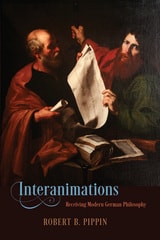
Interanimations
Receiving Modern German PhilosophyRobert B. Pippin
University of Chicago Press, 2015
After opening up his territory with an initial discussion of contemporary revisionist readings of Kant’s moral theory, Pippin sets his sights on his main objects of interest: Hegel and Nietzsche. Through them, however, he offers what few others could: an astonishing synthesis of an immense and diverse set of thinkers and traditions. Deploying an almost dialogical, conversational approach, he pursues patterns of thought that both shape and, importantly, connect the major traditions: neo-Aristotelian, analytic, continental, and postmodern, bringing the likes of Heidegger, Honneth, MacIntyre, McDowell, Brandom, Strauss, Williams, and Žižek—not to mention Hegel and Nietzsche— into the same philosophical conversation.
By means of these case studies, Pippin mounts an impressive argument about a relatively under discussed issue in professional philosophy—the bearing of work in the history of philosophy on philosophy itself—and thereby he argues for the controversial thesis that no strict separation between the domains is defensible.
Intoxicated Ways of Knowing
The Untold Story of Intoxicants and the Biological Subject in Nineteenth-Century GermanyMatthew Perkins-McVey
University of Chicago Press, 2026
Intoxicating substances can be found lurking in every corner of modern life, and Matthew Perkins-McVey’s pathbreaking book offers the untold story of how they were implicated in shifting perceptions of embodiment found in the emerging sciences of the body and mind in late-nineteenth-century Germany. Their use in this experimental context gave rise to a dynamic conception of the subject within the scientific, psychological, philosophical, and sociological milieu of the era. The history of the modern biological subject, Perkins-McVey argues, turns on “intoxicated ways of knowing.”
Intoxicated Ways of Knowing identifies the state of intoxication as a tacit form of thinking and knowing with the body. Intoxicants force us to feel, intervening directly in our perceptional awareness, and, Perkins-McVey contends, they bring latent conceptual associations into the foreground of conscious thought, engendering new ways of knowing the world. The book unfurls how intoxicants affected nineteenth-century German science and how, ultimately, the connection between mental life and intoxication is taken up in the works of Friedrich Nietzsche, Max Weber, and Sigmund Freud, bringing the biological subject out of the lab and into the worlds of philosophy, psychoanalysis, sociology, and politics.
Jargon of Authenticity
Theodor W. Adorno
Northwestern University Press, 1973
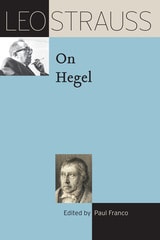
Leo Strauss on Hegel
Leo Strauss
University of Chicago Press, 2019
Leo Strauss on Hegel reconstructs Strauss’s seminar on Hegel, supplemented by passages from an earlier version of the seminar from which only fragments of a transcript remain. Strauss focused his seminar on the lectures collected in The Philosophy of History, which he considered more accessible than Hegel’s written works. In his own lectures on Hegel, Strauss continues his project of demonstrating how modern philosophers related to ancient thought and explores the development and weaknesses of modern political theory. Strauss is especially concerned with the relationship in Hegel between empirical history and his philosophy of history, and he argues for the primacy of religion in Hegel’s understanding of history and society. In addition to a relatively complete transcript, Leo Strauss on Hegel also includes annotations, which bring context and clarity to the text.
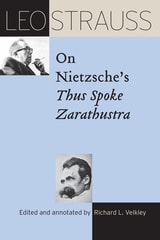
Leo Strauss on Nietzsche's "Thus Spoke Zarathustra"
Leo Strauss
University of Chicago Press, 2017
With Leo Strauss on Nietzsche’s “Thus Spoke Zarathustra,” eminent Strauss scholar Richard L. Velkley presents Strauss’s lectures on Zarathustra with superb annotations that bring context and clarity to the critical role played by Nietzsche in shaping Strauss’s thought. In addition to the broad relationship between Nietzsche and political philosophy, Strauss adeptly guides readers through Heidegger’s confrontations with Nietzsche, laying out Heidegger’s critique of Nietzsche’s “will to power” while also showing how Heidegger can be read as a foil for his own reading of Nietzsche. The lectures also shed light on the relationship between Heidegger and Strauss, as both philosophers saw Nietzsche as a central figure for understanding the crisis of philosophy and Western civilization.
Strauss’s reading of Nietzsche is one of the important—yet little appreciated—philosophical inquiries of the past century, both an original interpretation of Nietzsche’s thought and a deep engagement with the core problems that modernity posed for political philosophy. It will be welcomed by anyone interested in the work of either philosopher.
Moses Mendelssohn
Writings on Judaism, Christianity, and the BibleEdited by Michah Gottlieb
Brandeis University Press, 2011
Music in German Philosophy
An IntroductionEdited by Stefan Lorenz Sorgner and Oliver Fürbeth
University of Chicago Press, 2011
Though many well-known German philosophers have devoted considerable attention to music and its aesthetics, surprisingly few of their writings on the subject have been translated into English. Stefan Lorenz Sorgner, a philosopher, and Oliver Fürbeth, a musicologist, here fill this important gap for musical scholars and students alike with this compelling guide to the musical discourse of ten of the most important German philosophers, from Kant to Adorno.
Music in German Philosophy includes contributions from a renowned group of ten scholars, including some of today’s most prominent German thinkers, all of whom are specialists in the writers they treat. Each chapter consists of a short biographical sketch of the philosopher concerned, a summary of his writings on aesthetics, and finally a detailed exploration of his thoughts on music. The book is prefaced by the editors’ original introduction, presenting music philosophy in Germany before and after Kant, as well as a new introduction and foreword to this English-language addition, which places contemplations on music by these German philosophers within a broader intellectual climate.

Novalis, Spinoza, and the Limits of Romantic Materialism
Siarhei Biareishyk
Northwestern University Press, 2026
Offering an innovative and illuminating new reading of Spinoza and Novalis
This rigorously researched study reframes our understanding of the intellectual currents in Germany around 1800 through a careful reinterpretation of its key thinker, Novalis, in conversation with Spinoza’s philosophy. Siarhei Biareishyk presents an alternative to the standard narrative that resolutely links emergent modernity and secularization to philosophical “idealism” by showing how Spinozan materialism informs the scientific experiments, metaphysical inquiries, and political debates of Novalis and his contemporaries. Shifting our focus away from the historical interpretation of Novalis as a mystic and theorist of subjectivity, Biareishyk elaborates on the Spinozan materialist strain in Novalis in three key domains: ontology and the conception of nature, theories of singularity and individuation, and the concept of the political. He brings current romanticist scholarship into conversation with contemporary discussions of Spinoza in continental philosophy, in the Marxist tradition particularly, demonstrating that the Spinoza–Novalis encounter provides a viable alternative—in its articulation of causality, dialectics, and the political—to the dominant conceptual apparatuses of both Kant and Hegel.
Phenomenal Blackness
Black Power, Philosophy, and TheoryMark Christian Thompson
University of Chicago Press, 2022
Phenomenal Blackness examines the changing interdisciplinary investments of key mid-century Black writers and thinkers, including the growing interest in German philosophy and critical theory. Mark Christian Thompson analyzes this shift in intellectual focus across the post-war decades, placing Black Power thought in a philosophical context.
Prior to the 1960s, sociologically oriented thinkers such as W. E. B. Du Bois had understood Blackness as a singular set of socio-historical characteristics. In contrast, writers such as Amiri Baraka, James Baldwin, Angela Y. Davis, Eldridge Cleaver, and Malcolm X were drawn to notions of an African essence, an ontology of Black being. With these perspectives, literary language came to be seen as the primary social expression of Blackness. For this new way of thinking, the works of philosophers such as Adorno, Habermas, and Marcuse were a vital resource, allowing for continued cultural-materialist analysis while accommodating the hermeneutical aspects of Black religious thought. Thompson argues that these efforts to reimagine Black singularity led to a phenomenological understanding of Blackness—a “Black aesthetic dimension” wherein aspirational models for Black liberation might emerge.
Schopenhauer and Nietzsche
Georg Simmel
University of Illinois Press, 1991
Georg Simmel pits the two German masters of philosophy of life against
each other in a play of opposition and supplementation. This first English
translation of Simmel's work includes an extensive introduction, providing
the reader with ready access to the text by mapping its discursive strategies.
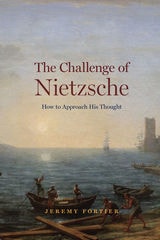
The Challenge of Nietzsche
How to Approach His ThoughtJeremy Fortier
University of Chicago Press, 2020
The Challenge of Nietzsche uses Nietzsche as a guide to Nietzsche, highlighting the fact that Nietzsche equipped his writings with retrospective self-commentaries and an autobiographical apparatus that clarify how he understood his development as an author, thinker, and human being. Fortier shows that Nietzsche used his writings to establish two major character types, the Free Spirit and Zarathustra, who represent two different approaches to the conduct and understanding of life: one that strives to be as independent and critical of the world as possible, and one that engages with, cares for, and aims to change the world. Nietzsche developed these characters at different moments of his life, in order to confront from contrasting perspectives such elemental experiences as the drive to independence, the feeling of love, and the assessment of one’s overall health or well-being. Understanding the tension between the Free Spirit and Zarathustra takes readers to the heart of what Nietzsche identified as the tensions central to his life, and to all human life.
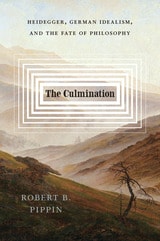
The Culmination
Heidegger, German Idealism, and the Fate of PhilosophyRobert B. Pippin
University of Chicago Press, 2024
Heidegger claimed that Western philosophy ended—failed, even—in the German Idealist tradition. In The Culmination, Robert B. Pippin explores the ramifications of this charge through a masterful survey of Western philosophy, especially Heidegger’s critiques of Hegel and Kant. Pippin argues that Heidegger’s basic concern was to determine sources of meaning for human life, particularly those that had been obscured by Western philosophy’s attention to reason. The Culmination offers a new interpretation of Heidegger, German Idealism, and the fate of Western rationalism.
The Dionysian Vision of the World
Friedrich Nietzsche
University of Minnesota Press, 2012
Before the world knew of the thinker who “philosophizes with a hammer,” there was a young, passionate thinker who was captivated by the two forces found within Greek art: Dionysus and Apollo. In this essay, which was the forerunner to his groundbreaking book The Birth of Tragedy, The Dionysian Vision of the World provides an unparalleled look into the philosophical mind of one of Europe’s greatest and provocative intellects at the beginning of his philosophical interrogation on the subject of art. “While dreaming is the game man plays with reality as an individual, the visual artist (in the larger sense) plays a game with dreaming.” This is the Dionysian vision of the world.
The Moral Meaning of Nature
Nietzsche’s Darwinian Religion and Its CriticsPeter J. Woodford
University of Chicago Press, 2018
We start with Friedrich Nietzsche, whose writings staged one of the first confrontations with the Christian tradition using the resources of Darwinian thought. The lebensphilosophie, or “life-philosophy,” that arose from his engagement with evolutionary ideas drew responses from other influential thinkers, including Franz Overbeck, Georg Simmel, and Heinrich Rickert. These critics all offered cogent challenges to Nietzsche’s appropriation of the newly transforming biological sciences, his negotiation between science and religion, and his interpretation of the implications of Darwinian thought. They also each proposed alternative ways of making sense of Nietzsche’s unique question concerning the meaning of biological evolution “for life.” At the heart of the discussion were debates about the relation of facts and values, the place of divine purpose in the understanding of nonhuman and human agency, the concept of life, and the question of whether the sciences could offer resources to satisfy the human urge to discover sources of value in biological processes. The Moral Meaning of Nature focuses on the historical background of these questions, exposing the complex ways in which they recur in contemporary philosophical debate.
The Romantic Absolute
Being and Knowing in Early German Romantic Philosophy, 1795-1804Dalia Nassar
University of Chicago Press, 2013
Scholars today interpret philosophical romanticism along two competing lines: one emphasizes the romantics’ concern with epistemology, the other their concern with metaphysics. Through careful textual analysis and systematic reconstruction of the work of three major romantics—Novalis, Friedrich Schlegel, and Friedrich Schelling—Nassar shows that neither interpretation is fully satisfying. Rather, she argues, one needs to approach the absolute from both perspectives. Rescuing these philosophers from frequent misunderstanding, and even dismissal, she articulates not only a new angle on the philosophical foundations of romanticism but on the meaning and significance of the notion of the absolute itself.
The Romantic Conception of Life
Science and Philosophy in the Age of GoetheRobert J. Richards
University of Chicago Press, 2002
Integrating Romantic literature, science, and philosophy with an intimate knowledge of the individuals involved—from Goethe and the brothers Schlegel to Humboldt and Friedrich and Caroline Schelling—Richards demonstrates how their tempestuous lives shaped their ideas as profoundly as their intellectual and cultural heritage. He focuses especially on how Romantic concepts of the self, as well as aesthetic and moral considerations—all tempered by personal relationships—altered scientific representations of nature. Although historians have long considered Romanticism at best a minor tributary to scientific thought, Richards moves it to the center of the main currents of nineteenth-century biology, culminating in the conception of nature that underlies Darwin's evolutionary theory.
Uniting the personal and poetic aspects of philosophy and science in a way that the German Romantics themselves would have honored, The Romantic Conception of Life alters how we look at Romanticism and nineteenth-century biology.
The Saving Line
Benjamin, Adorno, and the Caesuras of HopeMárton Dornbach
Northwestern University Press, 2021
Walter Benjamin and Theodor Adorno both turned to canonical literary narratives to determine why the Enlightenment project was derailed and how this failure might be remedied. The resultant works, Benjamin’s major essay on Goethe’s Elective Affinities and Adorno’s meditation on the Odyssey in Dialectic of Enlightenment, are centrally concerned with the very act of narration. Márton Dornbach’s groundbreaking book reconstructs a hitherto unnoticed, wide-ranging dialogue between these foundational texts of the Frankfurt School.
At the heart of Dornbach’s argument is a critical model that Benjamin built around the concept of caesura, a model Adorno subsequently reworked. Countering an obscurantism that would become complicit in the rise of fascism, the two theorists aligned moments of arrest in narratives mired in unreason. Although this model responded to a specific historical emergency, it can be adapted to identify utopian impulses in a variety of works.
The Saving Line throws fresh light on the intellectual exchange and disagreements between Benjamin and Adorno, the problematic conjunction of secular reason and negative theology in their thinking, and their appropriations of ancient and modern legacies. It will interest scholars of philosophy and literature, critical theory, German Jewish thought, classical reception studies, and narratology.
The Weimar Origins of Rhetorical Inquiry
David L. Marshall
University of Chicago Press, 2020

Theory as Practice
A Critical Anthology of Early German Romantic WritingsJochen Schulte-Sasse, Haynes Horne, Elizabeth Mittman, Lisa C. Roetzel, Andreas Michel, Assenka Oksiloff, and Mary R. Strand, EditorsTranslated by Jochen Schulte-Sasse
University of Minnesota Press, 1997
Theory as Practice was first published in 1997. Minnesota Archive Editions uses digital technology to make long-unavailable books once again accessible, and are published unaltered from the original University of Minnesota Press editions.
In light of recent, dramatic revisions in criticism of European-particularly German-Romanticism, this anthology brings together key texts of the movement, especially those written in the last quarter of the eighteenth century by a small, influential circle centered at Jena.
In their introductory essays, the editors locate writings by Fichte, Schelling, Novalis, August Wilhelm Schlegel, and Friedrich Schlegel, among others, in this context. The selections include extensive excerpts from the correspondence of the Jena Romantics, their commentaries on each other's work, their most pertinent essays, fragments, and dialogues as well as diary entries and reviews. These works, together with the editors' articulation and elaboration of their significance, provide a new perspective on the provenance of postmodern thought and literary theory.
Jochen Schulte-Sasse is professor of German and comparative literature at the University of Minnesota and coeditor (with Wlad Godzich) of the Theory and History of Literature series at the University of Minnesota Press. Haynes Horne (University of Alabama), Andreas Michel (Indiana University), Assenka Oksiloff (New York University), Elizabeth Mittman (Michigan State University), Lisa C. Roetzel (University of Rochester), and Mary R. Strand each received a Ph.D. from the University of Minnesota.
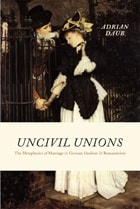
Uncivil Unions
The Metaphysics of Marriage in German Idealism and RomanticismAdrian Daub
University of Chicago Press, 2012
“What a strange invention marriage is!” wrote Kierkegaard. “Is it the expression of that inexplicable erotic sentiment, that concordant elective affinity of souls, or is it a duty or a partnership . . . or is it a little of all that?”
Like Kierkegaard a few decades later, many of Germany’s most influential thinkers at the turn of the eighteenth century wondered about the nature of marriage but rejected the easy answers provided by biology and theology. In Uncivil Unions, Adrian Daub presents a truly interdisciplinary look at the story of a generation of philosophers, poets, and intellectuals who turned away from theology, reason, common sense, and empirical observation to provide a purely metaphysical justification of marriage.
Through close readings of philosophers like Fichte and Schlegel, and novelists like Sophie Mereau and Jean Paul, Daub charts the development of this new concept of marriage with an insightful blend of philosophy, cultural studies, and theory. The author delves deeply into the lives and work of the romantic and idealist poets and thinkers whose beliefs about marriage continue to shape ideas about gender, marriage, and sex to the present day.
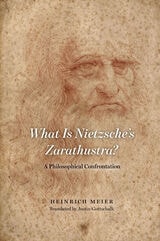
What Is Nietzsche's Zarathustra?
A Philosophical ConfrontationHeinrich Meier
University of Chicago Press, 2021
A masterful, nuanced, and novel examination of Nietzsche’s Zarathustra.
Thus Spoke Zarathustra is Nietzsche’s most famous and most puzzling work, one in which he makes the greatest use of poetry to explore the questions posed by philosophy. But in order to understand the movement of this drama, we must first understand the character of its protagonist: we must ask, What Is Nietzsche’s Zarathustra?
Heinrich Meier attempts to penetrate the core of the drama, following as a guiding thread the question of whether Zarathustra is a philosopher or a prophet, or, if he is meant to be both, whether Zarathustra is able to unite philosopher and prophet in himself. Via a close reading that uncovers the book’s hidden structure, Meier develops a highly stimulating and original interpretation of this much-discussed but still ill-understood masterwork of German poetic prose. In the process, he carefully overturns long-established canons in the academic discourse of Nietzsche interpretation. The result is a fresh and surprising grasp of Nietzsche’s well-known teachings of the overman, the will to power, and the eternal return.
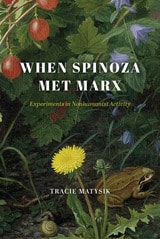
When Spinoza Met Marx
Experiments in Nonhumanist ActivityTracie Matysik
University of Chicago Press, 2022
Karl Marx was a fiery revolutionary theorist who heralded the imminent demise of capitalism, while Spinoza was a contemplative philosopher who preached rational understanding and voiced skepticism about open rebellion. Spinoza criticized all teleological ideas as anthropomorphic fantasies, while Marxism came to be associated expressly with teleological historical development. Why, then, were socialists of the German nineteenth century consistently drawn to Spinoza as their philosophical guide? Tracie Matysik shows how the metaphorical meeting of Spinoza and Marx arose out of an intellectual conundrum around the meaning of activity. How is it, exactly, that humans can be fully determined creatures but also able to change their world? To address this paradox, many revolutionary theorists came to think of activity in the sense of Spinoza—as relating. Matysik follows these Spinozist-socialist intellectual experiments as they unfolded across the nineteenth century, drawing lessons from them that will be meaningful for the contemporary world.