Results by title

12 books match the query 'Photography in ethnology'
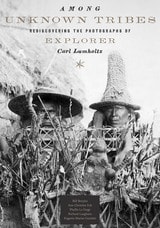
cover of Among Unknown Tribes: Rediscovering the Photographs of Explorer Carl Lumholtz

Among Unknown Tribes

Rediscovering the Photographs of Explorer Carl Lumholtz

By Bill Broyles

University of Texas Press, 2014

Internationally renowned as an exciting guide to unknown peoples and places, Norwegian Carl Lumholtz was a Victorian-era explorer, anthropologist, natural scientist, writer, and photographer who worked in Australia, Mexico, and Borneo. His photographs of the Tarahumara, Huichol, Cora, Tepehuan, Southern Pima, and Tohono O’odham tribes of Mexico and southwest Arizona were among the very first taken of these cultures and still provide the best photographic record of them at the turn of the twentieth century. Lumholtz published his photographs in several books, including Unknown Mexico and New Trails in Mexico, but, because photographic publishing was then in its infancy, most of the images were poorly printed, badly cropped, or reworked by “illustrators” using crude techniques. Among Unknown Tribes presents more than two hundred of Lumholtz’s best photographs—many never before published—from the archives of the American Museum of Natural History in New York and the Museum of Cultural History in Oslo, Norway. The images are newly scanned, most from the original negatives, and printed uncropped, disclosing a wealth of previously hidden detail. Each photograph is fully identified and often amplified by Lumholtz’s own notes and captions. Accompanying the images are essays and photo notes that survey Lumholtz’s career and legacy, as well as what his photographs reveal about the “unknown tribes.” By giving Lumholtz’s photographs the high-quality reproduction they deserve, Among Unknown Tribes honors not only the Norwegian explorer but also the native peoples who continue to struggle for recognition and justice as they actively engage in the traditional customs that Lumholtz recorded.
[more]
cover of Camera Indica: The Social Life of Indian Photographs

Camera Indica

The Social Life of Indian Photographs

Christopher Pinney

University of Chicago Press, 1997

A wedding couple gazes resolutely at viewers from the wings of a butterfly; a portrait surrounded by rose petals commemorates a recently deceased boy.

These quiet but moving images represent the changing role of photographic portraiture in India, a topic anthropologist Christopher Pinney explores in Camera Indica. Studying photographic practice in India, Pinney traces photography's various purposes and goals from colonial through postcolonial times. He identifies three key periods in Indian portraiture: the use of photography under British rule as a quantifiable instrument of measurement, the later role of portraiture in moral instruction, and the current visual popular culture and its effects on modes of picturing. Photographic culture thus becomes a mutable realm in which capturing likeness is only part of the project. Lavishly illustrated, Pinney's account of the change from depiction to invention uncovers fascinating links between these evocative images and the society and history from which they emerge.
[more]
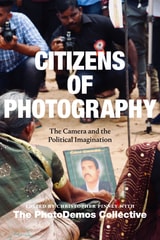
cover of Citizens of Photography: The Camera and the Political Imagination

Citizens of Photography

The Camera and the Political Imagination

Edited by Christopher Pinney with the PhotoDemos Collective (Naluwembe Binaisa, Vindhya Buthpitiya, Konstantinos Kalantzis, Christopher Pinney, Ileana L. Selejan, and Sokphea Young)

Duke University Press, 2023
Citizens of Photography explores how photography offers access to forms of citizenship beyond those available through ordinary politics. Through contemporary ethnographic investigations of photographic practice in Nicaragua, Nigeria, Greece, India, Nepal, Sri Lanka, Bangladesh, and Cambodia, the PhotoDemos Collective traces the resonances between political representation and photographic representation. The authors emphasize photography as lived practice and how photography’s performative, transformative, and transgressive possibilities facilitate the articulation of new identities. They analyze photography ranging from family albums and social media to state and public archives, showing how it points to new destinations in the context of social movements, the aftermath of atrocity and civil war, and the legacies of past injustices. By foregrounding photography’s open-ended and contingent nature and its ability to subvert and reconfigure conventional political identifications, this volume demonstrates that as much as photography looks to the past, it points to the future, acting in advance of social reality.
[more]
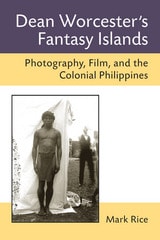
cover of Dean Worcester's Fantasy Islands: Photography, Film, and the Colonial Philippines

Dean Worcester's Fantasy Islands

Photography, Film, and the Colonial Philippines

Mark Rice

University of Michigan Press, 2014

Dean Worcester’s Fantasy Islands brings to life one of the most significant (but under examined) figures in the history of U.S. colonialism in the Philippines. Upon the outbreak of the Spanish-American War, Worcester, a scientist who had traveled twice to the Philippines on zoological expeditions, established himself as one of America’s leading experts on the Philippines. Over a fourteen-year career as a member of the U.S. colonial regime, Worcester devoted much of his time and energy to traveling among and photographing non-Christian minority groups in the Philippines. He amassed an archive of several thousand photographs taken by him or by government photographers. Worcester deployed those photographs in books, magazine articles, and lectures to promote his belief that the United States should maintain control of the Philippines for decades to come. While many historians have examined American colonial photography in the Philippines, this book is the first lengthy treatment of Worcester’s role in shaping American perceptions of the Philippines in the early twentieth century.

[more]
cover of Malinowski's Kiriwina: Fieldwork Photography 1915-1918

Malinowski's Kiriwina

Fieldwork Photography 1915-1918

Michael W. Young

University of Chicago Press, 1998

Kiriwina, the largest of the Trobriand Islands in eastern Papua New Guinea, is anthropology's "sacred place." It was here that Bronislaw Malinowski conducted the path-breaking fieldwork that enabled him to revolutionize British social anthropology. And it was here that he developed one of anthropology's most important tools: photography.

Malinowski's Kiriwina presents nearly two hundred of Malinowski's previously unpublished photographs, taken between 1915 and 1918, of the Trobriand Islanders. The images are more than embellishments of his ethnography; they are a recreation in striking detail of a distant world. Michael Young, an anthropologist and Malinowski's authorized biographer, has selected the photographs based on one of Malinowski's unpublished studies of the region, and the plan of that abandoned project has helped structure this book.

Divided into fourteen sections, Malinowski's Kiriwina is a series of linked photo-essays based on Trobriand institutions and cultural themes as described by Malinowski. The introductory essay by Young appraises the founding anthropologist's photographic oeuvre, explains the historical circumstances and technical aspects of the images, and puts them in their colonial context. Young illuminates the photographs with quotations from Malinowski's diaries, letters, and field notes, thereby giving a biographical dimension to the collection. Commentaries on the images by contemporary Trobrianders add a further layer of interpretation. The result is a stunning record not only of a fascinating place, but of the mutual relationship between ethnography and the visual.
[more]
cover of Margaret Mead, Gregory Bateson, and Highland Bali: Fieldwork Photographs of Bayung Gede, 1936-1939

Margaret Mead, Gregory Bateson, and Highland Bali

Fieldwork Photographs of Bayung Gede, 1936-1939

Gerald Sullivan

University of Chicago Press, 1999

In 1936 anthropologist Margaret Mead and her husband, Gregory Bateson, retreated from lowland Bali, which was the focal point of much scholarly and tourist activity, to the remote village of Bayung Gedé in the island's central highlands. Although they wrote relatively little about their work in this place, which Mead called "our village, way up in the mountains, a lovely self-contained village," they did leave behind a remarkably rich and extensive photographic record of their time there.

Margaret Mead, Gregory Bateson, and Highland Bali includes 200 photographs that the couple took between 1936 and 1939, the vast majority of which have never before been published. They vividly capture the everyday lives of the men, women, and children of Bayung Gedé, their homes and their temples, and many other fascinating details of village life not featured in Mead and Bateson's publications.

In a substantial introductory essay, Gerald Sullivan, who selected the photographs, uses excerpts from fieldnotes and correspondence to illuminate Mead and Bateson's ethnographic work. Tracing the project from its inception in their proposals to the publication of their work, Sullivan shows how they used the photographs both as fieldnotes and as elements in their theoretical argument. Finally, he explores what the photographs reveal—independently of Mead and Bateson's project—about the Balinese character to the contemporary viewer.

The result is a both a substantial contribution to visual anthropology and an invaluable supplement to the published works of Margaret Mead and Gregory Bateson.
[more]
cover of Navigating the African Diaspora: The Anthropology of Invisibility

Navigating the African Diaspora

The Anthropology of Invisibility

Donald Martin Carter

University of Minnesota Press, 2010
Investigating how the fraught political economy of migration impacts people around the world, Donald Martin Carter raises important issues about contemporary African diasporic movements. Developing the notion of the anthropology of invisibility, he explores the trope of navigation in social theory intent on understanding the lived experiences of transnational migrants.
 
Carter examines invisibility in its various forms, from social rejection and residential segregation to war memorials and the inability of some groups to represent themselves through popular culture, scholarship, or art. The pervasiveness of invisibility is not limited to symbolic actions, Carter shows, but may have dramatic and at times catastrophic consequences for people subjected to its force. The geographic span of his analysis is global, encompassing Senegalese Muslims in Italy and the United States and concluding with practical questions about the future of European societies. Carter also considers both contemporary and historical constellations of displacement, from Darfurian refugees to French West African colonial soldiers.
 
Whether focusing on historical photographs, television, print media, and graffiti scrawled across urban walls or identifying the critique of colonialism implicit in African films and literature, Carter reveals a protean and peopled world in motion.
[more]
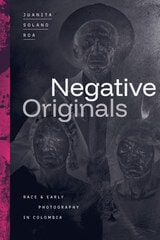
cover of Negative Originals: Race and Early Photography in Colombia

Negative Originals

Race and Early Photography in Colombia

Juanita Solano Roa

Duke University Press, 2025

In Negative Originals, Juanita Solano Roa explores race and identity through photographic practices in late nineteenth-century Medellín, Colombia. Focusing on the photographic studios of Fotografía Rodríguez and Benjamín de la Calle, Solano Roa examines the visual construction and dissemination of racial ideologies and the linkage of race to progress. She studies both positive and negative prints to highlight the juxtaposition of traditional portraiture, which reinforced prevailing racial ideologies, and subversive depictions of often excluded individuals such as cross-dressers, peasants, the poor, and Afro-Colombians. In redefining photography’s role, Solano Roa shifts the critic’s eye from traditional positive prints to negatives, exposing the form’s material, symbolic, and spatial significance. In doing so, she simultaneously uncovers new perspectives on the medium and challenges hegemonic histories. Engaging one of Latin America’s most important photographic archives, Solano Roa addresses urgent gaps in the history of Colombian and Latin American photography, particularly at the intersection of race, gender, and the construction of whiteness.
[more]
cover of Photographic Returns: Racial Justice and the Time of Photography

Photographic Returns

Racial Justice and the Time of Photography

Shawn Michelle Smith

Duke University Press, 2020
In Photographic Returns Shawn Michelle Smith traces how historical moments of racial crisis come to be known photographically and how the past continues to inhabit, punctuate, and transform the present through the photographic medium in contemporary art. Smith engages photographs by Rashid Johnson, Sally Mann, Deborah Luster, Lorna Simpson, Jason Lazarus, Carrie Mae Weems, Taryn Simon, and Dawoud Bey, among others. Each of these artists turns to the past—whether by using nineteenth-century techniques to produce images or by re-creating iconic historic photographs—as a way to use history to negotiate the present and to call attention to the unfinished political project of racial justice in the United States. By interrogating their use of photography to recall, revise, and amplify the relationship between racial politics of the past and present, Smith locates a temporal recursivity that is intrinsic to photography, in which images return to haunt the viewer and prompt reflection on the present and an imagination of a more just future.
[more]
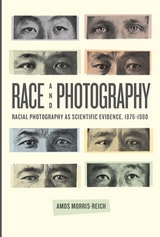
cover of Race and Photography: Racial Photography as Scientific Evidence, 1876-1980

Race and Photography

Racial Photography as Scientific Evidence, 1876-1980

Amos Morris-Reich

University of Chicago Press, 2015

Race and Photography studies the changing function of photography from the 1870s to the 1940s within the field of the “science of race,” what many today consider the paradigm of pseudo-science. Amos Morris-Reich looks at the ways photography enabled not just new forms of documentation but new forms of perception. Foregoing the political lens through which we usually look back at race science, he holds it up instead within the light of the history of science, using it to explore how science is defined; how evidence is produced, used, and interpreted; and how science shapes the imagination and vice versa.
           
Exploring the development of racial photography wherever it took place, including countries like France and England, Morris-Reich pays special attention to the German and Jewish contexts of scientific racism. Through careful reconstruction of individual cases, conceptual genealogies, and patterns of practice, he compares the intended roles of photography with its actual use in scientific argumentation. He examines the diverse ways it was used to establish racial ideologies—as illustrations of types, statistical data, or as self-evident record of racial signs. Altogether, Morris-Reich visits this troubling history to outline important truths about the roles of visual argumentation, imagination, perception, aesthetics, epistemology, and ideology within scientific study.  
[more]
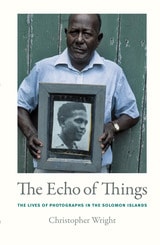
cover of The Echo of Things: The Lives of Photographs in the Solomon Islands

The Echo of Things

The Lives of Photographs in the Solomon Islands

Christopher Wright

Duke University Press, 2013

The Echo of Things is a compelling ethnographic study of what photography means to the people of Roviana Lagoon in the western Solomon Islands. Christopher Wright examines the contemporary uses of photography and expectations of the medium in Roviana, as well as people's reactions to photographs made by colonial powers in the late nineteenth and early twentieth centuries. For Roviana people, photographs are unique objects; they are not reproducible, as they are in Euro-American understandings of the medium. Their status as singular objects contributes to their ability to channel ancestral power, and that ability is a key to understanding the links between photography, memory, and history in Roviana. Filled with the voices of Roviana people, The Echo of Things is both a nuanced study of the lives of photographs in a particular cultural setting and a provocative inquiry into our own understandings of photography.
[more]
cover of Visualizing Anthropology: Experimenting with Image-Based Ethnography

Visualizing Anthropology

Experimenting with Image-Based Ethnography

Edited by Anna Grimshaw and Amanda Ravetz

Intellect Books, 1995

Questions of vision and knowledge are central to debates about the world in which we live. Developing new analytical approaches toward ways of seeing is a key challenge facing those working across a wide range of disciplines. How can visuality be understood on its own terms rather than by means of established textual frameworks? Visualizing Anthropology takes up this challenge. Bringing together a range of perspectives anchored in practice, the book maps experiments in the forms and techniques of visual enquiry.

The origins of this collection lie in visual anthropology. Although the field has greatly expanded and diversified, many of the key debates continue to be focused around the textual concerns of the mainstream discipline. In seeking to establish a more genuinely visual anthropology, the editors have sought to forge links with other kinds of image-based projects. Ethnography is the shared space of practice. Understood not as a specialized method but as cultural critique, the book explores new collaborative possibilities linked to image-based work.
[more]