Results by title
3 books match the query 'Photography in historiography'
History and Modern Media
A Personal JourneyJohn Mraz
Vanderbilt University Press, 2021
In History and Modern Media, John Mraz largely focuses on Mexican photography and his innovative methodology that examines historical photographs by employing the concepts of genre and function. He developed this method in extensive work on photojournalism; it is tested here through examining two genres: Indianist imagery as an expression of imperial, neo-colonizing, and decolonizing photography, and progressive photography as embodied in worker and laborist imagery, as well as feminist and decolonizing visuality.
The book interweaves an autobiographical narrative with concrete research. Mraz describes the resistance he encountered in US academia to this new way of showing and describing the past in films and photographs, as well as some illuminating experiences as a visiting professor at several US universities. More importantly, he reflects on what it has meant to move to Mexico and become a Mexican. Mexico is home to a thriving school of photohistorians perhaps unequaled in the world. Some were trained in art history, and a few continue to pursue that discipline. However, the great majority work from the discipline known as "photohistory" which focuses on vernacular photographs made outside of artistic intentions.
A central premise of the book is that knowing the cultures of the past and of the other is crucial in societies dominated by short-term and parochial thinking, and that today's hyper-audiovisuality requires historians to use modern media to offer their knowledge as alternatives to the "perpetual present" in which we live.
[more]

On European Ground
Alan Cohen
University of Chicago Press, 2001
A profound visual meditation on the trauma that scars twentieth-century Europe, Alan Cohen's On European Ground considers the battlefields of World War I, the Nazi death camps, and the Berlin Wall, and records the distance between what we remember about these places and what we can still observe in them today. By walking these sites and photographing the very ground in which their history has dissolved, Cohen opens a space for reflection on their complex gravity and legacy.
Cohen's images achieve a solemn beauty even as they engage history at its most topical. Pictures of trenches and bunkers at the battlefields of Somme and Verdun explore the tension between the violence of the past and the inscrutability of its remnants. Photographs from the grounds of Dachau and Auschwitz solicit a provocative dialogue between the ordinariness of these sites today and their haunting memory. They teach us, as the New Art Examiner notes, "that the living perceptual connection to the Holocaust is vanishing." Images of the Berlin Wall show only the footprint of the barricade that once separated two hostile ideologies. They record the physical erosion and looming disappearance of the Wall while capturing its reappearance as a memorialized abstraction.
Accompanying the photographs in On European Ground are essays by Sander Gilman and Jonathan Bordo, as well as an interview with Cohen by critic Roberta Smith of the New York Times. The essays present both an introduction to and aesthetic analysis of Cohen's work, while the interview discusses the intractable problems of history and memory that his photographs so uniquely capture.
[more]
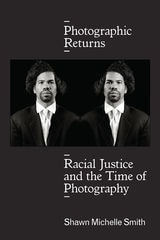
Photographic Returns
Racial Justice and the Time of PhotographyShawn Michelle Smith
Duke University Press, 2020
In Photographic Returns Shawn Michelle Smith traces how historical moments of racial crisis come to be known photographically and how the past continues to inhabit, punctuate, and transform the present through the photographic medium in contemporary art. Smith engages photographs by Rashid Johnson, Sally Mann, Deborah Luster, Lorna Simpson, Jason Lazarus, Carrie Mae Weems, Taryn Simon, and Dawoud Bey, among others. Each of these artists turns to the past—whether by using nineteenth-century techniques to produce images or by re-creating iconic historic photographs—as a way to use history to negotiate the present and to call attention to the unfinished political project of racial justice in the United States. By interrogating their use of photography to recall, revise, and amplify the relationship between racial politics of the past and present, Smith locates a temporal recursivity that is intrinsic to photography, in which images return to haunt the viewer and prompt reflection on the present and an imagination of a more just future.
[more]