Results by title
22 books match the query 'Physicists'

An Equation That Changed the World
Newton, Einstein, and the Theory of RelativityHarald Fritzsch
University of Chicago Press, 1994
"Fritzsch could not give the modern reader a more memorable introduction to the personalities and science of Isaac Newton and Albert Einstein unless somehow he could find the keys to H. G. Wells' time machine. . . . Many readers will applaud Fritzsch for this lively but profoundly insightful book." —Booklist, starred review
"[Fritzsch] has dreamed up a dialogue between the two great physicists, helped along by a fictional modern physicist. . . . The conversation builds up to an explanation of E=mc2, and on the way illuminates the important points where Newtonian and Einsteinian theory diverge." —David Lindley, New York Times Book Review
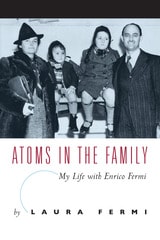
Atoms in the Family
My Life with Enrico FermiLaura Fermi
University of Chicago Press, 1995
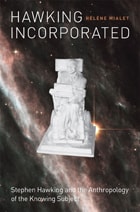
Hawking Incorporated
Stephen Hawking and the Anthropology of the Knowing SubjectHélène Mialet
University of Chicago Press, 2012
These days, the idea of the cyborg is less the stuff of science fiction and more a reality, as we are all, in one way or another, constantly connected, extended, wired, and dispersed in and through technology. One wonders where the individual, the person, the human, and the body are—or, alternatively, where they stop. These are the kinds of questions Hélène Mialet explores in this fascinating volume, as she focuses on a man who is permanently attached to assemblages of machines, devices, and collectivities of people: Stephen Hawking.
Drawing on an extensive and in-depth series of interviews with Hawking, his assistants and colleagues, physicists, engineers, writers, journalists, archivists, and artists, Mialet reconstructs the human, material, and machine-based networks that enable Hawking to live and work. She reveals how Hawking—who is often portrayed as the most singular, individual, rational, and bodiless of all—is in fact not only incorporated, materialized, and distributed in a complex nexus of machines and human beings like everyone else, but even more so. Each chapter focuses on a description of the functioning and coordination of different elements or media that create his presence, agency, identity, and competencies. Attentive to Hawking’s daily activities, including his lecturing and scientific writing, Mialet’s ethnographic analysis powerfully reassesses the notion of scientific genius and its associations with human singularity. This book will fascinate anyone interested in Stephen Hawking or an extraordinary life in science.
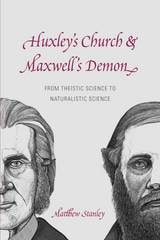
Huxley's Church and Maxwell's Demon
From Theistic Science to Naturalistic ScienceMatthew Stanley
University of Chicago Press, 2014
Matthew Stanley explores the overlap and shift between theistic and naturalistic science through a parallel study of two major scientific figures: James Clerk Maxwell, a devout Christian physicist, and Thomas Henry Huxley, the iconoclast biologist who coined the word agnostic. Both were deeply engaged in the methodological, institutional, and political issues that were crucial to the theistic-naturalistic transformation. What Stanley’s analysis of these figures reveals is that the scientific naturalists executed a number of strategies over a generation to gain control of the institutions of scientific education and to reimagine the history of their discipline. Rather than a sudden revolution, the similarity between theistic and naturalistic science allowed for a relatively smooth transition in practice from the old guard to the new.
Lives in Science
How Institutions Affect Academic CareersJoseph C. Hermanowicz
University of Chicago Press, 2009
What can we learn when we follow people over the years and across the course of their professional lives? Joseph C. Hermanowicz asks this question specifically about scientists and answers it here by tracking fifty-five physicists through different stages of their careers at a variety of universities across the country. He explores these scientists’ shifting perceptions of their jobs to uncover the meanings they invest in their work, when and where they find satisfaction, how they succeed and fail, and how the rhythms of their work change as they age. His candid interviews with his subjects, meanwhile, shed light on the ways career goals are and are not met, on the frustrations of the academic profession, and on how one deals with the boredom and stagnation that can set in once one is established.
An in-depth study of American higher education professionals eloquently told through their own words, Hermanowicz’s keen analysis of how institutions shape careers will appeal to anyone interested in life in academia.

Lord Kelvin
His influence on electrical measurements and unitsPaul Tunbridge
The Institution of Engineering and Technology, 1992
Loving Little Egypt
A NovelThomas McMahon
University of Chicago Press, 1986
Men Who Made a New Physics
Physicists and the Quantum TheoryBarbara Lovett Cline
University of Chicago Press, 1987
Oppenheimer
The Tragic IntellectCharles Thorpe
University of Chicago Press, 2007
Principles of American Nuclear Chemistry
A NovelThomas McMahon
University of Chicago Press, 1970

Secrets of the Sun
A MemoirMako Yoshikawa
The Ohio State University Press, 2024
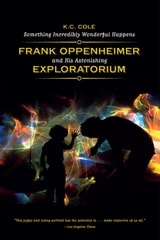
Something Incredibly Wonderful Happens
Frank Oppenheimer and His Astonishing ExploratoriumK. C. Cole
University of Chicago Press, 2012
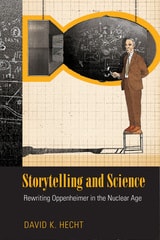
Storytelling and Science
Rewriting Oppenheimer in the Nuclear AgeDavid K. Hecht
University of Massachusetts Press, 2015
No single figure embodies Cold War science more than the renowned physicist J. Robert Oppenheimer. Although other scientists may have been more influential in establishing the institutions and policies of the nuclear age, none has loomed larger in the popular imagination than the “father of the atomic bomb.” Americans have been drawn to the story of the Manhattan Project Oppenheimer helped lead and riveted by the McCarthy-era politics that caught him in its crosshairs. Journalists and politicians, writers and artists have told Oppenheimer's story in many different ways since he first gained notoriety in 1945. In Storytelling and Science, David K. Hecht examines why they did so, and what they hoped to achieve through their stories.
From the outset, accounts of Oppenheimer's life and work were deployed for multiple ends: to trumpet or denigrate the value of science, to settle old scores or advocate new policies, to register dissent or express anxieties. In these different renditions, Oppenheimer was alternately portrayed as hero and villain, establishment figure and principled outsider, “destroyer of worlds” and humanist critic. Yet beneath the varying details of these stories, Hecht discerns important patterns in the way that audiences interpret, and often misinterpret, news about science. In the end, he argues, we find that science itself has surprisingly little to do with how its truths are assimilated by the public. Instead its meaning is shaped by narrative traditions and myths that frame how we think and write about it.
The Correspondence of Michael Faraday
1811-1831, Volume 1Frank A.J.L. James
The Institution of Engineering and Technology, 1991

The Correspondence of Michael Faraday
1832-1840, Volume 2Frank A.J.L. James
The Institution of Engineering and Technology, 1993

The Correspondence of Michael Faraday
1841-1848, Volume 3Frank A.J.L. James
The Institution of Engineering and Technology, 1996

The Correspondence of Michael Faraday
1849-1855, Volume 4Frank A.J.L. James
The Institution of Engineering and Technology, 1999
The Correspondence of Michael Faraday
1855-1860, Volume 5Frank A.J.L. James
The Institution of Engineering and Technology, 2008
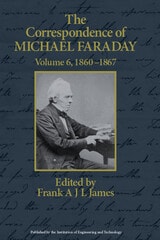
The Correspondence of Michael Faraday
1860-1867, Volume 6Frank A.J.L. James
The Institution of Engineering and Technology, 2011
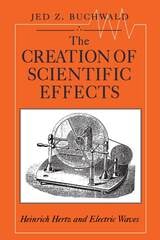
The Creation of Scientific Effects
Heinrich Hertz and Electric WavesJed Z. Buchwald
University of Chicago Press, 1994
Drawing on the lab notes, published papers, and unpublished manuscripts of Heinrich Hertz, Buchwald recreates Hertz's 1887 invention of a device that produced electromagnetic waves in wires. The invention itself was serendipitous and the device was quickly transformed, but Hertz's early experiments led to major innovations in electrodynamics. Buchwald explores the difficulty Hertz had in reconciling the theories of other physicists, including Hermann von Helmholtz and James Clerk Maxwell, and he considers the complex and often problematic connections between theory and experiment.
In this first detailed scientific biography of Hertz and his scientific community, Buchwald demonstrates that tacit knowledge can be recovered so that we can begin to identify the unspoken rules that govern scientific practice.
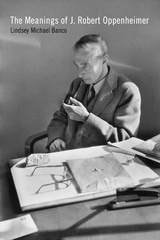
The Meanings of J. Robert Oppenheimer
Lindsey Michael Banco
University of Iowa Press, 2016
The Meanings of J. Robert Oppenheimer examines how he has been represented over the past seven decades in biographies, histories, fiction, comics, photographs, film, television, documentaries, theater, and museums. Lindsey Michael Banco gathers an unprecedented group of cultural texts and seeks to understand the multiple meanings Oppenheimer has held in American popular culture since 1945. He traces the ways these representations of Oppenheimer have influenced public understanding of the atomic bomb, technology, physics, the figure of the scientist, the role of science in war, and even what it means to pursue knowledge of the world around us. Questioning and unpacking both how and why Oppenheimer is depicted as he is across time and genre, this book is broad in scope, profound in detail, and offers unique insights into the rise of nuclear culture and how we think about the relationship between history, imagination, science, and nuclear weapons today.
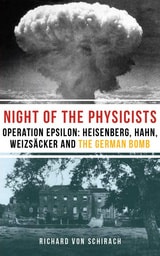
The Night of the Physicists
Operation Epsilon: Heisenberg, Hahn, Weizsäcker and the German BombRichard von Schirach
Haus Publishing, 2015